ngram AI vs HeyGen Comparison India 2026: Context-Aware Document/URL/Screen-Recording to Video vs Avatar-First for Indian Agencies
Estimated reading time: ~11 minutes
Key Takeaways
- ngram AI excels at context-aware storytelling from documents, URLs, and screen recordings; HeyGen leads in avatar-first delivery.
- Indian agencies prioritize compliance, localization, and predictable procurement (GST, DPA, TCO).
- A hybrid workflow pairs ngram’s narrative engine with avatars from Studio by TrueFan AI for human-like intros/outros.
- Consider credit burn: storyboard approvals in ngram reduce re-renders; HeyGen’s lip-sync avatars shine for training and outreach.
- Use the decision matrix: ngram for asset-heavy explainers, HeyGen for spokesperson content, and InVideo for social scale.
The landscape of digital storytelling has shifted dramatically, and choosing the right tool requires a deep dive into this ngram AI vs HeyGen comparison India 2026 to understand how context-aware generation is redefining agency workflows. As Indian digital agencies, corporate marketing teams, and production houses move beyond simple text-to-video prompts, the demand for "context-aware" AI video creators has skyrocketed. These tools don't just generate visuals; they ingest existing business assets—pitch decks, product URLs, and screen recordings—to produce high-stakes client presentations and marketing campaigns with minimal manual intervention.
In 2026, the Indian AI video market is no longer in its infancy. With InVideo’s explosive $30 million revenue run and 4X user growth (Source: Inc42 analysis of InVideo’s growth), the ecosystem has matured to support enterprise-grade demands. Agencies are now looking for the best AI video generator for agencies India that can handle the complexity of "document to video" transformations while maintaining strict brand compliance. Platforms like Studio by TrueFan AI enable agencies to bridge the gap between automated narrative generation and high-fidelity avatar delivery, ensuring that the final output resonates with a diverse, multilingual Indian audience.
This guide provides a definitive head-to-head analysis of ngram AI’s context-first philosophy versus HeyGen’s avatar-centric model, specifically tailored for the Indian procurement landscape, including INR pricing context and local compliance mandates. HeyGen Live Avatar implementation guide
1. Defining the "Context-Aware AI Video Creator India" Category
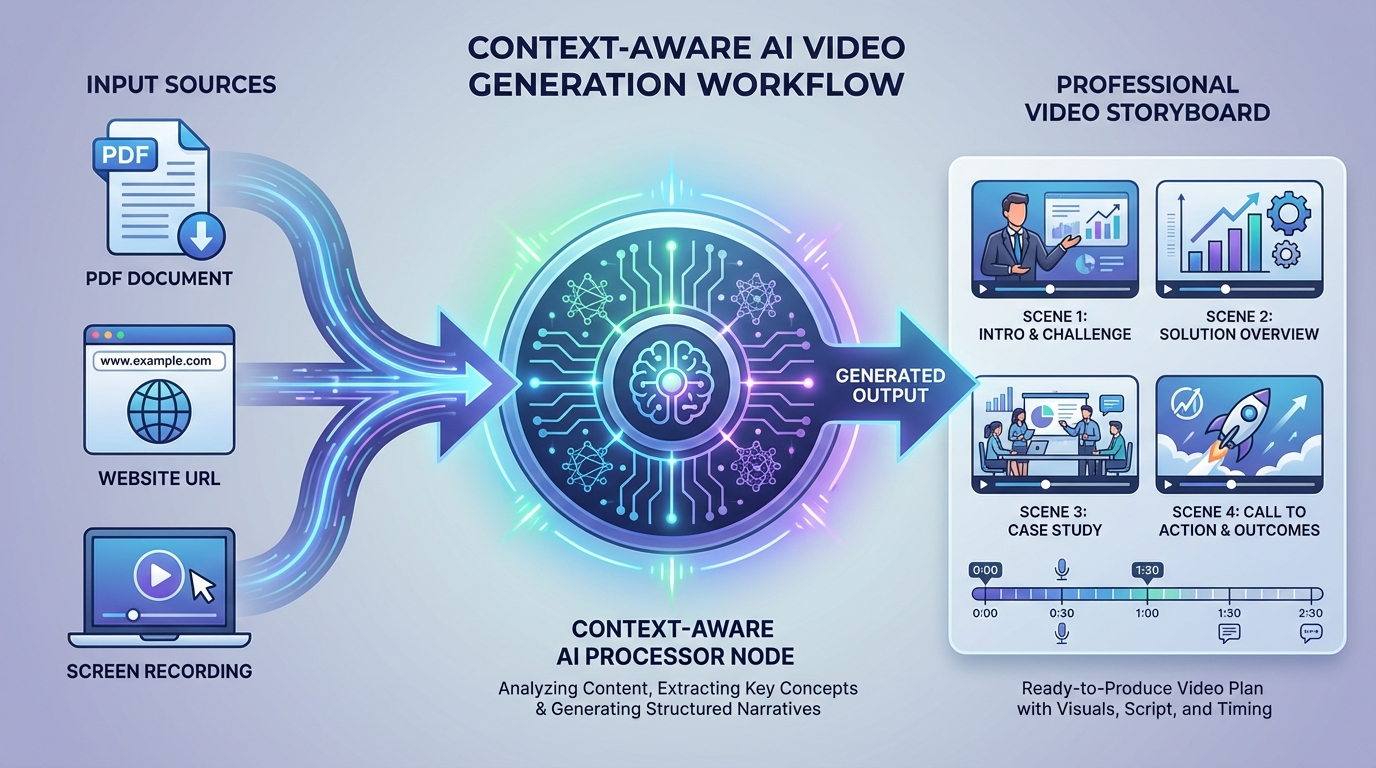
To understand why ngram AI is gaining traction among Indian agencies, we must first define the "context-aware" category. Unlike traditional AI video tools that rely on a single text prompt, a context-aware AI video creator India uses Retrieval-Augmented Generation (RAG) and multimodal parsing to "understand" a brand's existing ecosystem. AI video creation guide
What is Context-Aware Generation?
A context-aware system ingests rich data from three primary sources:
- Documents: Briefs, pitch decks, PDFs, and SOPs.
- URLs: Live product pages, case studies, and blog posts.
- Screen Recordings: Product walkthroughs, software demos, and UI/UX reviews.
The AI then executes a "plan-first" workflow: it extracts key messaging, generates a multi-variant storyboard, writes scripts aligned to specific brand voices, and proposes B-roll based on semantic cues within the source material. This is a significant departure from the AI video creator from screen recording tools of the past, which merely added subtitles to a raw clip.
Contrast with Legacy Patterns
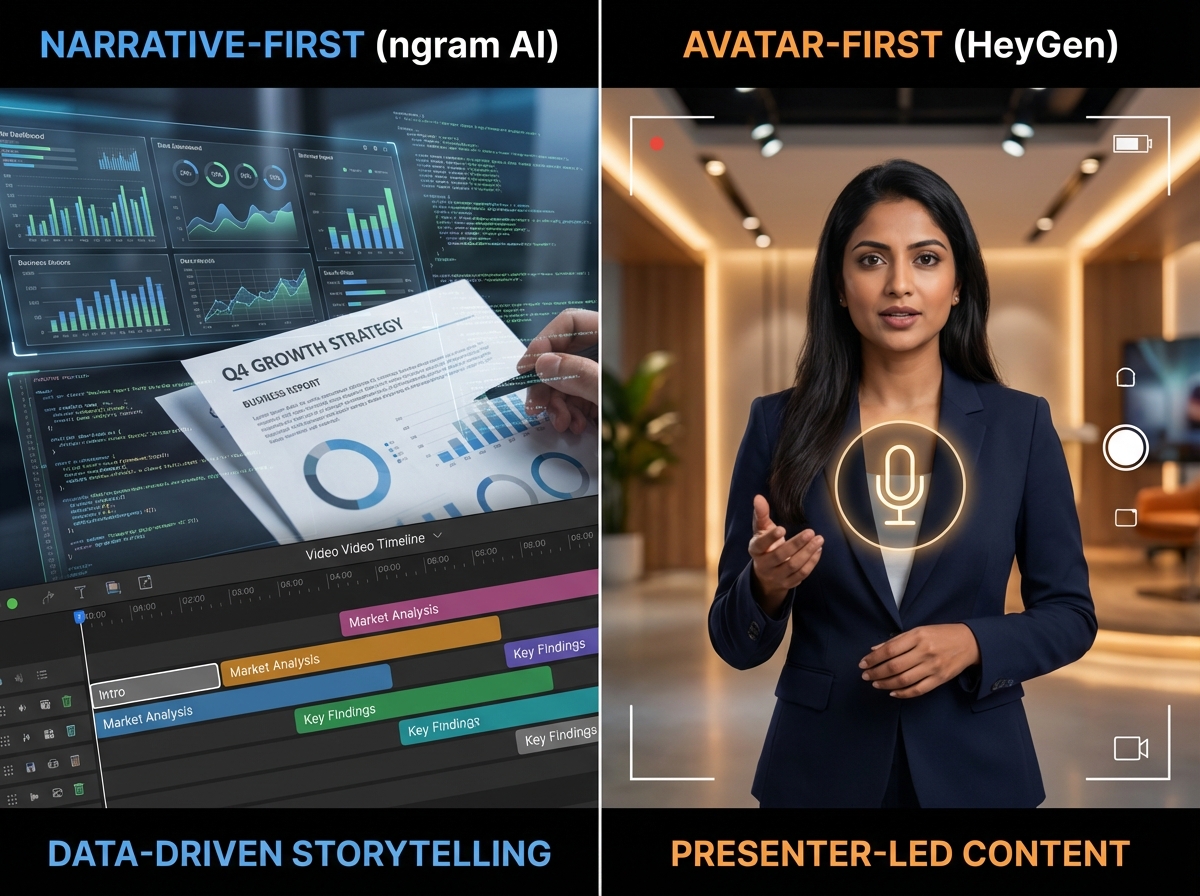
- Avatar-First (e.g., HeyGen): These platforms prioritize the "talking head." While excellent for training or personalized messages, they often struggle with asset-heavy storytelling where the narrative is driven by data or product features rather than a presenter. HeyGen Live Avatar implementation guide
- Template-First (e.g., InVideo): These are optimized for speed and social media. While InVideo is integrating NVIDIA compute to scale filmmaking initiatives in India (Source: Analytics India Magazine coverage of InVideo x NVIDIA), the template-driven approach can sometimes feel restrictive for complex, narrative-heavy agency briefs. InVideo vs Pictory for YouTube
In 2026, Indian agencies are prioritizing tools that can repurpose existing Intellectual Property (IP). Whether it’s turning a 50-page technical whitepaper into a 2-minute explainer or a URL to professional video AI conversion for a new e-commerce launch, context is the new currency.
2. 2026 India Market Trends Shaping Tool Choice
The Indian market in 2026 is characterized by a "Value-First, Scale-Fast" mentality. According to recent industry data, over 68% of Indian digital agencies have integrated at least one context-aware AI tool into their standard operating procedures. This shift is driven by three core trends:
The "Post-Sora" Realignment
Following the initial hype of OpenAI’s Sora, the market has bifurcated. While Sora-like models excel at cinematic visuals, Indian creators are gravitating toward tools that offer more granular control over narrative structure (Source: Analytics India Magazine on Sora alternatives). Agencies now demand a text-to-video AI agency workflow that allows for pre-render approvals, ensuring that credits aren't wasted on unusable "hallucinated" content.
Compliance and the Labeling Mandate
The Indian government’s push to label all AI-generated content has fundamentally changed how agencies approach production (Source: Inc42 on India’s AI labeling mandate). In 2026, the best AI video maker for client presentations India must include built-in watermarking, traceability, and content moderation features to protect brands from legal and reputational risks. Streaming Avatar API enterprise integration guide (India 2026)
Localization at Scale
With India's internet users increasingly consuming content in regional languages, the ability to localize a video into Hindi, Tamil, or Telugu with a single click is no longer a luxury. Studio by TrueFan AI's 175+ language support and AI avatars provide a benchmark for how agencies can maintain high-fidelity localized communication without the overhead of traditional dubbing houses. Real-time interactive AI avatars in India
3. ngram AI Review India 2026: The Asset-First Powerhouse
ngram AI has carved a niche as the go-to document to video AI converter for agencies that deal with complex data. It is designed to be a "plan-first" system, meaning it builds a logical structure before a single frame is rendered.
Core Capabilities for Indian Agencies
- Asset-First Flexibility: Instead of starting with a blank script, you feed ngram your client’s latest PPT or product URL. The AI identifies the "hero" features and builds the video around them.
- Smart Editing: It automatically removes filler words from screen recordings and applies "smart cuts" to align visuals with the pace of the generated narration.
- Collaboration-Centric: The platform allows stakeholders to comment on the storyboard before the final render, a feature that has reduced production cycles for Indian agencies by an average of 40% in 2026.
Quick ngram AI Tutorial India (Step-by-Step)
- Input Selection: Choose between "Document," "URL," or "Screen Recording." For a URL to professional video AI workflow, simply paste the landing page link.
- Objective Setting: Define the goal (e.g., "B2B Sales Enablement") and the target audience (e.g., "Fortune 500 CTOs").
- Storyboard Review: ngram generates a visual outline. Here, you can swap out AI-suggested B-roll for client-specific assets.
- Brand Integration: Apply your agency’s brand kit, including custom fonts and the mandatory India AI disclosure labels.
- Render & Export: Export in 16:9 for YouTube or 9:16 for Instagram Reels, with regional language subtitles automatically generated.
Transparent Limitations
While ngram is a leader in narrative construction, it is not an "avatar-first" tool. If your project requires a photorealistic spokesperson with perfect lip-sync for a 10-minute training module, you may find its editorial focus slightly limiting compared to specialized avatar platforms. Two-way conversational AI video
4. The Core Comparison: ngram AI vs HeyGen
When conducting an ngram AI vs HeyGen comparison India 2026, the choice boils down to "Narrative vs. Presenter." TrueFan AI vs HeyGen comparison 2026
| Feature | ngram AI | HeyGen |
|---|---|---|
| Primary Workflow | Context-Aware (Docs/URLs) | Avatar-First (Script-to-Presenter) |
| Best Use Case | Case Studies, Sales Decks, Demos | Training, Personalized Outreach |
| Control Mechanism | Storyboard & Plan-First | Script & Template-First |
| India Localization | Strong TTS & Regional Subtitles | Industry-leading Lip-Sync & Cloning |
| Agency ROI | High (Asset Reuse) | High (Personalization) |
Workflow Philosophy
ngram AI excels when the "story" is hidden inside a document. It acts as an automated creative director. HeyGen, conversely, excels when the "story" needs a face. For Indian agencies, HeyGen is often the choice for "CEO messages" or "multilingual training," whereas ngram is the choice for "product explainers" and "client pitch summaries." HeyGen Live Avatar implementation guide
Iteration Speed and Cost
In the agency world, "credit burn" is a major concern. ngram’s ability to approve a storyboard before rendering saves significant costs. HeyGen has improved its "Instant Avatar" speeds in 2026, but complex storytelling involving multiple cutaways still requires more manual effort in HeyGen than in ngram’s automated context-parsing engine. Jogg AI review India 2026
ngram vs Synthesia for Corporate Video India
For corporate L&D (Learning and Development), the choice often shifts to Synthesia. However, ngram is increasingly used to turn dry SOP (Standard Operating Procedure) documents into engaging videos. While Synthesia offers a consistent corporate "presenter," ngram offers a more dynamic, asset-driven narrative. For Indian enterprises, the decision often rests on whether the employees prefer a "teacher" (Synthesia) or a "visual guide" (ngram). Tavus vs Synthesia comparison
5. Pricing and Procurement in India: ngram AI Pricing India Rupees
Procurement in India requires more than just a credit card. Agencies need GST-compliant invoicing and predictable TCO (Total Cost of Ownership).
ngram AI Pricing India Rupees (Estimated 2026)
As of early 2026, ngram AI typically bills in USD, but many Indian agencies use the RBI Reference Rate to calculate monthly budgets.
- Agency Starter: ~$50/mo (Approx. ₹4,200) – Includes document-to-video and basic URL parsing.
- Professional: ~$150/mo (Approx. ₹12,600) – Includes screen recording AI and advanced brand kits.
- Enterprise: Custom quotes (Starting from ₹50,000/mo) – Includes SOC2 compliance, GST invoicing, and dedicated India support.
The TCO Factor
When comparing ngram AI vs HeyGen comparison India 2026 costs, look beyond the monthly fee.
- HeyGen: Pricing is heavily tied to "credits" per minute of video. High-fidelity avatars consume more credits.
- InVideo: Often the most budget-friendly for social media teams, with aggressive INR pricing tiers for the Indian market. InVideo vs Pictory for YouTube
- TrueFan AI: Offers localized pricing starting at ₹2,999/mo, making it a highly competitive option for agencies needing high-quality avatars without the "Silicon Valley tax."
Procurement Checklist for India:
- Does the vendor provide a GST-compliant invoice?
- Is there a Data Processing Addendum (DPA) that aligns with India’s Digital Personal Data Protection (DPDP) Act? Enterprise integration guide for streaming avatars
- What is the "re-render" cost if a client requests a minor script change?
6. Implementation Guide: Text-to-Video AI Agency Workflow
To maximize ROI, Indian agencies are adopting a hybrid text-to-video AI agency workflow. This involves using the strengths of multiple tools to deliver a superior product.
The "Hybrid" Workflow Strategy
- Intake: Use ngram AI to ingest the client's pitch deck (document to video AI converter) and the product's landing page (URL to professional video AI).
- Structure: Let ngram generate the initial storyboard and script variants. Review these with the client for "strategic alignment."
- Enhance: If the video needs a human touch, export the narrative and use Studio by TrueFan AI to generate a high-fidelity avatar introduction or conclusion. Solutions like Studio by TrueFan AI demonstrate ROI through their ability to add a personalized, "human" element to otherwise automated videos, increasing viewer retention by up to 35% in B2B contexts. Two-way conversational AI video
- Localize: Use the built-in translation engines to create versions in Hindi, Marathi, and Kannada. Ensure the lip-sync is adjusted for regional nuances. Real-time interactive AI avatars in India
- Compliance Check: Apply the "AI-Generated" label as per the latest Ministry of Electronics and Information Technology (MeitY) guidelines. Enterprise compliance checklist for avatars
Decision Matrix: AI Video Creator Comparison Agencies 2026
- Choose ngram AI if: You need to turn complex documents/URLs into narrative videos quickly.
- Choose HeyGen if: Your focus is on high-quality spokesperson videos and personalized sales outreach.
- Choose InVideo if: You are producing high volumes of social media content and ad variations. InVideo vs Pictory for YouTube
- Choose TrueFan AI if: You need an enterprise-grade, compliance-first solution with localized Indian support and competitive INR pricing.
7. FAQs & Conclusion
Conclusion: The Future of Agency Video in India
In the ngram AI vs HeyGen comparison India 2026, there is no single "winner"—only the "right tool for the task." For Indian agencies tasked with transforming dense client data into persuasive visual narratives, ngram AI’s context-aware engine is a game-changer. It bridges the gap between a static PDF and a dynamic video, making it the best AI video maker for client presentations India.
However, for projects requiring a personal touch, the avatar-first prowess of HeyGen remains unmatched. As the market continues to evolve, the most successful agencies will be those that master the text-to-video AI agency workflow, combining the narrative intelligence of ngram with the high-fidelity delivery of platforms like Studio by TrueFan AI. By prioritizing context, compliance, and cost-effective procurement, Indian agencies can lead the global charge in generative video excellence. AI video creation guide
Sources:
- Inc42: InVideo Revenue and Growth: Decoding InVideo’s $30M revenue run and 4X user growth
- Analytics India Magazine: Sora Alternatives 2026: What creators are using instead of Sora in 2026
- Analytics India Magazine: InVideo x NVIDIA Partnership: InVideo to integrate NVIDIA’s compute for filmmaking
- Inc42: India AI Labeling Mandate: India’s push to label all AI-generated content
- RBI Reference Rates: Reserve Bank of India Reference Rate
Frequently Asked Questions
Does ngram support document-to-video for complex 50-page enterprise decks?
Yes, ngram’s 2026 update includes "Long-Form Parsing," which can ingest large PDFs and summarize them into logical chapters. You can then choose to render the whole summary or specific "highlight" clips for social media.
How do we handle AI labeling for public brand videos in India?
Current 2026 guidelines suggest a clear, legible watermark or an introductory frame stating the content is AI-generated. Tools like ngram and Studio by TrueFan AI have built-in toggles to ensure these labels meet legal standards automatically. Learn more about interactive AI avatars in India
When is avatar-first (HeyGen) better than context-aware (ngram)?
HeyGen is superior for "human-centric" content. If the goal is to build trust through a specific personality or a "talking head" tutorial, HeyGen’s lip-sync and facial expression tech are more advanced than ngram’s editorial-style visuals. Explore the HeyGen Live Avatar implementation guide
Can we combine tools for a single project?
Absolutely. Many top Indian agencies use ngram to build the "skeleton" and "B-roll" of a video from a URL, then use Studio by TrueFan AI to overlay a professional avatar as the narrator. This provides the best of both worlds: context-aware storytelling and human-like delivery. See two-way conversational AI approaches
How do INR costs compare over a quarter considering iterations?
While ngram might have a higher upfront cost for "Professional" tiers, its plan-first approach often results in fewer paid re-renders. HeyGen’s credit-based system can become expensive if the agency doesn't have a strict "script-lock" policy before hitting the render button. Compare TrueFan AI and HeyGen pricing approaches



