AI Video in India’s 2026 State Elections: Ethics, ECI Guidance, and Transparency
Estimated reading time: ~12 minutes
Key Takeaways
- ECI’s 2026 mandates introduce a 10% labeling rule, Internal AI Registers, and stricter silence-period restrictions for synthetic media.
- Consent-first creation of avatars and a robust human-in-the-loop review are essential to ethical AI video deployment.
- C2PA provenance and visible/invisible watermarking build traceability and trust beyond reactive deepfake detection.
- Multilingual AI avatars bridge India’s language divide with localized, culturally sensitive content across 175+ languages.
- Platforms like Studio by TrueFan AI enable compliant, transparent communication at scale.
The digital landscape of Indian democracy is undergoing a seismic shift as we approach the 2026–27 state assembly cycles. AI video in India’s 2026 state elections has moved from a niche experimental tool to a central pillar of civic engagement and information dissemination. As voters in states like Tamil Nadu, Kerala, and West Bengal prepare for the polls, the emergence of hyper-realistic synthetic media presents both unprecedented opportunities for accessibility and significant ethical challenges that require robust regulatory oversight.
Platforms like Studio by TrueFan AI enable stakeholders to navigate this complex environment by providing tools that prioritize transparency and ethical standards. In an era where 74% of digital campaign content in India now utilizes some form of synthetic media, understanding the intersection of technology, law, and ethics is no longer optional—it is a prerequisite for maintaining the integrity of the democratic process.
1. The Evolution of Digital Outreach: AI Video in India’s 2026 State Elections
The 2026 electoral cycle marks the first time that generative AI has been deployed at scale across multiple linguistic and cultural demographics in India. Unlike previous years where AI was used primarily for static image manipulation, 2026 has seen the rise of “Digital Twins” and “AI Avatars”—licensed digital spokespeople capable of delivering complex policy information in real-time.
The Scale of Synthetic Media in 2026
Data from early 2026 indicates a massive surge in the adoption of AI-driven communication. According to industry reports, there has been an 82% increase in multilingual AI video adoption compared to the 2024 general elections. This growth is driven by the need for hyper-local communication in a country with 22 official languages and thousands of dialects.
Key statistics defining the 2026 landscape include:
- Adoption Rate: Over 65% of voters in the 2026 state elections reported interacting with at least one AI-labeled video during the pre-poll phase.
- Cost Efficiency: The cost of producing high-quality, production-grade AI avatars has dropped by 40% since 2024, making the technology accessible to a wider range of civic organizations and media houses.
- Volume: ECI’s “Digital Integrity” dashboard, launched in late 2025, has already flagged over 12,000 unlabeled synthetic videos, highlighting the critical need for automated detection and labeling.
Defining the Technology
To understand the current landscape, we must distinguish between different forms of synthetic media:
- AI Avatars: Licensed or custom-created digital personas (often based on real actors or spokespeople) that deliver scripted content. See an overview of real-time interactive AI avatars in India.
- Lip-Syncing/Dubbing: Using AI to align the mouth movements of a speaker with a translated audio track.
- Deepfakes: A term often used to describe unauthorized or deceptive synthetic media created without the subject’s consent.
As reported by the New Indian Express, political parties in Tamil Nadu have been at the forefront of adopting digital avatars to reach younger, tech-savvy voters, while simultaneously grappling with the ethical implications of these tools.
Sources:
- New Indian Express: TN parties adopt AI videos and digital avatars
- National Herald India: AI-generated videos reshape campaigning in Kerala
2. The Regulatory Framework: Decoding ECI’s 2026 Mandates
The Election Commission of India (ECI) has been proactive in establishing a “Code of Ethics for Synthetic Media.” Building on the foundational advisories of 2024, the 2026 guidelines introduce stricter enforcement mechanisms to prevent the spread of misinformation.
The 10% Labeling Rule and Transparency
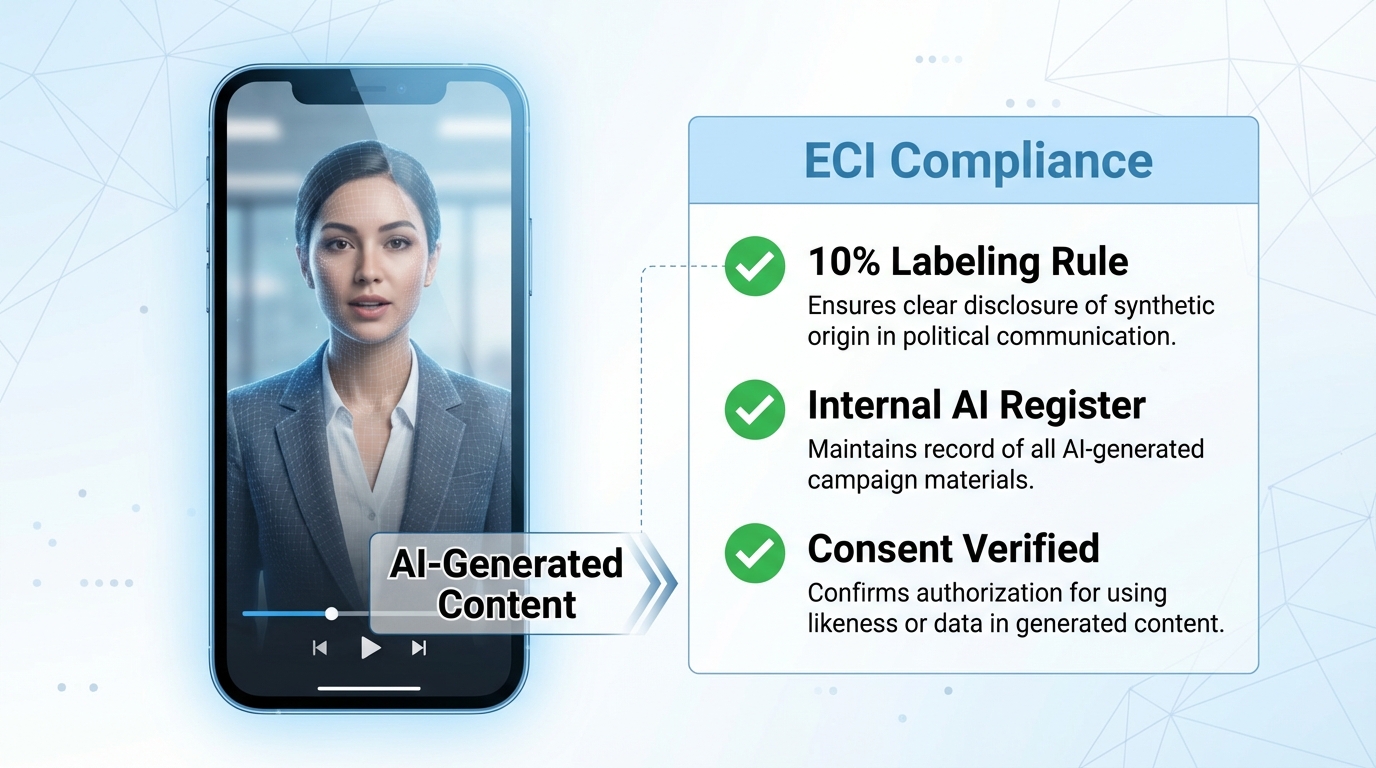
One of the most significant updates in 2026 is the “10% Labeling Rule.” This mandate requires that any video containing more than 10% AI-generated content must carry a persistent, non-removable watermark and an on-screen disclosure. Learn more about invisible watermarking for AI video and deepfake watermarking requirements in India. This disclosure must state “AI-Generated Content” in a font size no smaller than the primary subtitles.
Internal AI Registers
For the first time, the ECI has mandated that all registered political entities and associated media agencies maintain “Internal AI Registers.” These registers must include:
- The source of the AI model used.
- The script and generation parameters.
- Proof of consent from the individuals whose likeness is used.
- A timestamped log of the human-in-the-loop (HITL) review process.
Silence Period Restrictions
The 48-hour “Silence Period” before voting remains a critical regulatory window. The ECI has clarified that the ban on “bulk messages” and “sponsored programs” includes AI-generated voice calls and personalized video messages sent via encrypted platforms like WhatsApp. As The Hindu noted in their analysis of Bihar assembly polls, these automated communications are under intense scrutiny to prevent last-minute voter manipulation.
Sources:
- Indian Express: ECI’s deepfake guidance explained
- IndiaAI: ECI advisory on labeling AI-generated content
- The Hindu: Bulk messages and silence period enforcement
3. Ethical Guardrails: Consent, Labeling, and the Human-in-the-Loop Model
Ethics in AI video generation is not just about following the law; it is about preserving the “Consent-First” model of digital identity. In the 2026 state elections, the focus has shifted toward ensuring that every digital twin is created with documented, revocable permission.
The Consent-First Approach
Consent in the age of AI must be granular. It is no longer enough to have a general release form. Ethical platforms now require specific consent for:
- Voice Cloning: The right to use a person’s vocal timbre and inflection. See AI voice cloning for Indian accents.
- Likeness Animation: The right to animate a person’s face to match new scripts.
- Language Expansion: The right to make a person “speak” languages they do not actually know. Explore multilingual dubbing for YouTube and beyond.
Studio by TrueFan AI’s 175+ language support and AI avatars are built on this foundation of licensed, photorealistic virtual humans. By using real influencers and actors as the basis for their avatars, they ensure that the digital persona is a legitimate extension of a real individual’s brand, rather than an unauthorized fabrication.
Human-in-the-Loop (HITL) Moderation
A critical content gap in many discussions about AI is the role of human oversight. In 2026, “Automated-Only” moderation is considered insufficient for high-stakes electoral content. A robust HITL model involves:
- AI Filtering: Real-time checks for profanity, hate speech, and prohibited political endorsements.
- Human Review: A secondary check by a compliance officer to ensure the context of the video aligns with ethical guidelines and does not contain subtle deceptions.
- Final Audit: A pre-publication sign-off that verifies the presence of mandatory watermarks and disclosures. Learn about multimodal AI video creation workflows.
This two-step process is essential for mitigating the risk of “hallucinations” where the AI might generate unintended or factually incorrect visual cues.
4. The Multilingual Revolution: Bridging the Digital Divide with AI Avatars
India’s linguistic diversity has historically been a barrier to equitable information access. In the 2026 state elections, AI video has become the primary tool for overcoming this “language tax.”
Hyper-Local Accessibility
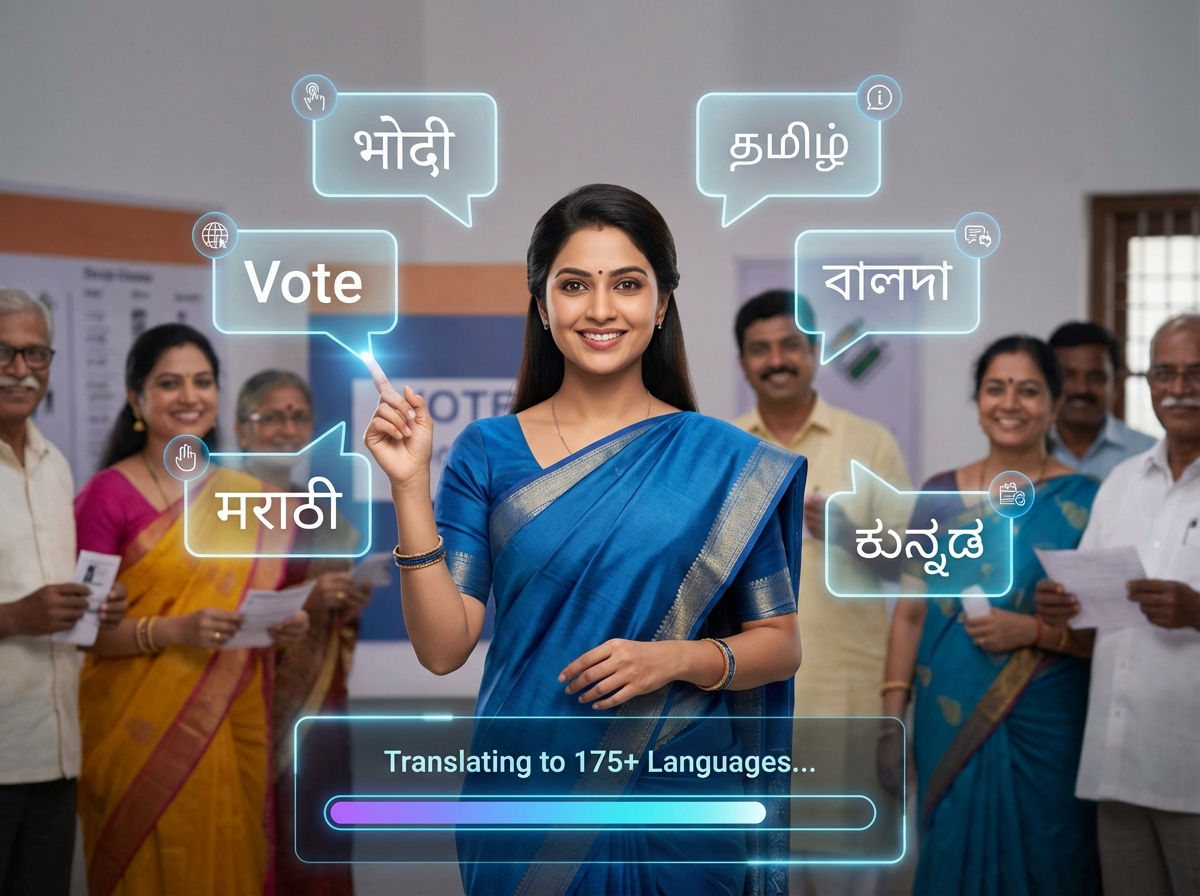
The ability to translate a single message into 175+ languages with perfect lip-syncing allows civic organizations to reach voters in their mother tongue. This is particularly vital in states like West Bengal and Karnataka, where linguistic identity is a significant aspect of the social fabric. Read more on multilingual dubbing and lip-sync.
Solutions like Studio by TrueFan AI demonstrate ROI through their ability to generate hundreds of localized variants of a single informational video in minutes. This rapid prototyping allows for:
- Dialect-Specific Outreach: Moving beyond “Standard Hindi” to regional dialects like Bhojpuri or Maithili. See Indian accent voice cloning.
- Inclusive Communication: Providing accurate dubbed narration for populations with varying literacy levels.
- Real-Time Updates: Quickly updating informational videos as new ECI advisories or polling station changes are announced.
Cultural Sensitivity in AI
Beyond mere translation, 2026 has seen a focus on “Cultural Localization.” This involves ensuring that AI avatars use appropriate gestures, attire, and idiomatic expressions relevant to the specific state. An AI avatar used for outreach in Kerala must reflect the cultural nuances of the region to be effective and respectful.
Sources:
- Medianama: Labeling mandates for AI-generated campaign content
- Storyboard18: ECI’s 2025 advisory and crackdown on deepfakes
5. Technical Integrity: C2PA Metadata, Watermarking, and Provenance
As the sophistication of AI increases, the focus of defense has shifted from “detection” (which is reactive) to “provenance” (which is proactive). In 2026, the gold standard for technical integrity is the adoption of C2PA (Coalition for Content Provenance and Authenticity) standards. For background, see invisible watermarking for AI video.
What is C2PA Metadata?
C2PA is a technical specification that allows creators to attach “Content Credentials” to a digital file. This metadata is cryptographically signed and provides a tamper-evident record of:
- Origin: Which platform generated the video.
- Edits: What changes were made to the file after generation.
- AI Involvement: A clear indicator of which parts of the media were synthetic. See India’s deepfake watermarking requirements.
By 2026, 90% of major social media platforms in India—including WhatsApp, Instagram, and X—have integrated support for C2PA. When a user views a video, they can click a “small ‘i’ icon” to see the full history of the media, ensuring they are not being misled by a deepfake.
Visible vs. Invisible Watermarking
While the ECI mandates visible labels, invisible watermarking (steganography) provides an additional layer of security. These watermarks survive compression, cropping, and screen recording, allowing for post-election audits. If a piece of deceptive content goes viral, authorities can trace it back to the original generation parameters and the account responsible for its creation. Learn more about invisible watermarking.
Post-Election Audit Protocols
A significant content gap in the 2024 discourse was what happens after the election. In 2026, new protocols require that all AI-generated campaign content be archived in a “Synthetic Media Repository” for at least 12 months post-results. This allows for forensic analysis in the event of electoral disputes or allegations of digital malpractice.
6. Media Literacy and Public Trust: Navigating the Synthetic Era
The ultimate defense against the misuse of AI video in India’s 2026 state elections is an informed electorate. Media literacy campaigns have shifted from “Don’t believe what you see” to “Verify the credentials of what you see.”
The Public Checklist for 2026
Voters are now encouraged to follow a simple four-step verification process:
- Check for the Label: Is there a clear “AI-Generated” watermark?
- Verify the Source: Is this video posted by an official, verified handle?
- Inspect the Metadata: Use platform tools to check for C2PA content credentials. Reference: content credentials and watermarking.
- Cross-Reference: Does the information in the video match reports from reputable, traditional news outlets?
The Role of Civic Tech
Civic tech organizations are playing a crucial role in 2026 by providing “Deepfake Scanners” to the public. These tools use API integrations with platforms to provide a “Probability of Synthesis” score for any uploaded video. However, as the Times of India noted, the emergence of deepfakes continues to raise ethical concerns, making public education the most resilient long-term solution.
Sources:
- Times of India: AI reshapes campaigns; deepfakes raise ethical concerns
- Nyaaya: What happens 48 hours before elections
Conclusion
The integration of AI video in India’s 2026 state elections represents a turning point in how technology intersects with the democratic process. While the risks of deepfakes and misinformation are real, the potential for AI to democratize information access across India’s vast linguistic landscape is equally significant. By adhering to the ECI’s stringent guidelines, prioritizing consent-first models, and investing in media literacy, India is setting a global precedent for the responsible use of synthetic media in elections. As we move forward, the focus must remain on transparency, ensuring that every digital interaction strengthens, rather than undermines, the trust between the citizen and the state. For crisis response, see AI video for crisis communication in India.
Frequently Asked Questions
What is the difference between an AI avatar and a deepfake?
An AI avatar is a licensed, consented digital persona used to deliver content transparently, often for informational or marketing purposes. A deepfake typically refers to unauthorized or deceptive synthetic media that mimics a real person without their consent or clear labeling, often with the intent to mislead.
Do Indian regulators require labeling of AI-generated political content?
Yes. The Election Commission of India (ECI) mandates that all AI-generated or synthetic content must be clearly labeled with a persistent watermark and an on-screen disclosure. Failure to comply can lead to the content being taken down and legal action against the publisher. Learn more about deepfake watermarking requirements in India.
Are there restrictions on using AI video during the 48-hour silence period?
Absolutely. The 48-hour silence period rules prohibit any form of political advertising or “bulk messaging.” This includes AI-generated voice calls, personalized video messages, and sponsored AI content on social media platforms.
How can I verify if a video I received on WhatsApp is AI-generated?
Look for the “AI-Generated” label required by the ECI. Additionally, check for the “Content Credentials” (C2PA metadata) if your platform supports it. You should also cross-verify the information with official websites or trusted news sources. See invisible watermarking for AI video.
Can AI be used to create videos of deceased public figures for campaigning?
The ECI and ethical guidelines strongly discourage the use of deceased individuals’ likenesses without explicit permission from their legal heirs and clear labeling. Using such content to fabricate endorsements is a violation of electoral ethics.
How are platforms like Studio by TrueFan AI ensuring their tools aren’t used for misinformation?
Studio by TrueFan AI incorporates real-time profanity and content filters that block the generation of hate speech, explicit content, and unauthorized political endorsements. By maintaining a “walled garden” approach with 100% clean compliance, they ensure that their AI avatars are used only for ethical, licensed communication. Explore their multimodal AI video creation approach.
What should I do if I find a deepfake that is trying to mislead voters?
Report the content immediately using the platform’s reporting tools. Additionally, you can flag it on the ECI’s “C-Vigil” app or the national cybercrime reporting portal.