
IPL 2026 Live Commerce in India: Real-Time Cricket Shopping Videos, Match Moment Flash Sales, and Fantasy Gamification That Convert
Estimated reading time: ~14 minutes
Key Takeaways
- Convert live-match micro-moments into purchases with shoppable videos and event-triggered overlays
- Achieve sub-5-second rendering to preserve fan excitement and maximize conversion
- Use WhatsApp automation and fantasy gamification to lift retention and AOV
- Localize creative via multilingual sentiment analysis and city/team personalization
- Measure success with MMM/MTA, trigger-window KPIs, and sponsorship ROI models
IPL 2026 live commerce is no longer a futuristic concept; it is the definitive conversion engine for the Indian digital economy. As the tournament evolves, the practice of converting in-match micro-moments into instant purchases through shoppable videos, notifications, and gamified offers has become the gold standard for enterprise brands. By tailoring commerce triggers to real-time cricket events—such as wickets, sixes, or strategic timeouts—brands are capturing fan attention when it is at its absolute peak. IPL 2026 live commerce India
The stakes for IPL 2026 live commerce India are unprecedented, with digital ad spends projected to reach between ₹3,800 and ₹4,400 crore. Influencer marketing alone is expected to command a 16–18% share, roughly ₹700 crore, fueled by nearly a million creators who are actively bridging the gap between entertainment and transaction. Platforms like TrueFan AI enable brands to navigate this high-velocity environment by delivering hyper-personalized, match-triggered content that resonates with millions of viewers simultaneously.
This guide provides a concrete blueprint for sports marketing directors and e-commerce growth teams to launch and measure match-triggered commerce, gamification, and loyalty programs during the IPL 2026 season.
1. The Evolution of IPL 2026 Live Commerce in India
The shift toward micro-moments sports marketing is driven by a fundamental change in how Indian fans consume cricket. With the explosive growth of Connected TV (CTV) and OTT platforms, the "second screen" has become the primary point of purchase. Brands are no longer satisfied with passive logo placement; they are leaning into CTV-to-commerce formats that allow viewers to shop directly from their television screens or synchronized mobile apps.
Market data suggests a 30% spike in summer advertising outlay for 2026, largely attributed to the "heatwave effect" and the intensification of competition following the exit of traditional Real Money Gaming (RMG) players from key ad slots. This opening has allowed quick-commerce and tech-led retail brands to dominate in-moment conversion windows. Innovations like JioCinema’s "Hype Feed" have matured the interactive ad rails necessary for seamless shoppable experiences, making real-time engagement a baseline requirement rather than a luxury.
In this landscape, the ability to operationalize moment-based commerce at scale is the primary differentiator. Enterprises are now utilizing API-triggered creative swaps and automated governance to ensure that every six hit by a star batsman results in a relevant, localized offer delivered to the fan's device in seconds. This level of agility requires a robust technical infrastructure capable of handling millions of concurrent requests without latency.
Sources:
2. Engineering Real-Time Cricket Shopping Videos and Match-Triggered Sales
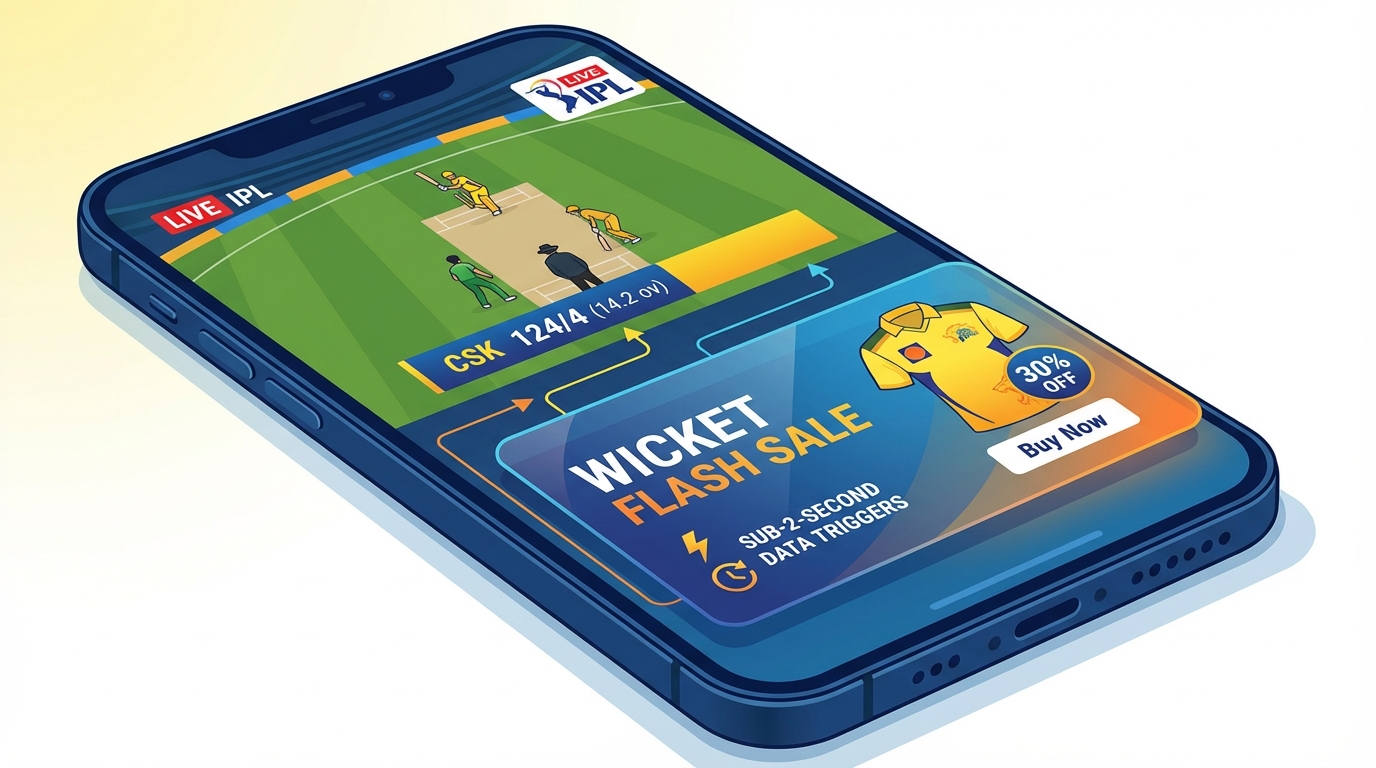
Real-time cricket shopping videos are defined as shoppable overlays or short-form cut-ins synchronized to live match events. These videos feature tappable product pins, deep links to checkout, and countdown timers that create a sense of immediate urgency. For an enterprise to succeed here, the user experience (UX) must be non-intrusive. Overlays should ideally occupy the bottom-third of the screen, staying under 20% of the total screen height, and should auto-hide within five seconds if no interaction occurs. Real-time cricket shopping videos
The technical "latency budget" is the most critical metric for match-triggered sales. To maintain the emotional connection of a live event, brands must achieve sub-2-second event ingestion and sub-5-second overlay rendering. If a wicket falls, the "wicket celebration discount triggers" must fire almost instantly. For example, if a star bowler takes a crucial wicket, a rule-based engine can automatically activate a "Bowlers’ Bundle" discount for exactly 10 minutes, complete with a dynamic stock meter to drive scarcity.
Match moment flash sales thrive on these rule-based triggers. A typical logic flow might be: IF [Batsman hits 4th six] THEN [Unlock player jersey coupon]. To prevent technical bottlenecks, enterprises should prefetch SKU data and assets—such as thumbnails and pricing—to the device cache before the match begins. Using Content Delivery Network (CDN) edge rules localized by city ensures that the Time to First Byte (TTFB) remains minimal, providing a smooth experience for fans across different regions of India. Match moment flash sales
Sources:
3. Gamification and Retention via Fantasy Videos and WhatsApp Automation
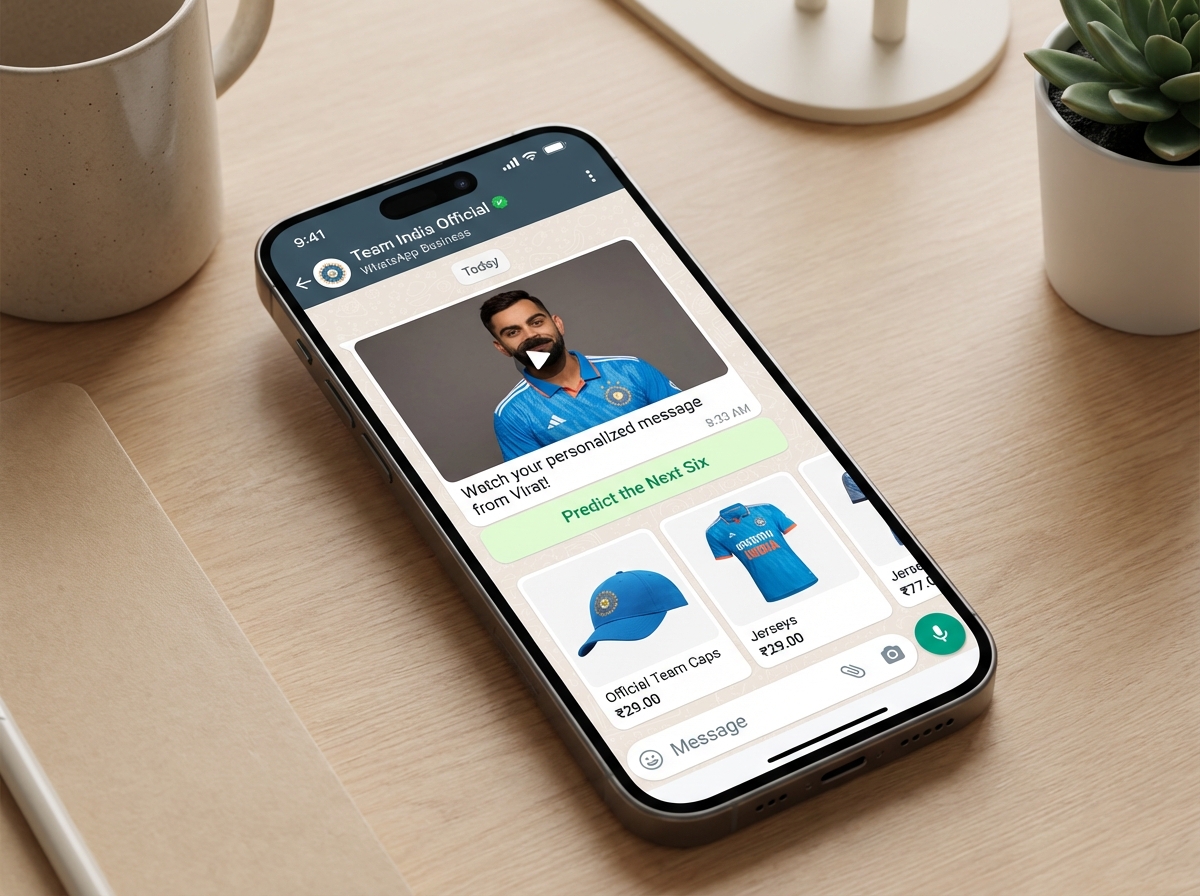
Fantasy league gamification videos are personalized, short-form video prompts that assign prediction quests to fans. For instance, a video might ask, "Will Shubman Gill score 50+ runs tonight?" Correct predictions unlock exclusive coupons or loyalty points, which are tightly integrated with shoppable items like player kits. This creates a "participation loop" where fans are rewarded for their engagement, leading to higher Average Order Value (AOV) through tiered couponing and bundle upgrades. Fantasy league gamification videos
To scale this engagement, WhatsApp cricket notifications have become the primary delivery channel. These are opt-in, templated alerts triggered by match events. The implementation follows a "template ladder": starting with pre-match hype, moving to live triggers (wickets/sixes) with deep links, and concluding with post-match recaps featuring personalized merchandise. The momentum behind the Open Network for Digital Commerce (ONDC) and WhatsApp bots, such as the "Sahayak" bot, has validated conversational commerce as a preferred route for Indian consumers. WhatsApp cricket notifications
Team loyalty program automation further compounds this retention. By using rule-based progression, fans can move from "Bronze" to "Gold" tiers based on their engagement and purchase history. Automation ensures that "double-points windows" are activated during high-stakes matches, and city-specific badges are awarded for attending matches or participating in local fan parks. This stadium-to-digital fan experience ensures that the loyalty journey continues long after the final ball is bowled.
Sources:
4. Hyper-Local Relevance through Sentiment Analysis and Personalization
Cricket sentiment analysis marketing involves mining multilingual social chatter across platforms to classify fan mood by team, city, and player. In a country as diverse as India, localization is not just about translation—it is about tone. TrueFan AI's 175+ language support and Personalised Celebrity Videos allow brands to shift their creative tone based on the match outcome. For example, a celebratory tone is used for a winning city, while a "make-good" offer like "We’ve got your back" coupons can be deployed to fans of a losing team to maintain brand affinity. IPL micro-moments marketing
IPL merchandise personalization at enterprise scale requires a sophisticated operations blueprint. This includes real-time inventory synchronization with Product Information Management (PIM) feeds and print-on-demand SLAs. When a "moment merch" opportunity arises—such as a record-breaking century—pre-approved design templates are automatically updated with the relevant stats, and video showcases featuring celebrity endorsements are generated via API to promote the limited-run items. Real-time cricket shopping videos
The data pipeline for this level of personalization must be robust. It starts with social scraping and language detection, followed by city/team tagging and sentiment scoring. Once a sentiment threshold is met, the system triggers a creative tone switch. This ensures that a fan in Chennai receives a Tamil-language celebratory video after a CSK win, while a fan in Mumbai receives a different, localized message. This hyper-local approach significantly improves viewer retention strategies by making every fan feel seen and heard.
Sources:
5. Bridging the Phygital Gap: Stadium-to-Digital Fan Experiences
The stadium-to-digital fan experience bridges the gap between the physical energy of the venue and the convenience of digital commerce. In-venue interactions, such as scanning QR codes for AR jersey try-ons or receiving geofenced rewards, are now seamlessly connected to OTT and CTV journeys. For example, a fan at the stadium might scan a code to unlock a "stadium-only" discount, which is then automatically available in their mobile app for later use on a CTV-linked account.
Connected TV (CTV) plays a pivotal role in this "phygital" journey. During "Hype Feed" segments on JioCinema, QR codes can appear on the screen, opening WhatsApp chats pre-filled with contextual offers. This allows for a frictionless transition from viewing to shopping. Brands are increasingly leaning into these CTV-to-commerce trends because they capture the attention of the entire household, leading to higher conversion rates compared to individual mobile browsing.
To maximize the impact of these experiences, brands must enforce strict brand-safety and governance controls. This includes ensuring that all AR assets and video variants adhere to brand guidelines across both offline and online channels. Fast venue-specific variant generation allows brands to tailor their messaging to the specific atmosphere of each stadium, whether it's the high-octane environment of the Wankhede or the passionate crowd at Eden Gardens.
Sources:
6. Quantifying Impact: Sports Sponsorship and Fan Engagement ROI
Measuring sports sponsorship ROI measurement requires a shift from traditional exposure metrics to business outcome attribution. Enterprises are now using hybrid Marketing Mix Modeling (MMM) and Multi-Touch Attribution (MTA) calibrated to specific match windows. By linking sponsorship exposures—such as logo appearances or integrated segments—to incremental sales, brands can justify the high costs of IPL associations. Fan engagement ROI is similarly measured by the revenue and Customer Lifetime Value (CLV) impact per engagement unit, such as a video view or a prediction streak. Cricket micro-moments ROI
Solutions like TrueFan AI demonstrate ROI through detailed analytics dashboards that track watch-through rates, click-through rates (CTR), and conversion lifts. For instance, a campaign might show that personalized celebrity videos delivered via WhatsApp resulted in a 17% higher read rate compared to standard text notifications. These data points allow marketing directors to optimize their spend in real-time, shifting budget toward the triggers and creative variants that yield the highest returns.
A comprehensive KPI framework for IPL 2026 should include:
- Conversion Rate during Trigger Windows: The percentage of users who purchase within the 10-minute window following a wicket or six.
- AOV Uplift: The increase in average order value attributed to fantasy gamification and bundle offers.
- WhatsApp Funnel Metrics: Opt-in rates, CTR, and redemption rates for match-triggered notifications.
- Sponsorship ROI Formula: (Incremental Sales Attributed – Sponsorship Cost) / Sponsorship Cost.
Sources:
7. Implementation Playbook, Compliance, and Strategic FAQs
Executing a successful IPL 2026 live commerce strategy requires a disciplined technical and operational approach. The following playbooks outline the essential steps for key activations.
Match-Trigger Pipeline Playbook
- Data Ingestion: Connect to an official match API or partner feed to receive real-time event data.
- Trigger Rules: Define logic in the rules engine (e.g., IF [Wicket] AND [Team=Mumbai Indians] THEN [Trigger Offer A]).
- Creative Swap: Call the video API to generate or select the relevant shoppable overlay variant.
- Rendering & Serving: Render the overlay in <5 seconds and serve via a localized CDN.
- Orchestration: Sync the offer with real-time inventory and coupon management systems.
- Checkout: Provide a deep link to a pre-filled cart with UTM parameters for tracking.
- Attribution: Fire pixels at the over boundary to measure the impact of the specific trigger window.
WhatsApp Notification Ladder Playbook
- Opt-in Capture: Use QR codes on CTV and site modals to collect consent before the season starts.
- Pre-Match Hype: Send a personalized video teaser 2 hours before the toss.
- Live Alerts: Deploy match-triggered alerts (wickets/sixes) with dynamic fields for the fan's name and city.
- Post-Match Recap: Send a summary video featuring personalized merchandise.
- Loyalty Integration: Update the fan's loyalty tier and send a "streak reminder" to encourage engagement in the next match.
Compliance and Risk Mitigation
Operating at the scale of the IPL requires strict adherence to governance standards. Brands must ensure they have explicit rights for all match assets and logos to avoid infringing on broadcast IP. WhatsApp policies require explicit opt-ins and easy opt-out mechanisms to maintain high deliverability. From a data perspective, ISO 27001 and SOC 2 compliance are essential for protecting fan PII (Personally Identifiable Information) and ensuring secure transactions.
Strategic FAQs
Q1: How does IPL 2026 live commerce differ from traditional e-commerce?
A1: Traditional e-commerce relies on search and discovery, whereas IPL 2026 live commerce is driven by real-time, emotional triggers. It converts the high-attention "micro-moments" of a live match into instant purchase opportunities through synchronized overlays and notifications.
Q2: What is the ideal latency for a wicket celebration discount trigger?
A2: To be effective, the trigger should fire within 5-10 seconds of the event. Technical pipelines should aim for sub-2-second event detection and sub-5-second creative rendering to ensure the offer reaches the fan while the excitement is still fresh.
Q3: Can small brands participate in IPL live commerce?
A3: Yes, through the creator economy and localized social commerce. While large enterprises dominate CTV, smaller brands can leverage "nearly a million creators" to run niche, match-synced campaigns on platforms like Instagram and WhatsApp.
Q4: How do you measure the ROI of a sports sponsorship in a live context?
A4: ROI is measured by linking specific sponsorship exposures to incremental business outcomes. This involves using multi-touch attribution to track the path from a live trigger (like a logo appearing during a six) to a final purchase.
Q5: How does TrueFan AI support multilingual campaigns for the IPL?
A5: TrueFan AI's 175+ language support and Personalised Celebrity Videos allow brands to create millions of unique video variants. This ensures that fans across India receive messages in their native language with perfect lip-sync and voice retention, significantly boosting engagement.
Conclusion
The IPL 2026 season represents the pinnacle of sports marketing innovation in India. By integrating real-time cricket shopping videos, match moment flash sales, and fantasy league gamification, enterprise brands can transform passive viewers into active customers. The key to success lies in the seamless orchestration of data, creative, and commerce, ensuring that every match moment is an opportunity for growth. As the digital landscape continues to evolve, those who master the art of micro-moments sports marketing will define the future of fan engagement ROI and sports sponsorship ROI measurement in India.
Final Sources Summary:
Frequently Asked Questions
How do match-moment flash sales work during IPL 2026?
Rule engines listen to live events (e.g., a wicket or sixth six) and instantly unlock contextual offers—such as limited-time coupons or bundles—while overlays and deep links guide fans to a pre-filled cart within seconds.
What tech stack is needed to deliver sub-5-second overlays?
Use low-latency event ingestion, CDN edge localization, prefetching of SKU assets, and an API-driven creative system. Aim for sub-2s detection and sub-5s render for seamless fan experience.
How can WhatsApp automation and ONDC lift conversions?
Opt-in WhatsApp templates deliver timely, personalized prompts with deep links to purchase. Integration with ONDC and commerce bots ensures fast, trusted checkouts across devices.
How should brands measure CTV-to-commerce ROI?
Blend MMM and MTA tuned to match windows, track trigger-window conversions, AOV uplift, opt-in/CTR metrics, and tie sponsorship exposures to incremental sales.
What are key governance and compliance practices?
Secure IP rights for all assets, enforce brand-safety across variants, honor WhatsApp consent/opt-out, and maintain ISO 27001/SOC 2 controls to protect fan data.



