IPL 2026 fantasy league marketing: The match‑day personalization playbook for Sports Marketing Directors and Fantasy Gaming Platforms
Estimated reading time: ~11 minutes
Key Takeaways
- Win IPL 2026 with micro‑moment personalization that activates fans during tosses, wickets, milestones, and timeouts.
- Use WhatsApp‑first orchestration with consented, template‑approved alerts enriched by dynamic variables and localized content.
- Build a data and AI backbone for fantasy team optimization and real‑time cricket sentiment analysis to adapt tone and offers.
- Drive revenue via AI‑led sponsorships and merchandise personalization tied to predictions and loyalty tiers.
- Ship in 4 weeks with a blueprint covering data plumbing, creative, triggers, A/B tests, and ROI dashboards.
IPL 2026 fantasy league marketing is the end-to-end orchestration of personalized, real-time engagements tied to live match events (micro-moments) across WhatsApp, in-app, email, and on-site to lift viewer retention, conversion, and sponsorship ROI. As the IPL season commences on March 26, 2026, brands must be “match-ready” with a live trigger matrix, WhatsApp-first delivery, and an AI backbone capable of processing predictions, player updates, and sentiment-led creative swaps. This strategic shift moves beyond generic broadcasting toward a precision-engineered engagement model that capitalizes on the high-intent windows of a live cricket match.
The 2026 season represents a watershed moment for the Indian fantasy sports ecosystem, which is projected to reach a staggering valuation of USD 5.05 billion by 2030, according to Mordor Intelligence. To capture this growth, Sports Marketing Directors and Fantasy Gaming Platforms require a practical, ROI-backed blueprint that integrates trigger catalogs and data schemas into a cohesive fan experience. This playbook provides the necessary framework to deploy sophisticated personalization strategies in under four weeks, ensuring that every boundary, wicket, and toss result becomes a measurable opportunity for fan engagement ROI.
Success in this high-stakes environment is defined by rigorous KPIs, including session duration, repeat opens per match, and a significant reduction in drop-offs during innings breaks. By implementing advanced viewer retention strategies and match-day offer triggers, platforms can achieve a higher fan engagement ROI, calculated as the incremental gross margin from personalized interactions minus the cost of personalization, divided by the cost of personalization. This document outlines the transition from static advertising to dynamic, micro-moment sports marketing, providing the technical and creative roadmap for the 2026 season.
Why IPL 2026 fantasy league marketing must be personalization‑first
The paradigm of sports consumption has shifted from passive viewing to active participation, necessitating a personalization-first approach to IPL 2026 fantasy league marketing. Micro-moments sports marketing involves recognizing and activating 5–60 second windows during live play—such as the toss, boundaries, wickets, milestones, and strategic timeouts—when fan intent spikes and contextual messages can drive immediate actions. These windows are the most fertile ground for viewer retention strategies, as they allow platforms to mitigate the natural drop-off in engagement that occurs during lulls in play or innings breaks.
In 2026, the pressure to demonstrate sharper ROI is higher than ever, with BestMediaInfo reporting that 27–30% of incremental IPL spend is net new, while 65–70% is reallocated from other marketing channels. This reallocation demands in-season optimization and the use of sophisticated measurement tools like Ormax Media’s Trac20, which benchmarks ad and sponsorship effectiveness on a weekly basis. By aligning personalization efforts with these real-time benchmarks, marketers can pivot their strategies mid-season to maximize impact and justify the shift in budget toward digital-first, personalized experiences.
Furthermore, the integration of WhatsApp cricket notifications has become the gold standard for reaching fans where they are most active. Personalization at this level ensures that match-day offer triggers are not perceived as spam but as valuable, timely interventions that enhance the user experience. Whether it is a nudge to swap a captain after the toss or a limited-time discount on merchandise following a century, personalization ensures that the right message reaches the right fan at the exact moment of highest emotional resonance.
Sources:
- Mordor Intelligence: India Fantasy Sports Market Growth
- BestMediaInfo: IPL 2026 Budget Shifts and ROI Pressure
- Ormax Media: Trac20 Ad and Sponsorship Effectiveness
The match‑day micro‑moments map: From toss to post‑match highlights
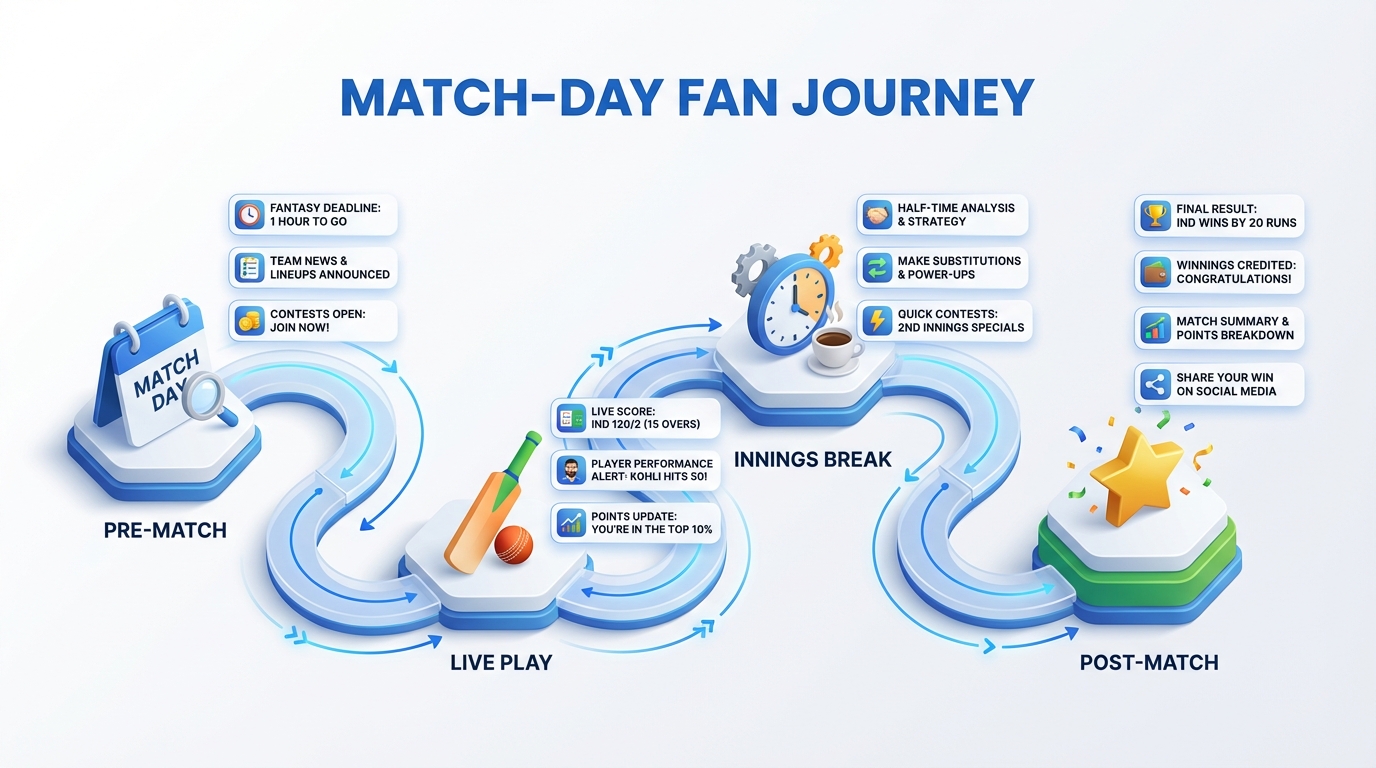
To execute a successful IPL 2026 fantasy league marketing strategy, one must map the fan journey across specific match-day phases: pre-match, live play, breaks, and post-match. During the pre-match phase (T-24h to the toss), the objective is to drive opt-ins and warm up squads by providing player performance updates and pitch/venue insights. Platforms like TrueFan AI enable the delivery of personalized video previews teasing likely XIs, which are highly effective in driving early contest joins and setting the stage for match-day engagement.
As the match transitions from the toss to the Powerplay (Overs 1-6), the focus shifts to capitalizing on line-up confirmations and early momentum. This is the prime window for real-time match prediction rewards, where fans are prompted to predict Powerplay totals or wicket-takers. Integrating cricket gamification videos—such as digital “spin the wheel” challenges or boundary streak trackers—keeps the adrenaline high and ensures that users remain within the app ecosystem during the most explosive part of the innings.
The middle overs (7-15) often see a dip in intensity, making it the most critical period for viewer retention strategies. Here, cricket sentiment analysis plays a vital role; by gauging the emotional state of the fan base, platforms can deploy sentiment-adjusted messages and mini-quests, such as picking the next wicket-taker. During the death overs (16-20) and nail-biting finishes, the strategy pivots to high-stakes predictions and time-bound match-day offer triggers, such as IPL merchandise personalization offers that are only valid until the final ball is bowled. Finally, the post-match phase (0-4h) focuses on reinforcing team loyalty programs through personalized recap videos and loyalty streaks that reward consistent participation.
Sources:
- TrueFan AI: IPL 2026 Personalization Playbooks
- Indian Television: Ormax Trac20 for In-Season Optimization
Enterprise-grade channel orchestration via WhatsApp cricket notifications
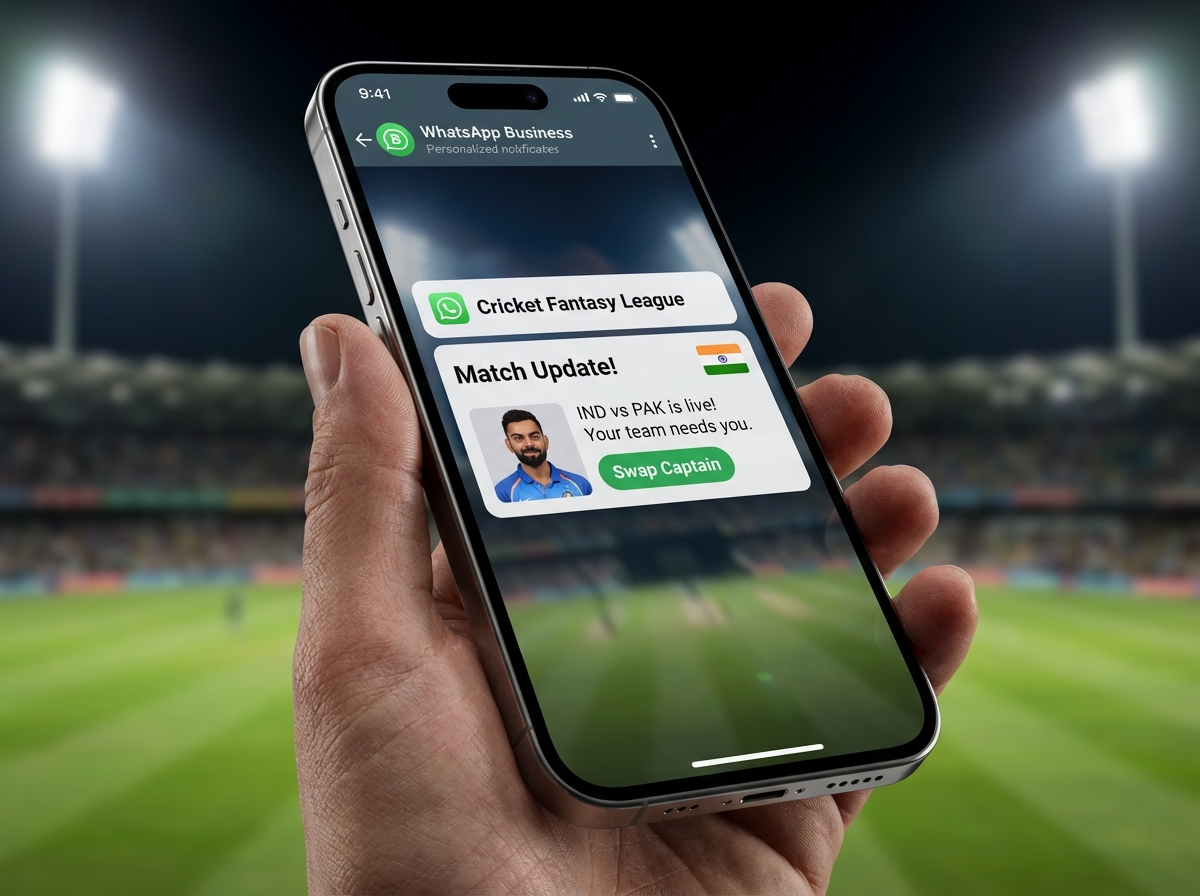
WhatsApp has evolved into the primary engagement hub for Indian cricket fans, making WhatsApp cricket notifications a non-negotiable component of any fantasy gaming strategy. These notifications must be policy-compliant, template-approved messages delivered via the WhatsApp Business API, utilizing dynamic variables such as the fan's name, city, favorite team, and prior fantasy picks. The technical orchestration involves a complex trigger catalog that includes the toss, wickets, milestones, and strategic timeouts, ensuring that every message is contextually relevant to the live action.
Compliance with the Digital Personal Data Protection (DPDP) Act is paramount in 2026. This requires explicit consent capture for specific purposes, granular opt-out mechanisms, and meticulous metadata logging. Platforms must ensure that their WhatsApp strategy balances high-frequency updates with user-centric value. For instance, a toss alert should not just state the result but should include a “captaincy suggestion” based on fantasy team optimization AI, providing the user with an immediate, actionable insight that improves their chances of winning.
TrueFan AI's 175+ language support and Personalised Celebrity Videos allow for a level of localization that was previously unattainable at scale. By routing messages in Hindi, Tamil, Bengali, and other regional languages, platforms can penetrate deeper into Tier 2 and Tier 3 markets. These localized templates, featuring dynamic video thumbnails and deep-links into contest flows, significantly outperform generic notifications in terms of CTR and conversion. The goal is to create a seamless stadium-to-digital experience where the fan feels a direct, personal connection to the game through their preferred messaging app. Explore regional scaling in the 175+ language video SEO guide.
Sources:
- BW Marketing World: Benchmarking IPL 2026 Sponsorship Impact
- Custom Market Insights: India Fantasy Sports Projections
The data and AI backbone: Powering fantasy team optimization AI and sentiment analysis
The engine behind a sophisticated IPL 2026 fantasy league marketing campaign is a robust data and AI backbone. This begins with a comprehensive event taxonomy that tracks both match events (toss, wickets, boundaries) and user events (lineup locks, captain changes, contest joins). By integrating live player performance updates from authorized feeds and normalizing them against historical data, platforms can power a fantasy team optimization AI. This system uses a hybrid of supervised learning and rule-based logic to recommend XIs based on venue dimensions, pitch type, and player matchups, providing fans with “explainable” tips that build trust.
Cricket sentiment analysis adds another layer of intelligence by performing real-time NLP on social signals and in-app interaction velocity. This allows the system to classify the fan base's mood into categories like “joy,” “tension,” or “disappointment.” If a fan's favorite team loses a quick succession of wickets, the creative tone of the notifications can shift from celebratory to encouraging, perhaps offering a “recovery booster” or a mini-game to maintain engagement. This level of emotional intelligence is what separates market leaders from laggards in the 2026 season.
The decisioning architecture must be built for low-latency execution. A stream processor ingests match and user events, passes them through an eligibility engine (checking for consent and balance), and then selects the appropriate content variant. This might involve a TrueFan AI video render that addresses the user by name and references their specific loyalty tier. Finally, identity resolution joins app IDs, WhatsApp phone hashes, and even stadium QR scans to enable a unified stadium-to-digital experience, ensuring that a fan who scans a code at the venue receives a personalized recap video the following morning.
Sources:
- TrueFan AI: IPL Sponsor Activation Campaigns
- Mordor Intelligence: Market Dynamics and AI Integration
Activating sponsorship and commerce through Gemini AI and merchandise personalization
Sponsorship in 2026 (IPL sponsor activation campaigns) has moved beyond static logo placement toward dynamic, AI-led activations. The concept of Gemini AI IPL sponsorship involves using generative AI co-pilots to auto-generate sponsor copy variants that align with the real-time sentiment of the match. For example, a “Powerplay Predictor” sponsored by a major brand can feature live leaderboards and sentiment-adaptive offers. These dynamic creative overlays morph based on the micro-moment, ensuring that the sponsor's message is always contextually relevant and emotionally resonant with the viewer.
Commerce activation is further enhanced through IPL merchandise personalization. By tying jersey or equipment offers to a user’s last correct prediction or their movement within team loyalty programs, platforms can drive significant increases in Average Order Value (AOV). Imagine a scenario where a fan predicts a winning six; within seconds, they receive a WhatsApp message featuring a personalized video of a celebrity showing a jersey with the fan's name on it, accompanied by a one-click link to purchase. This integration of emotion, personalization, and commerce is the ultimate goal of micro-moments sports marketing.
Solutions like TrueFan AI demonstrate ROI through these high-conversion journeys, where the cost of the personalized video is far outweighed by the incremental revenue from merchandise sales and contest entries. By creating a loyalty flywheel where XP is earned for every micro-action—from watching a video to placing a prediction—platforms can sustain engagement throughout the grueling two-month IPL season. This tiered loyalty structure, ranging from “Rookie” to “Legend,” provides fans with exclusive perks like boosted rewards and personalized celebrity shout-outs, further cementing their relationship with the platform.
Sources:
- BestMediaInfo: Competitive Landscape for Real Money Gaming
- TrueFan AI: Guide to IPL 2026 Fantasy League Marketing
Measuring fan engagement ROI and the 4-week implementation blueprint
To achieve market-leading results, the implementation of an IPL 2026 fantasy league marketing strategy must be precise and rapid. The 4-week blueprint begins in Week 1 with data plumbing and the finalization of the event taxonomy. This includes connecting live score feeds and submitting WhatsApp templates for approval. Week 2 focuses on creative production, where cricket gamification videos and sentiment-based copy bundles are developed in multiple languages. By Week 3, live triggers are activated, and real-time match prediction rewards are rolled out to a subset of users for A/B testing.
Week 4 is dedicated to scaling and optimization. This involves load testing for peak events—such as the IPL final—and launching comprehensive ROI dashboards. The fan engagement ROI model must be explicit, taking into account attributed revenue from contest fees and IAPs against the cost of media and personalization. By layering in Ormax Trac20 signals for ad recall and favorability, marketers can triangulate their internal data with industry benchmarks to provide a holistic view of sponsorship effectiveness.
Attribution in the age of micro-moments requires mapping every notification ID to a specific user action, such as a captain change or a purchase, using a time-decay model. This level of granularity allows for incrementality testing via holdout cohorts, proving the true value of personalization. Compliance remains the final pillar of the blueprint, with DPDP consent logs and model audit logs ensuring that the platform remains trustworthy and transparent. This rigorous approach to measurement and governance ensures that the 2026 season is not just a period of high engagement, but a period of sustainable, profitable growth.
Sources:
Recommended Internal Links
- Fantasy team optimization AI — Deep dive on building and deploying fantasy team optimization AI for IPL 2026.
- IPL sponsor activation campaigns — Tactics and KPI frameworks for IPL sponsor activation campaigns in 2026.
- Viewer retention strategies — Practical retention playbooks for live cricket micro-moments and streaks.
- Conversational cricket commerce in India — WhatsApp-first conversational commerce flows for cricket, from prediction to purchase.
- Regional language video SEO — Scaling 175+ language video personalization and SEO for Indian audiences.
- IPL 2026 marketing strategy guide — 4-week IPL 2026 implementation blueprint with real-time triggers and ROI tracking.
- IPL 2026 marketing strategy — Data-driven IPL 2026 marketing strategy across channels, triggers, and loyalty.
Frequently Asked Questions
What is IPL 2026 fantasy league marketing?
It is the strategic orchestration of personalized, real-time, micro-moment campaigns across WhatsApp, in-app, and email, tied specifically to live match events. The goal is to improve viewer retention, increase contest participation, and maximize sponsorship ROI through data-driven engagement.
How can platforms use WhatsApp cricket notifications without spamming users?
The key is to limit notifications to event-driven, consented templates that provide clear value. By using triggers like wickets or milestones and including rewards like prediction boosters or fantasy tips, the messages are perceived as helpful updates rather than intrusive ads.
How does cricket sentiment analysis work in this context?
Cricket sentiment analysis uses real-time NLP to process social media signals and in-app interaction rates. It classifies the collective mood of the fans (e.g., joy, tension, disappointment) and automatically adjusts the tone of marketing creative and sponsor overlays to match that emotion.
How is fan engagement ROI measured in-season?
ROI is measured by tracking incremental revenue from personalized interactions against the costs of personalization technology and media. Platforms often use dashboards provided by partners like TrueFan AI and cross-reference them with third-party benchmarks like Ormax Trac20 to validate impact.
What is the stadium-to-digital experience?
This refers to a unified fan journey where physical interactions at the stadium—such as scanning a QR code on a big screen or using geofenced Wi-Fi—trigger personalized digital follow-ups. For example, a fan might scan a code at the match and receive a personalized video recap of their fantasy team's performance the following morning.
How does fantasy team optimization AI improve user retention?
By providing fans with data-backed, explainable recommendations for their XI and captaincy choices, the AI reduces the “cognitive load” of playing fantasy sports. This leads to better performance for the user, which in turn increases their likelihood of returning for the next match.
Can Gemini AI IPL sponsorship concepts be deployed for any brand?
Yes, these concepts are designed to be brand-agnostic. They use generative AI to create sponsor-aligned content that reacts to match events, such as a “Powerplay Predictor” or “Death Over Challenges,” allowing any sponsor to become an integral part of the live match narrative.



