In-house AI video production enterprise 2026: Agency vs AI video platform TCO for India (CFO/CMO/Procurement Guide)
Estimated reading time: ~9 minutes
Key Takeaways
- Shift from agency retainers to an AI Studio + API stack for TCO reduction up to 90% on repeatable video formats.
- DPDP-ready governance (consent, auditability, data residency) is a procurement imperative for AI video platforms.
- Automation reclaims thousands of production-hours, enabling rapid multi-language localization and virtual reshoots.
- CRM-integrated pipelines enable 1:1 personalized video via API for WhatsApp/SMS journeys at national scale.
- Adopt a phased FY27 migration roadmap to institutionalize AI-first video operations across the enterprise.
The landscape of digital engagement in India has undergone a seismic shift, with digital media officially crossing the ₹1 trillion mark in 2025 to become the largest segment in the Media and Entertainment (M&E) sector. As we approach the FY27 budget cycle 2026 digital transformation budget planning guide, the mandate for Indian enterprises is clear: scale video content exponentially while simultaneously driving a massive enterprise video production cost reduction. The traditional reliance on external creative agencies for every iteration of video content is no longer financially or operationally viable for the modern, data-driven organization.
For the CFO and CMO, the strategic priority has shifted toward in-house AI video production enterprise 2026 models. This transition is not merely about adopting new software; it is a fundamental restructuring of the content operating model. By moving from a high-touch, agency-dependent workflow to a governed, self-serve Studio and programmatic API stack, enterprises are reclaiming control over their brand assets and their budgets. Platforms like TrueFan AI enable this transition by providing the infrastructure necessary to handle ideation, templated creative, and hyper-localization within a single, secure ecosystem.
This guide provides a comprehensive Total Cost of Ownership (TCO) analysis, contrasting traditional agency retainers with an integrated AI video stack. We will quantify the production-hour savings, explore the procurement and compliance guardrails necessitated by the Digital Personal Data Protection (DPDP) Act, and provide a phased roadmap for FY27 migration. By the end of this analysis, procurement heads and financial controllers will have the data-backed framework required to greenlight the in-housing of video marketing operations to reduce video production costs 90 percent.
What TCO really means in India: Agency vs AI video platform TCO
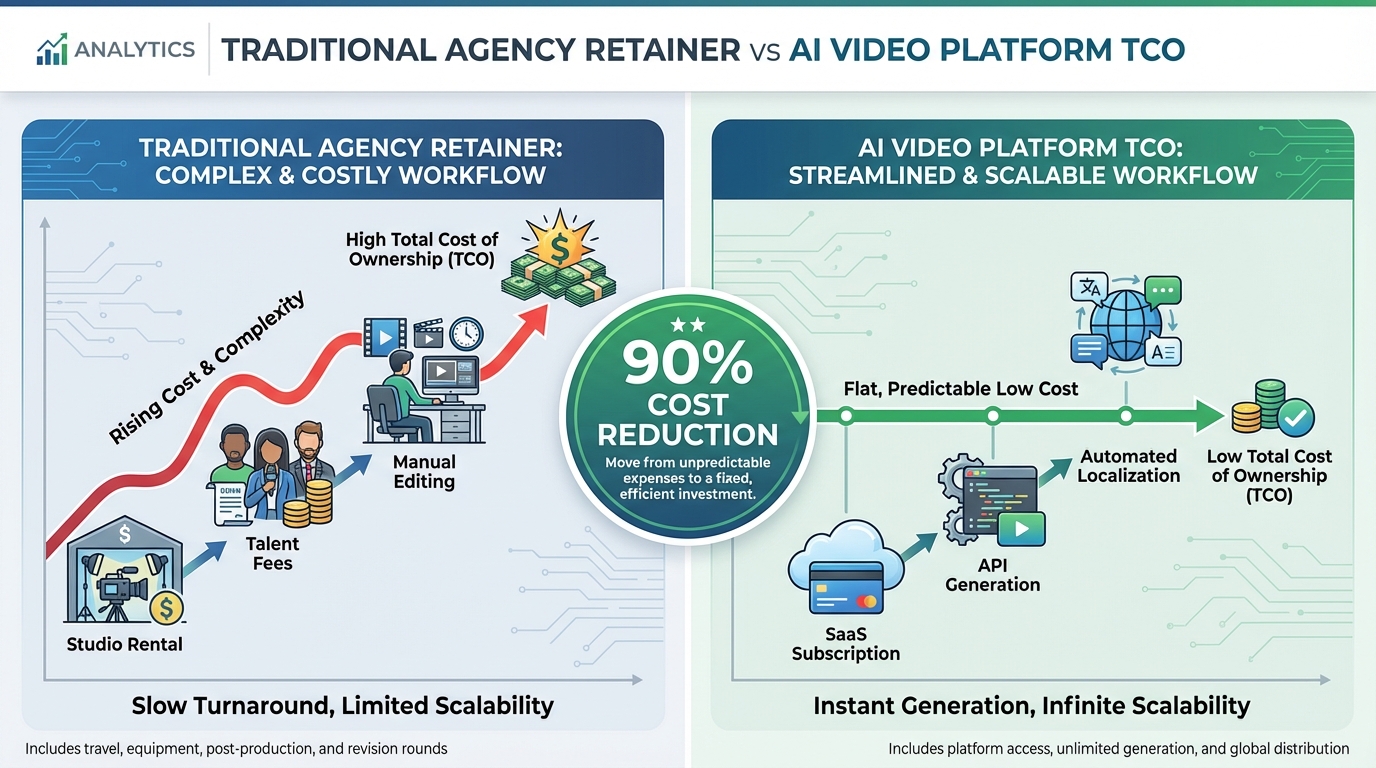
To accurately evaluate the shift toward in-housing, one must look beyond the sticker price of a SaaS subscription or an agency retainer. Total Cost of Ownership (TCO) in the context of enterprise video encompasses the all-in cost to ideate, produce, revise, localize, distribute, and govern content. In the Indian market, this includes fixed retainers, day rates for shoots, celebrity usage rights, and the often-overlooked “cost of delay” to market.
The traditional agency model is characterized by a linear, high-friction workflow: creative brief, storyboard, physical shoot, post-production, and localization. Each step involves significant line items, including Director/DoP day rates, studio rentals, equipment insurance, and talent fees. Furthermore, the Indian enterprise often faces high costs for multi-language variants, where each language might require separate dubbing or even re-shoots to ensure cultural resonance. These costs are compounded by agency markups and the administrative overhead of managing multiple vendor rosters.
In contrast, the AI video platform total cost ownership model shifts the financial burden from fixed, labor-intensive costs to scalable, usage-based SaaS and API expenses. The primary line items here include SaaS subscription tiers for a governed Studio, API usage for programmatic generation, and AI compute for render minutes. This model significantly lowers the marginal cost per variant. While the initial setup requires integration with CRM/MA systems and internal enablement, the long-term TCO is drastically lower because “virtual reshoots” replace physical ones, and localization is handled via automated AI pipelines rather than manual editing.
Sources:
- EY India: India’s M&E sector reached INR 2.78T in 2025
- FICCI: Sector grew 9% in 2025; digital and live drove growth
- TrueFan AI: AI spokesperson platform pricing comparison
Production-hour math: Video production automation enterprise in practice
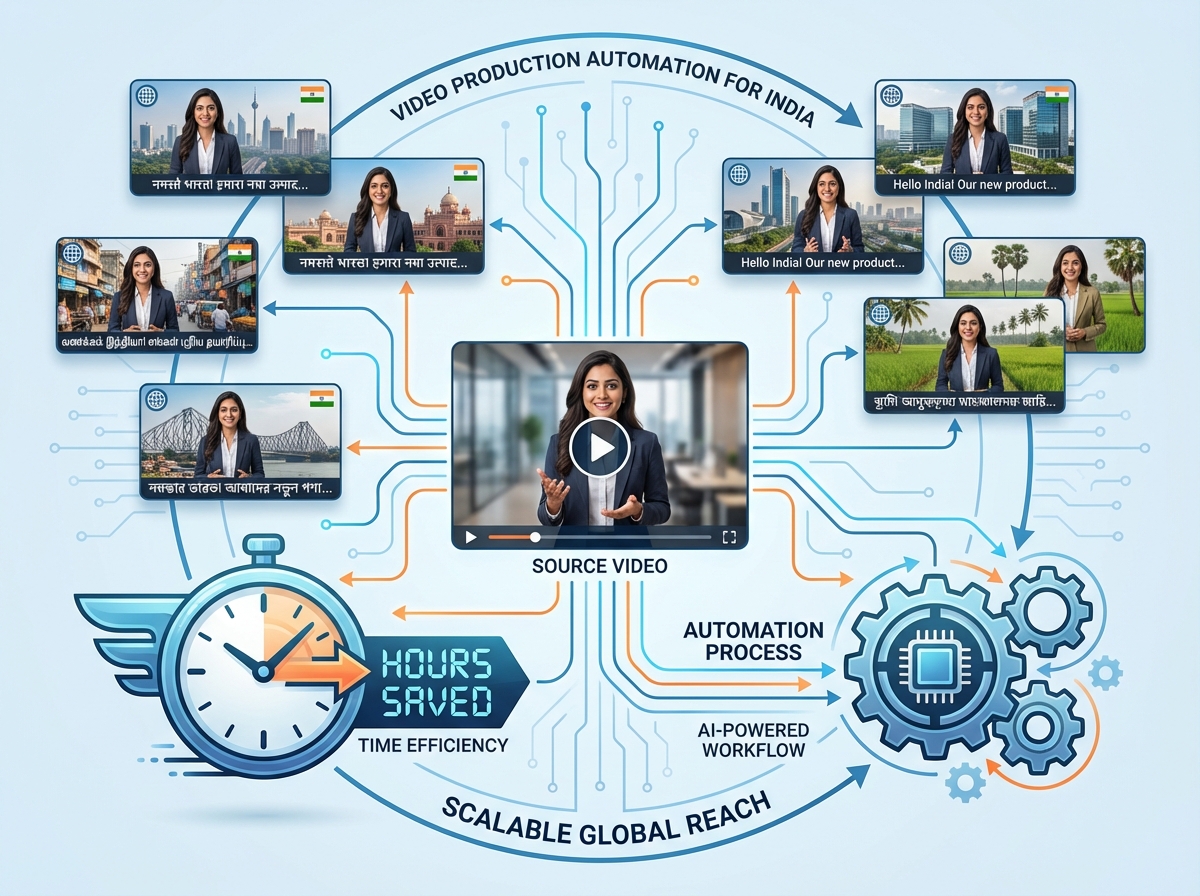
The most compelling argument for video production automation enterprise models lies in the sheer volume of human hours reclaimed. Traditional video production is a time-sink; a single 60-second brand video can consume 40–60 hours of pre-production and 30–50 hours of post-production. When you factor in localization for India’s diverse linguistic landscape, an additional 10–20 hours per language is typical. For an enterprise producing hundreds of variants, the math simply does not scale without an army of editors. Corporate Training Video AI: Cut Production Time by 90%
By adopting an AI Studio + API workflow, the enterprise moves to a “produce once, generate infinitely” model. A reusable master template is created with “brand locks” that ensure visual consistency. When a script change is needed or a new offer is launched, “virtual reshoots” allow for the replacement of specific lines or visual elements without a fresh shoot. This automation extends to localization, where AI can translate, re-voice, and re-lip-sync content into 175+ languages in minutes, preserving the original speaker's voice timbre and identity. Corporate Training Video AI: Faster, Smarter L&D at Scale
The impact of this shift is documented and quantifiable. In recent enterprise implementations, this model has achieved over 3,888 creative hours saved across corporate programs. Corporate Training Video AI: Automate Onboarding Fast For instance, during a high-scale campaign like Zomato’s Mother’s Day initiative, the ability to generate 354,000 personalized videos in a single day would have been physically impossible under a traditional agency model. This level of production cost savings AI video is driven by cycle-time compression, where the time from brief to publish is reduced from weeks to hours, allowing marketing teams to respond to market trends in real-time.
Sources:
- TrueFan AI: Zomato Mother’s Day Case Study
- TrueFan AI: Corporate training video AI (3,888 hours saved)
- Videonetics: Top 6 Trends in AI Industry in 2026
Procurement lens: Agency retainer vs SaaS video platform compliance
Procurement departments in India are currently navigating a complex regulatory environment, primarily driven by the Digital Personal Data Protection (DPDP) Act. When comparing an agency retainer vs SaaS video platform, the procurement lens must focus on data residency, consent management, and auditability. Agency contracts are often fragmented, with intellectual property (IP) and usage rights buried in complex sub-contracts with talent and production houses. This creates significant “compliance debt” for the enterprise.
An enterprise-grade AI video platform simplifies this by embedding governance directly into the software. A robust platform will offer ISO 27001 and SOC 2 certifications, ensuring that data handling meets international security standards. More importantly, for the Indian context, the platform must facilitate DPDP-aligned controls. This includes explicit consent management for talent likeness, purpose limitation for data usage, and automated workflows for Data Subject Requests (DSRs). The risk of non-compliance is high, with penalties under the DPDP Act reaching up to ₹250 Cr for significant breaches.
Furthermore, the procurement process for a SaaS platform is more streamlined than managing a rotating roster of agencies. A single contract covers the SLA-backed uptime, render latency, and integration support. Procurement heads should look for platforms that offer Single Sign-On (SSO) and SCIM for secure access control, as well as detailed audit logs that track every video generated. This shift to a software-first approach allows for more predictable budgeting and ensures that the enterprise maintains full ownership of its creative IP and customer data at all times.
Sources:
- LawSikho: DPDP Act 2023 Compliance Guide and Penalties
- EY India: India’s data privacy shift and DPDP readiness
- DPO India: Consent requirements under DPDPA Sec. 6
Personalization at scale: Scalable personalized video SaaS India with CRM
The true power of in-housing video marketing India is realized when video production is integrated directly into the enterprise's MarTech stack. Scalable personalized video SaaS India allows for the programmatic generation of 1:1 video variants triggered by customer actions. Imagine a scenario where a customer abandons a cart on an e-commerce site, and within 30 seconds, they receive a WhatsApp message featuring a personalized video from a brand spokesperson addressing them by name and offering a specific discount on the item they left behind.
TrueFan AI's 175+ language support and Personalised Celebrity Videos provide the technical foundation for this level of hyper-personalization. By connecting the AI video API to CRMs like Salesforce or HubSpot, enterprises can automate the delivery of policy renewal reminders, loyalty tier upgrades, or festive greetings at a scale of tens of lakhs. This is not just about “inserting a name”; it is about perfect lip-sync and voice retention that makes the video feel bespoke and authentic, significantly increasing click-through rates (CTR) and conversion metrics.
As the NASSCOM GenAI landscape for 2025-2026 highlights, the Indian enterprise ecosystem is rapidly maturing in its use of agentic AI. The shift is moving away from generic content toward highly contextual, data-driven video. This requires a platform that can handle low-latency rendering and high-volume API calls without compromising on brand governance. By automating the “last mile” of content delivery through WhatsApp Business API or SMS, enterprises can create a seamless, high-touch customer experience that was previously only possible for the highest-value segments.
Sources:
- NASSCOM: India Generative AI Startup Landscape 2025
- TrueFan AI: Enterprise AI video API guide
- TrueFan AI: AI avatar API integration guide
Achieving up to 90% enterprise video production cost reduction: The "How"
The claim that an enterprise can reduce video production costs 90 percent often meets with skepticism from CFOs. However, when the math is applied to high-volume, repeatable video formats, the reduction is not only possible but inevitable. The primary driver is the elimination of physical production overhead. In a traditional model, every new campaign requires a shoot day, which carries a high fixed cost regardless of the number of videos produced. In an AI-driven model, the “shoot” happens once (or is entirely virtual), and the marginal cost of each subsequent video is negligible.
Solutions like TrueFan AI demonstrate ROI through the radical optimization of the localization and revision cycles. Corporate Training Video AI: Tips to Boost Engagement In the Indian market, a brand might need to launch a campaign in 10 different regional languages. Traditionally, this would involve 10 different voice-over sessions and 10 different editing timelines. With AI, this is a single API call. Furthermore, the “cost of error” is drastically reduced. If a price point changes or a legal disclaimer needs updating, the enterprise doesn't need to schedule a reshoot; they simply update the script in the Studio and re-render the assets.
This financial efficiency allows CMOs to reallocate budgets from “keeping the lights on” (production) to “driving the needle” (media spend and strategy). As digital media dominance continues to grow in India, the ability to produce 10x the content at 1/10th of the cost becomes a competitive necessity. Enterprises that fail to adopt this model will find themselves outspent and out-maneuvered by leaner, AI-native competitors who can test and iterate on creative at a fraction of the cost and time.
Sources:
- ET BrandEquity: Digital and live drive India’s M&E growth to INR 2.78T
- TrueFan AI: AI spokesperson ROI comparison
- TrueFan AI: 2026 marketing technology budget planning
FY27 marketing technology in-housing roadmap: A Quarterly Guide
Transitioning to an in-house AI video production enterprise 2026 model requires a structured, phased approach to minimize disruption and maximize early wins. For Indian enterprises planning their FY27 budgets, the following roadmap provides a blueprint for successful migration.
Q1: Baseline and Pilot
The first quarter should focus on auditing the current agency vs AI video platform TCO. Procurement and marketing teams must identify the “hidden” costs of their existing agency retainers, including the time spent on briefing and approvals. Simultaneously, the enterprise should set up its AI Studio workspace, importing brand kits and configuring roles and permissions. A pilot use case—such as CRM-triggered retention nudges or simple product explainers—should be launched to establish governance and QA gates.
Q2: Scale and Integrate
In the second quarter, the focus shifts to technical integration. The AI video API should be connected to the enterprise's Salesforce, HubSpot, or WhatsApp flows. This allows for the automation of event-triggered videos, such as cart abandonment or policy renewal alerts. By this stage, the enterprise should aim to move 30–40% of its repeatable video formats to the AI platform, allowing for the first round of agency retainer renegotiations based on the documented production cost savings AI video.
Q3: Creative Agency Replacement for High-Volume Formats
By Q3, the enterprise is ready to use AI as a creative agency replacement AI video for all high-volume, performance-based content. This includes UCG-like ads, localized festive offers, and L&D refreshes. Corporate Training Video AI: Automate L&D at Scale The organization should be personalizing content across 175+ languages as a standard operating procedure. At this point, 50–70% of traditional retainer line items for these categories can be retired, and organization-wide playbooks should be institutionalized.
Q4: Institutionalize and Optimize
The final quarter of FY27 is dedicated to full institutionalization. The enterprise should have a “video-first” culture where the Studio is the primary tool for content creation. CFOs and CMOs should review the outcome dashboard, tracking KPIs like cost per video, cycle-time compression, and conversion lift. This data will form the basis for the FY28 run-rate, ensuring that the enterprise is fully optimized for a future where video is the primary language of customer engagement.
Sources:
- TrueFan AI: 2026 digital transformation budget planning
- TrueFan AI: Agentic AI marketing India
- Leegality: Consent FAQ and penalties under DPDP
FAQ: Navigating the Shift to In-house AI Video
Looking for answers? See the consolidated responses in the Frequently Asked Questions section at the end of this article.
Conclusion: The Strategic Mandate for FY27
The transition to in-house AI video production enterprise 2026 is no longer a luxury for Indian enterprises; it is a strategic necessity. As digital media continues to dominate the M&E landscape and the DPDP Act sets a new bar for data governance, the traditional agency-heavy model is becoming a liability. By adopting a governed, self-serve platform with robust API capabilities, CFOs and CMOs can unlock up to 90% TCO reduction while delivering hyper-personalized experiences that drive real business outcomes.
The evidence from market leaders like Zomato, combined with the 3,888+ hours saved in corporate operations Corporate Training Video AI: Automate Onboarding Fast, proves that the technology is mature and the ROI is immediate. As you plan your FY27 budgets, the question is not whether to in-house your video production, but how quickly you can execute the migration. By following a structured roadmap and prioritizing compliance-grade platforms, your organization can lead the charge in the next era of digital engagement in India.
Next Steps for Leadership:
- Audit: Conduct a full TCO analysis of your current agency retainers and “hidden” production costs.
- Pilot: Identify a high-volume use case for a Q1 FY27 pilot program.
- Govern: Ensure your procurement checklist includes DPDP compliance, ISO 27001, and SSO requirements.
- Scale: Book an enterprise workshop to map your Q1–Q4 migration strategy and achieve enterprise video production cost reduction at scale.
Recommended Internal Links
- A CTO's Guide to 2026 Digital Transformation Budget Planning
- Corporate Training Video AI: Cut Production Time by 90%
- Corporate Training Video AI: Faster, Smarter L&D at Scale
- Corporate Training Video AI: Automate L&D at Scale
- Corporate Training Video AI: Tips to Boost Engagement
- Corporate Training Video AI: Automate Onboarding Fast
Frequently Asked Questions
How does an enterprise AI video platform differ from a Canva-for-video alternative?
Lightweight design tools are useful for basic editing, but they lack programmatic personalization, deep governance, and API-first generation. An enterprise-grade platform like TrueFan AI provides 175+ language support with perfect lip-sync, consent-first spokesperson workflows, and audit-ready controls needed for high-scale, high-trust marketing.
What are the DPDP compliance requirements for AI video?
Enterprises must capture explicit consent for likeness usage, enforce purpose limitation and data minimization, and support DSR workflows. Look for ISO 27001/SOC 2, SSO/SCIM, detailed audit logs, and DPDP-aligned consent management to remain compliant.
Can AI video truly replace a creative agency?
AI excels at repeatable, high-volume, data-driven formats such as performance ads, localization, and personalized journeys. Agencies still add value in brand strategy and cinematic productions. The optimal model moves production “grunt work” in-house while retaining strategic agency partnerships.
How long does it take to see a return on investment (ROI)?
Most enterprises break even within 3–6 months depending on video volume. Savings from a single multi-language national campaign can offset an annual platform subscription due to up to 90% lower cost per variant.
How does TrueFan AI ensure brand consistency across thousands of videos?
Studio templates enforce “brand locks” on colors, logos, fonts, and scene structure. Whether content is generated by decentralized teams or APIs, outputs remain within pre-approved brand guidelines for visual and tonal consistency.



