
Quick Commerce Festival Marketing 2026: Hyperlocal Playbooks for Blinkit, Zepto, and Swiggy Instamart
Estimated reading time: 12 minutes
Key Takeaways
- Hyperlocal, inventory-aware creatives with 10-minute delivery personalization drive same-hour conversion and higher ROI.
- Dark store marketing automation with real-time inventory alerts prevents ghost ads and syncs messaging to stock and ETAs.
- Optimize for each platform: Blinkit seasonal tiles, Zepto micro-window pushes, and Swiggy Instamart Brandverse + CPC search placements.
- Festival playbooks for Valentine’s and Holi center on bundles, scarcity cues, and location-based urgency triggers.
- Measure via instant shopping conversion funnels and scale creative with data-triggered automation using TrueFan AI.
Brands that master quick commerce festival marketing 2026 will win same-hour delivery campaigns with instant gratification marketing and higher contribution margins through hyperlocal relevance. In the current fiscal landscape, the compression of the “desire-to-delivery” window has redefined consumer loyalty. Enterprise playbooks now demand a sophisticated blend of hyperlocal demand spikes—covering Valentine’s, Holi, Rakhi, and Diwali—on platforms like Blinkit, Zepto, and Swiggy Instamart. By combining 10-minute delivery personalization, platform-exclusive festival deals, and location-based urgency triggers, brands can drive impulse conversion in minutes rather than days.
The stakes for 2026 are defined by specific KPIs: conversion speed (view-to-same-hour conversion), AOV lift from intelligent bundles, and the management of CAC against rising platform fees. Success requires a robust data and automation architecture, utilizing dark store marketing automation and real-time inventory alerts to ensure that creative systems, such as hyperlocal flash sale videos, never promote out-of-stock items. This guide provides the strategic framework for executing high-velocity campaigns that leverage API-triggered dynamic content and shoppable overlays to dominate the quick commerce landscape.
1. The 2026 India Landscape: Why Festivals and Instant Gratification Marketing Yield Outsized ROI
The Indian retail ecosystem has undergone a seismic shift, where instant gratification marketing is no longer a luxury but a baseline requirement. This strategy compresses the traditional marketing funnel into a sub-60-minute window, utilizing location-based urgency triggers and inventory-aware creatives to optimize for same-hour delivery campaigns. By 2026, the quick commerce market in India is projected to surpass $10 billion, with festival periods accounting for nearly 45% of annual incremental growth.
Consumer expectations have evolved such that 10-minute delivery personalization is now considered “table stakes” within Tier 1 and Tier 2 micro-markets. Shoppers no longer respond to generic “fast delivery” claims; they respond to dynamic timers stating “delivers to Andheri West in 12 min” or localized credibility cues like “fresh gulal available in your Lokhandwala store.” This level of granularity ensures that the brand remains relevant at the exact moment of intent, capturing the “panic-buy” or “impulse-gift” segments that traditional e-commerce misses.
Platform momentum signals from 2025 and early 2026 indicate that the narrative has shifted toward Zepto and Swiggy Instamart for culture-jacking and topical brandverse activations. Blinkit’s success with contextual, hyperlocal OOH—such as interactive bus shelters and dynamic billboards—proves that real-time, locality-aware creative increases brand salience significantly. For enterprise teams, the implication is clear: you must combine in-app performance placements with contextual out-of-app touchpoints, all synchronized via dark store marketing automation to maintain inventory-safe urgency.
Source: Social Samosa: Trend Pulse and Brandverse Activations
Source: Media4Growth: Blinkit Contextual OOH Case Study
Source: Media4Growth: Real-time Dynamic Billboards for Quick Commerce
2. Navigating the Platform Ecosystem: Blinkit, Zepto, and Swiggy Instamart Strategies
For enterprise marketing teams, understanding the nuances of Blinkit Zepto festival campaigns is critical for budget allocation. Swiggy Instamart offers a diverse array of placements, including search/item ads (CPC), image/video ads, and the “Brandverse” brand stores. These formats allow for full-funnel activation, from top-of-mind awareness to the final add-to-cart. Measurement in 2026 focuses on category ROI benchmarks, view-to-cart ratios, and the crucial cart-to-same-hour conversion metric.
Blinkit remains a powerhouse for in-app category carousels and high-frequency push notifications. Their strength lies in the integration of seasonal homepage tiles with neighborhood-specific credibility. By aligning placement windows to micro-peaks—such as morning gifting hours for Rakhi or late-night party supplies for New Year’s Eve—brands can maximize their Share of Voice (SOV) when it matters most. Platform-exclusive festival deals are essential here to differentiate from competitors and secure premium “above-the-fold” visibility.
Zepto’s agility in seasonal storefronts and micro-window push cadences makes it ideal for scarcity-led messaging. Their high responsiveness to festival-timed triggers allows brands to execute rapid-fire campaigns. To succeed, enterprise teams must negotiate real-time inventory alerts that feed directly into their creative engines. This ensures that if a specific dark store in Indiranagar runs out of a promotional SKU, the ads for that locality are automatically paused or swapped for a substitute, protecting the customer experience and ad spend.
Source: Paxcom: Swiggy Instamart Ad Solutions Overview
Source: LinkedIn: Swiggy Instamart ROI Benchmarks and CPC Models
Source: Media4Growth: Zepto Localized OOH and Audience Targeting
3. The 2026 Festival Playbook: Valentine’s Day and Holi Quick Commerce Strategies
Playbook A: Valentine’s Day Instant Offers (February)
The objective for Valentine’s Day is to capture impulse gifting conversion within a 10–30 minute window. Key SKUs include chocolates, premium flowers, scented candles, and artisanal desserts. Platforms like TrueFan AI enable brands to generate personalized video messages from celebrities that can be delivered alongside these gifts, adding a layer of premium experience to the 10-minute delivery.
Tactics for Valentine’s Day:
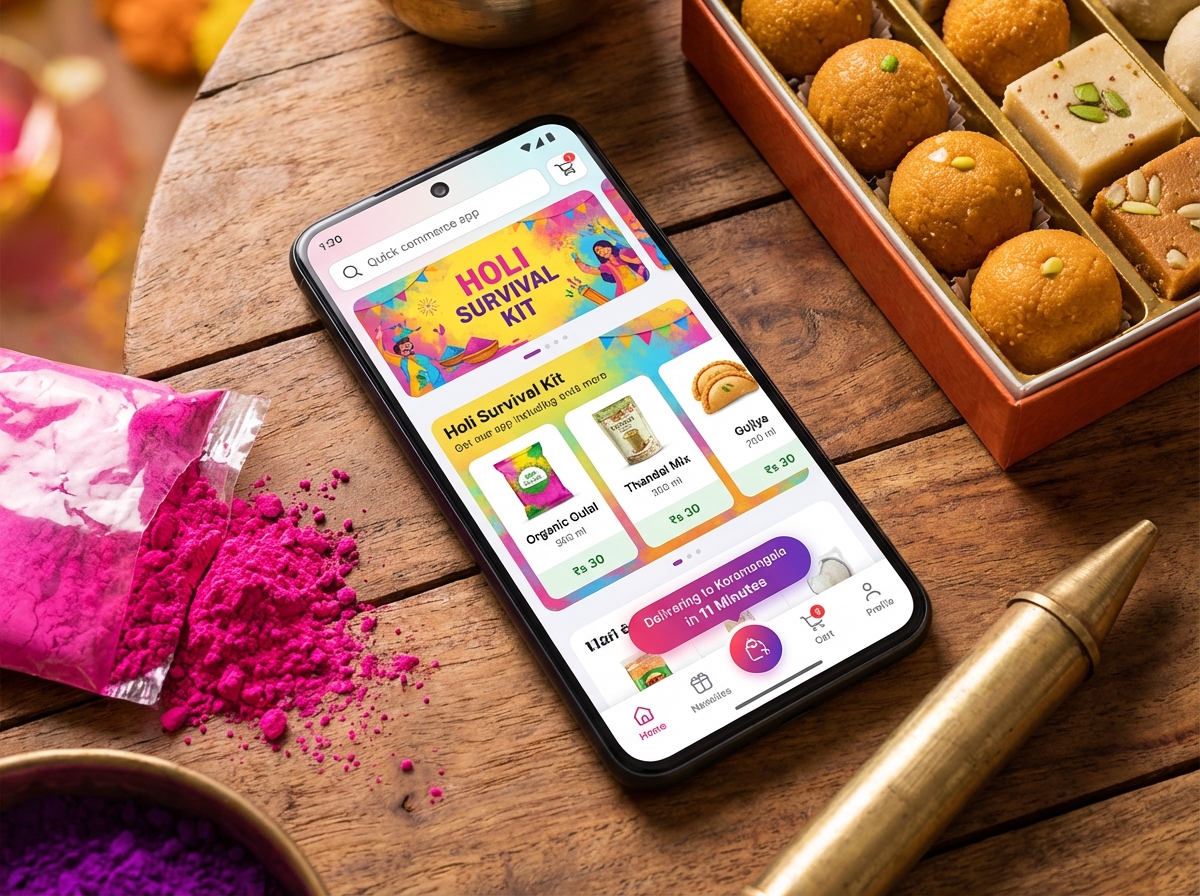
- Platform-exclusive festival deals: Launch “2-hour romance rescue” bundles with free gift-wrapping, triggered by location-based urgency triggers (e.g., “Delivering to Koramangala in 11 min”).
- Hyperlocal flash sale videos: Deploy 15-second clips with romantic CTAs, A/B testing countdown timers against arrival ETAs.
- Inventory Management: Use real-time inventory alerts to auto-swap out-of-stock (OOS) flower varieties with premium chocolate substitutes.
- Creative Copy: “Forgot a gift? 10-minute delivery personalization for <Neighborhood> ensures you’re never late.”
Playbook B: Holi Quick Commerce Strategies (March)
Holi requires a focus on bulk and impulse buys for colors (gulal), pichkaris, snacks, and stain removers. The peak window is the pre-party morning rush, where delivery speed is the primary conversion driver.
Tactics for Holi:
- Inventory-led bundling: Create “Holi Survival Kits” (gulal + thandai + stain remover). Set alert thresholds to trigger creative pauses when stock levels dip below 15% in specific dark stores.
- Hyperlocal flash sale videos: Show live inventory counts like “Last 25 gulal packs in Andheri” with neighborhood-specific offers and route-time overlays.
- Same-hour delivery campaigns: Emphasize splash-proof packaging and “party-ready” delivery speeds.
- Operational Guardrails: Implement geo-cluster caps to protect fill rates during peak surges (10 AM - 1 PM).
4. The Data and Automation Backbone: Dark Store Marketing Automation
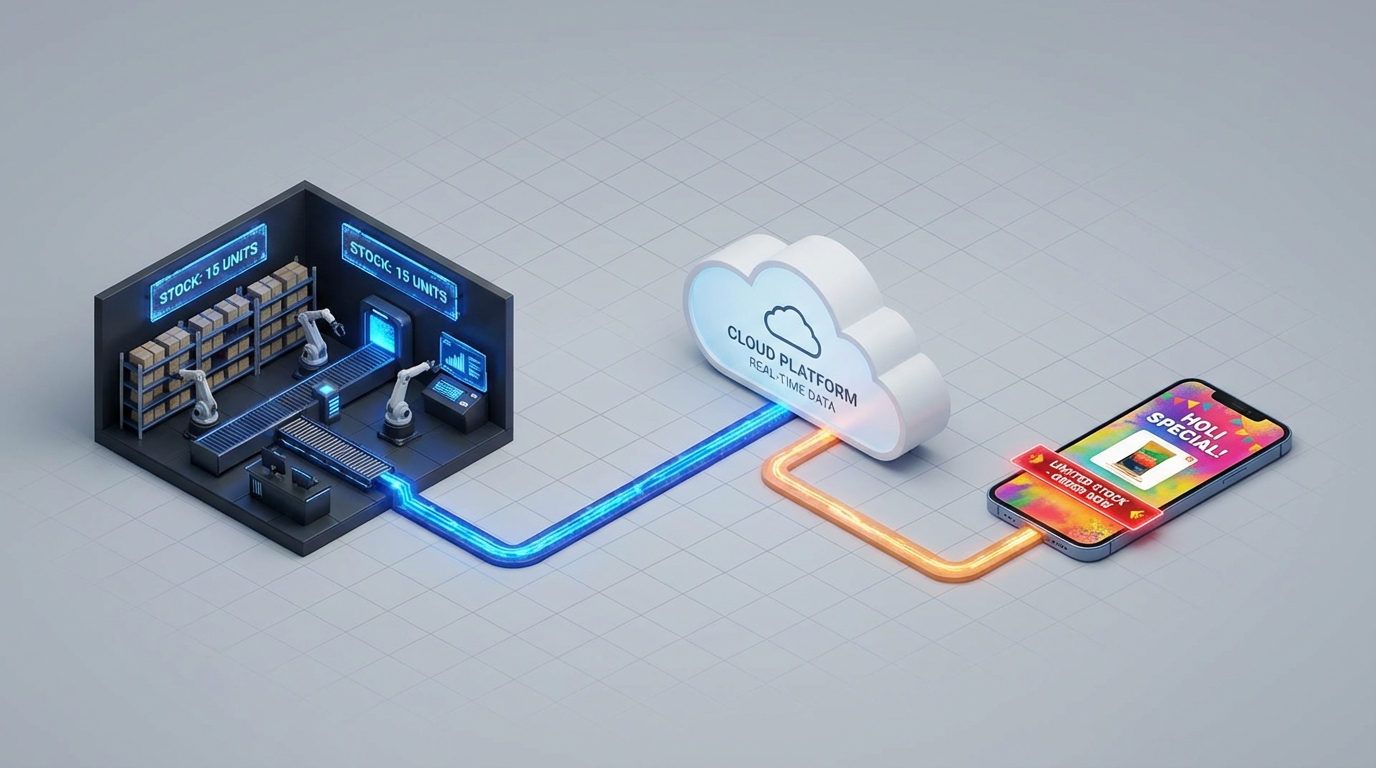
To execute these playbooks at scale, a robust technical architecture is required. Dark store marketing automation is defined as a rules engine connected to q-commerce hubs that ingests live inventory, ETA/SLA data, and geo-clusters. This system automatically creates, updates, or pauses creatives by neighborhood in near real-time. Without this, brands risk “ghost ads”—promoting products that are unavailable, leading to high cancellation rates and wasted spend.
Real-time inventory alerts serve as the event triggers for this system. When stock for a high-demand festival SKU crosses a threshold (e.g., fewer than 30 units), the system fires an API call to switch product tiles or creative variants. Similarly, rapid fulfillment personalization adapts the messaging based on the live ETA per pincode. If a dark store in JP Nagar is experiencing a rider shortage, the ad copy might shift from “10-minute delivery” to “Reserved slots for evening delivery,” maintaining transparency and trust.
The final component is 10-minute delivery personalization. This involves dynamic copy elements that reflect hyperlocal ETAs within a 10–15 minute range. By adjusting urgency phrasing and dynamic timers per user location, brands can significantly lift CTR. The system inputs—including inventory per SKU, store capacity, and discount elasticity—must be governed by an escalation matrix to handle festival-day surges and API errors effectively.
5. Creative Systems for High Conversion: Hyperlocal Flash Sale Videos and Urgency Triggers
The creative strategy for 2026 revolves around hyperlocal flash sale videos. These 20–30 second formats are structured to hook the viewer immediately with a locality-specific signal. For instance: “Bandra West—arrives in 9 minutes.” This is followed by proof of stock and a clear, time-bound offer. These videos are most effective when deployed across Swiggy Instamart’s Brandverse and Blinkit’s seasonal tiles.
Location-based urgency triggers utilize variables such as pincode, micro-neighborhood name, and live stock counts. A successful creative library includes phrases like “Beat the rush in <Area>” or “Ready in 9 minutes for <Neighborhood>.” These triggers are not just text overlays; they are data-driven signals that reassure the customer of the platform’s ability to fulfill the promise of speed.
Placement Mapping and QA:
- Instamart: Optimize video thumbnails for mobile scrolling; use Brandverse stories for high-impact storytelling.
- Blinkit: Use seasonal homepage tiles for mass reach, complemented by contextual OOH for neighborhood credibility.
- Zepto: Focus on micro-window pushes during high-intent hours (e.g., 8 AM for breakfast/puja needs).
- QA Checklist: Ensure geo-name validation (no “Andheri” ads showing in “Colaba”) and price accuracy across all dynamic variants.
6. Measurement, ROI, and the Role of TrueFan AI in 2026
Measuring success in the quick commerce space requires a shift toward instant shopping conversion funnels. This tracks the journey from the first view of a hyperlocal ad to the final same-hour conversion. Key metrics include conversion speed (median minutes from impression to order), AOV lift, and the 7-day repeat rate. Solutions like TrueFan AI demonstrate ROI through their ability to automate the production of thousands of these hyperlocal variants, which would be impossible to create manually.
TrueFan AI’s 175+ language support and Personalised Celebrity Videos allow brands to resonate deeply with diverse Indian cohorts during festivals. For example, a Holi campaign can feature a celebrity greeting the user in their native tongue, mentioning their specific neighborhood, and highlighting a platform-exclusive festival deal. This level of personalization has been shown to save over 3,800 creative hours while driving significant lifts in geo-specific conversion rates.
In 2026, the integration of API-triggered dynamic video is the gold standard. When a real-time inventory alert is triggered, the system can automatically render a new video variant with updated SKU information and push it to the relevant platform placements in under 30 seconds. This ensures that the creative is always synchronized with the physical reality of the dark store, maximizing the efficiency of same-hour delivery campaigns and minimizing customer friction.
Source: Paxcom: Quick Commerce Ad Strategies
Source: Media4Growth: Blinkit and Fabindia Dynamic Billboards
Source: Social Samosa: 2025-2026 Brandverse Trends
Conclusion
In the competitive landscape of quick commerce festival marketing 2026, the winners will be those who move beyond generic broadcasting to embrace hyperlocal precision. By integrating Valentine’s Day instant offers and Holi quick commerce strategies with automated creative systems, brands can capture the fleeting windows of festival demand with unprecedented efficiency. The combination of hyperlocal data, automated video production, and platform-native placements creates a powerful engine for growth, driving both immediate sales and long-term brand salience.
To dominate the next festival cycle, enterprise leaders must invest in the technical and creative infrastructure required for instant shopping conversion funnels. Whether it is through same-hour delivery campaigns or neighborhood-specific offers, the goal remains the same: delivering the right product, to the right place, in under ten minutes.
Frequently Asked Questions
What is dark store marketing automation?
It is a technology stack that connects a brand’s creative assets to the real-time inventory and delivery data of quick commerce dark stores, allowing for automated ad updates based on local availability.
How do real-time inventory alerts improve festival ROI?
They prevent ad spend wastage by automatically pausing promotions for out-of-stock items and redirecting budget to available SKUs, ensuring a seamless instant shopping conversion funnel.
What are the best placements on Swiggy Instamart for festivals?
The most effective placements are Brandverse story cards for engagement and CPC search/item ads for direct conversion during high-intent search moments.
How does 10-minute delivery personalization work?
It uses the user’s geolocation to fetch the exact ETA from the nearest dark store and dynamically inserts that time into the ad creative, creating a powerful urgency signal.
How can TrueFan AI help with quick commerce festival marketing 2026?
TrueFan AI provides the engine for generating thousands of hyperlocal, celebrity-led, or brand-ambassador-led video variants that are triggered by live data, ensuring every neighborhood receives a personalized and inventory-accurate message.



