Voice commerce vernacular India 2026: The enterprise growth playbook for tier‑2/3 scale
Estimated reading time: ~12 minutes
Key Takeaways
- Vernacular voice will be the growth engine for tier‑2/3 India by 2026, reducing typing friction and boosting conversion.
- Winning strategies combine Hindi, Tamil, and Bengali voice intents with omnichannel video explainers.
- Multilingual voice marketing automation and smart speaker integration drive discovery, reorder, and repeat purchases.
- Governance matters: compliant AI voice cloning, consent, and dialect accuracy build long‑term trust.
- A 90–180 day rollout moves from Hindi/Hinglish pilots to multi‑regional scale with clear KPIs (CVR, AOV, WER).
In the rapidly evolving landscape of Indian e-commerce, voice commerce vernacular India has emerged as the definitive frontier for enterprise expansion. By 2026, the end-to-end shopping journey—from discovery to final payment—will be increasingly initiated and completed through voice interactions in local dialects.
This shift is not merely a convenience; it is a structural transformation for the “Next Billion Users” in tier-2 and tier-3 cities. These consumers often face high cognitive friction with traditional text-based interfaces but find natural resonance with voice-first platforms in Hindi, Hinglish, Tamil, Bengali, and other regional variants.
The year 2026 represents a critical breakpoint for the industry. Government-backed initiatives like Bhashini have democratized high-quality ASR (Automatic Speech Recognition) and TTS (Text-to-Speech) models, while smart speaker penetration has mainstreamed voice as a primary input method.
For enterprises, the objective is clear: lower typing friction and deliver multilingual personalization to drive higher conversion rates and repeat orders. Platforms like TrueFan AI enable brands to bridge the gap between voice intent and visual confirmation, creating a seamless, trust-based shopping experience.
Executive Summary: The Vernacular Voice Mandate
- Market Reality: Vernacular voice is no longer optional for tier-2/3 scale. Alexa data confirms that nearly 1 in 2 Echo users in India prefer Hinglish, and total voice interactions are growing at a 67% CAGR.
- Strategic Implementation: Enterprises must deploy Hindi voice shopping optimization, Tamil conversational commerce AI, and Bengali voice-activated offers to capture regional demand.
- Operational Backbone: Success requires multilingual voice marketing automation and the use of a 175 language video platform to provide visual reinforcement for voice-led transactions.
- 90-180 Day Roadmap: Start with a Hindi/Hinglish pilot, expand to Tamil and Bengali with smart speaker integration, and eventually scale with AI voice cloning for hyper-local accents.
Why voice commerce vernacular India 2026 will define enterprise growth
The “friction thesis” is the primary driver behind the 2026 voice surge. For a user in a tier-3 town like Gorakhpur or Coimbatore, typing complex product names in English is a barrier to entry. Voice input in native languages reduces this cognitive load, enabling faster product discovery and effortless reordering.
Data from 2026 projections indicates that India will surpass one billion digital users, with the majority of new entrants coming from non-English speaking backgrounds. This demographic shift is supported by the rapid maturation of India’s public language AI stack, Bhashini, which provides robust models for Hindi, Tamil, and Bengali.
Furthermore, AI marketing ROI has reached a tipping point. Enterprises investing in vernacular voice and video are seeing up to a 3.5x return on investment compared to traditional text-based campaigns. This is driven by a 25% increase in average order value (AOV) when users interact with personalized, voice-enabled interfaces.
The normalization of Hinglish—a blend of Hindi and English—is particularly significant. As Alexa India reports show, the preference for multilingual modes is skyrocketing, making it essential for brands to move beyond “pure” language models to embrace the colloquial reality of Indian speech.
Sources:
- Amazon Alexa Hinglish Multilingual Mode
- India’s Digital Surge 2026 - MXM India
- AI Marketing Stats 2026 - Cloud9 Digital
- Bhashini Language AI Stack
Tier-2 voice adoption strategies that actually convert
To successfully implement tier-2 voice adoption strategies, enterprises must focus on the transition from discovery to repeat purchase. The first step is localized onboarding. When a user opens an app, the system should automatically detect language preferences or offer a simple voice prompt: Hindi, Tamil, or Bengali? Aap ka pasandida bhaasha chunen.
Teaching usage is equally critical. Many tier-2 users are hesitant to use voice for payments. Brands should embed 10-15 second voice tutorials and Hinglish AI video creation within their apps or WhatsApp micro-sites to build user confidence through visual and auditory demonstrations.
Low-bandwidth audio UX is a technical necessity for regional scale. By using on-device ASR where possible and compressing audio to 16 kHz mono, enterprises can ensure that voice intents are captured even in areas with intermittent connectivity. This “store-and-forward” approach prevents session drops and user frustration.
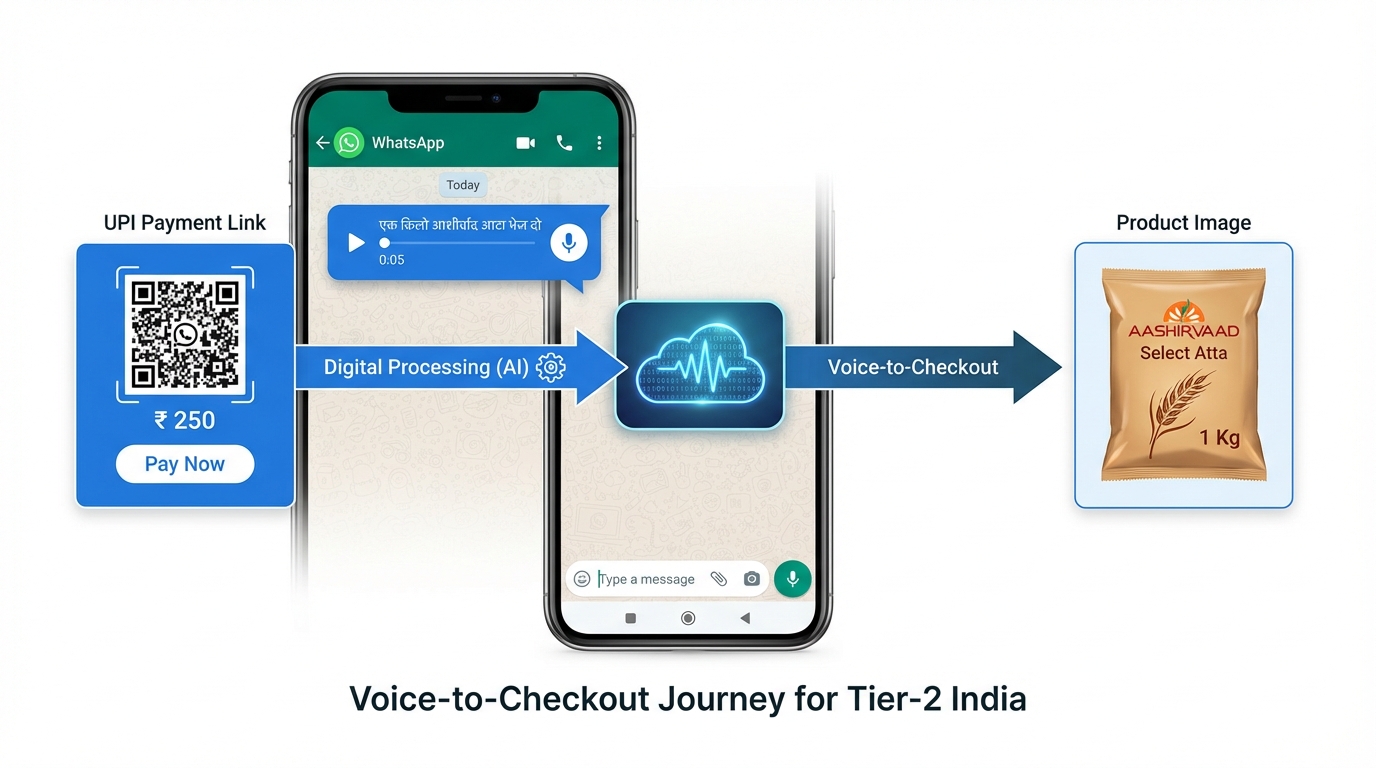
WhatsApp Business has become the de facto operating system for tier-2 India. Integrating voice-note capture into WhatsApp funnels allows users to send a 10-second audio clip like Ek kilo Aashirvaad Atta bhej do. This intent is then processed via cloud ASR, leading to an instant checkout link or a personalized confirmation video.
Finally, the “one-shot intent” for reorders is the ultimate conversion tool. A user saying Kal wala atta dubara bhejo (Send yesterday's flour again) should trigger an immediate confirmation of quantity and address, followed by a UPI autopay prompt, bypassing the traditional cart-and-checkout flow entirely.
Sources:
Hindi voice shopping optimization: From discovery to reorder
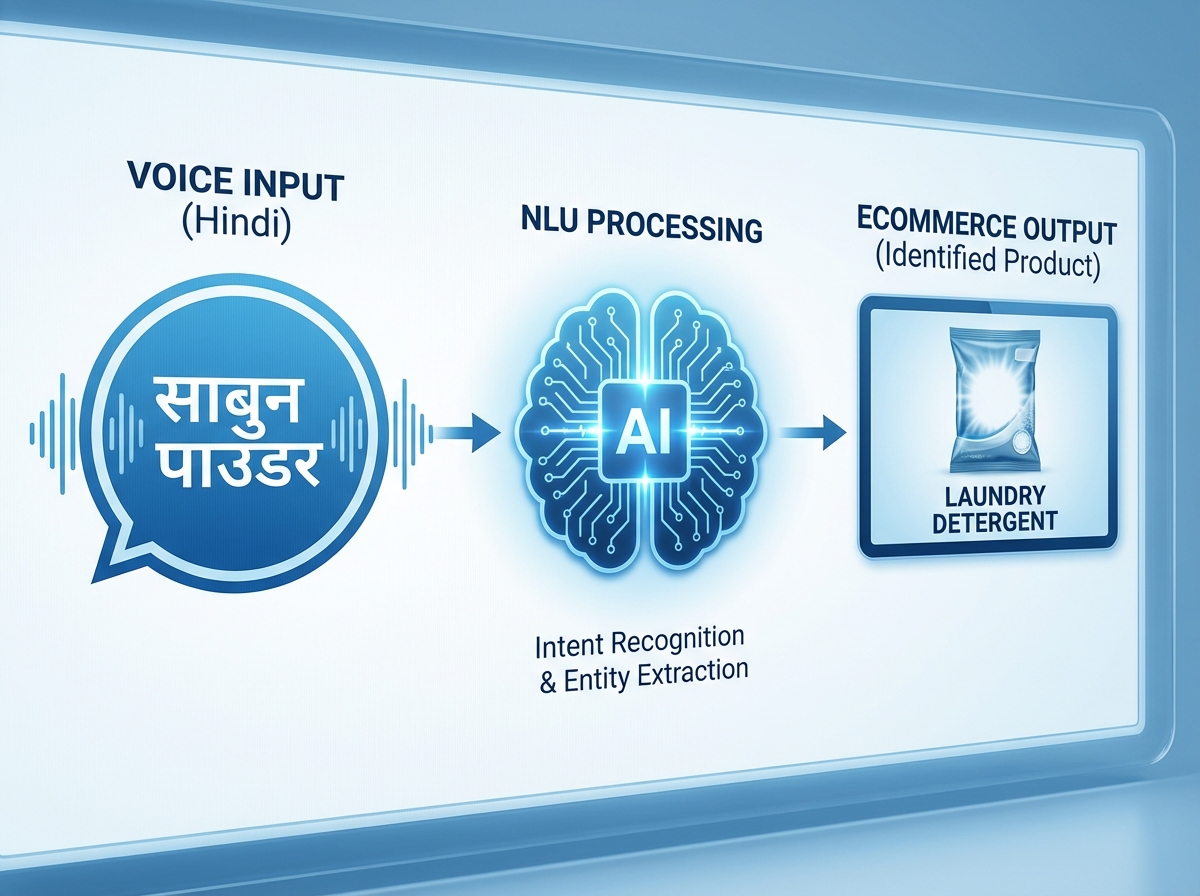
Hindi voice shopping optimization is the systematic tuning of ASR lexicons and NLU (Natural Language Understanding) intents to maximize conversion for Hindi and Hinglish speakers. This requires more than simple translation; it requires an understanding of how people actually speak when they shop.
Technical execution begins with the lexicon. Enterprises must add brand and product synonyms that include common Hindi transliterations. For instance, “detergent powder” should be mapped to “sabun powder” (साबुन पाउडर) to ensure the search engine recognizes the intent regardless of the terminology used.
Sample intents for a robust Hindi voice funnel include:
- Discovery: Mujhe bacchon ka shampoo dikhao (Show me kids' shampoo).
- PDP Q&A: Ye ek litre ka hai kya? (Is this one litre?).
- Reorder: Pichle hafte wala chawal phir se order karo (Order last week's rice again).
Prompting must also feel natural. Instead of robotic confirmations, use conversational phrases like Theek hai, 5 kilo Basmati chawal aapke cart mein jod diya hai—confirm karein? with a Hinglish fallback of Confirm karu? for younger demographics.
To build trust during the purchase phase, brands should attach short Hinglish AI video creation explainers to the Product Detail Page (PDP). These videos can explain key specifications or return policies in the user’s preferred dialect, significantly reducing pre-purchase anxiety and subsequent return rates.
Sources:
Tamil conversational commerce AI and Bengali voice-activated offers
Designing Tamil conversational commerce AI requires an intent-aware dialog system that can handle the unique colloquialisms of Tamil Nadu’s tier-2 and tier-3 regions. Users often mix Tamil with English, necessitating a model that can resolve slots like Offer irukka? (Is there an offer?) or Return epdi? (How to return?).
A stateful flow in Tamil might look like this:
- User: Nethu vaangina mixer-ku jar venum. (I need a jar for the mixer I bought yesterday).
- Bot: Sari, unga order-il compatible jar ₹699—add pannalaamaa? (Okay, the compatible jar for your order is ₹699—should I add it?).
For the West Bengal market, Bengali voice-activated offers provide a powerful tool for festival and payday peaks. These are geo-temporal promotions unlocked via specific Bengali utterances during high-affinity windows like Durga Puja or Poila Boishakh.
Enterprises can deploy “cashierless” flows where a user unlocks a coupon by saying Aajker best offer-ta dekhao (Show me today's best offer). This serves a localized promo with a deep link to the PDP. It is vital to ensure the ASR models account for dialectical differences between Kolkata and regional districts to maintain high accuracy.
To support these regional flows, TrueFan AI's 175+ language support and Personalised Celebrity Videos can be used to create audio-visual explainers for festival bundles. For example, a Tamil-speaking celebrity avatar can explain a Pongal special offer, creating an immediate emotional connection and driving higher engagement than a generic text banner.
Sources:
Hinglish AI video creation and regional dialect shopping videos
Trust and comprehension are the two biggest hurdles in tier-2 e-commerce. Hinglish AI video creation addresses this by generating short-form, automatically localized PDP explainers that mirror the user’s vernacular phrasing. These are not generic videos; they are hyper-local assets designed to reduce returns.
Regional dialect shopping videos take this a step further by using specific accents—such as Bundelkhandi for North India or Coimbatore Tamil for the South. These micro-explainers (20-40 seconds) walk the user through product specs, the “Cash on Delivery” process, or how to initiate an exchange.
Distribution of these assets should be omnichannel:
- In-App: Embedded directly on the PDP for instant clarification.
- WhatsApp: Sent as a follow-up to a voice-note inquiry.
- CTV: Overlaid on connected TV screens with audio remote prompts for “lean-back” shopping.
By combining voice intents with these regional videos, enterprises create a “closed-loop” of trust. When a user asks a question via voice, they receive a video answer in their own dialect. This level of conversational AI personalization is what will separate market leaders from laggards in 2026.
Solutions like TrueFan AI demonstrate ROI through these localized video assets, which have been shown to increase view-through rates by 40% and reduce customer support tickets by nearly 20% in vernacular-heavy cohorts.
Sources:
Multilingual voice marketing automation and smart speaker commerce integration
Multilingual voice marketing automation is the engine that orchestrates these interactions across the customer lifecycle. It involves rule-based triggers that select the appropriate language and dialect based on user behavior. For example, a browse abandonment event in Tamil Nadu should trigger a 15-second Tamil voice note and a micro-video summarizing the product benefits.
Smart speaker commerce integration is a critical component of this automation. By building commerce intents for Alexa, brands can allow users to search, add to cart, and check order status via voice. Secure checkout is handled through voice PINs or by pushing a UPI deep link to the user’s phone to complete the transaction.
An integrated omnichannel trigger might look like this:
- Voice Search: User searches for “running shoes” on a smart speaker.
- WhatsApp Trigger: The brand sends a personalized Hinglish video recap of the top-rated shoes to the user's phone.
- Voice Reorder: Two months later, the user tells their smart speaker to “reorder the same shoes,” which triggers an automated confirmation.
This level of integration requires a robust 175 language video platform as the content backbone. This allows the enterprise to generate thousands of personalized video variants for every possible voice intent without the need for expensive, repetitive video shoots.
Sources:
AI voice cloning Indian accents: Governance and Ethics
As enterprises scale, AI voice cloning Indian accents becomes a powerful tool for maintaining a consistent brand voice while sounding local. This involves synthesizing voices that reflect regional lilts—such as a Haryanvi-accented Hindi or a Bengali voice with a Sylheti cadence.
However, this must be managed with strict governance. Under India's DPDP (Digital Personal Data Protection) framework, consent is paramount. Enterprises must:
- Obtain Verbal Consent: Prompts must be in the local language, explaining how the voice data will be used.
- Ensure Disclosure: If a cloned voice is used, it must be disclosed to the user in their native tongue.
- Maintain Quality: Word Error Rate (WER) must be tracked by dialect, with a target of >95% accuracy for brand and product names.
Ethical AI usage also includes bias testing. Models must be “red-teamed” to ensure they do not misinterpret regional slang or inadvertently use culturally insensitive phrasing. By prioritizing transparency and user control, brands can build long-term trust in tier-2 markets.
The 175 language video platform provided by TrueFan AI incorporates these governance standards, offering ISO 27001 and SOC 2 compliance, along with moderation filters to ensure all generated content remains brand-safe and culturally appropriate.
90-180 Day Rollout Plan: From Pilot to Scale
Implementing a comprehensive voice commerce vernacular India 2026 strategy requires a phased approach to manage technical complexity and measure ROI.
Days 1–30: Hindi/Hinglish Pilot
- Scope: Focus on three primary intents: search, add-to-cart, and reorder in Hindi/Hinglish. Hindi voice shopping optimization
- Assets: Create Hinglish AI video creation assets for the top 20 SKUs.
- Metrics: Establish a baseline for CVR and AOV. Target a Word Error Rate (WER) of less than 10%.
Days 31–90: Tamil/Bengali Expansion
- Scope: Launch Tamil conversational commerce AI and Bengali voice-activated offers timed to regional festivals.
- Integration: Connect smart speaker commerce intents to the mobile app for seamless handoffs.
- Content: Scale to 100 SKUs with regional dialect shopping videos.
Days 91–180: Tier-2/3 Scale & Governance
- Scope: Roll out to the top 10 vernacular clusters in India.
- Advanced Tech: Standardize AI voice cloning Indian accents for the brand's virtual assistant.
- Optimization: Implement full-scale conversational AI personalization based on user purchase history and dialect preference.
Measurement and KPI Framework
To justify the investment in multilingual voice marketing automation, enterprises must track a specific set of KPIs:
- Conversion Rate (CVR) Uplift: Compare the CVR of voice-led journeys against traditional text-based journeys.
- Average Order Value (AOV) Delta: Measure the increase in AOV when users are served Bengali voice-activated offers or Tamil bundles.
- Reorder Rate: Track the percentage of repeat purchases initiated through “one-shot” voice intents.
- Word Error Rate (WER): Monitor ASR accuracy across different dialects to ensure the system is learning and improving.
- Video View-Through Rate: Measure how many users watch the regional dialect shopping videos and how that correlates with a reduction in return rates.
By 2026, the brands that have mastered the intersection of voice, vernacular, and video will be the ones that dominate the Indian e-commerce landscape. The transition from “typing in English” to “talking in Tamil” is not just a feature—it is the future of retail in India.
Frequently Asked Questions
What is voice commerce in vernacular India?
Voice commerce in vernacular India refers to the ability for consumers to search for, discover, and purchase products using their native Indian languages and dialects. This includes interactions via smart speakers, mobile app microphones, and WhatsApp voice notes, specifically optimized for the linguistic nuances of tier-2 and tier-3 regions.
How do I implement tier-2 voice adoption strategies?
Successful implementation involves three pillars: localized onboarding with automatic language detection, low-bandwidth technical optimization for intermittent connectivity, and the use of visual aids like AI-generated videos to build trust and explain the voice-to-payment process.
What are examples of Hindi voice shopping optimization?
Examples include tuning ASR lexicons to recognize “Hinglish” terms, creating intents for specific regional needs (e.g., “Pichle hafte wala order”), and using natural, conversational prompts that mirror how a local shopkeeper would interact with a customer.
How does AI voice cloning Indian accents work compliantly?
Compliant voice cloning requires explicit user consent, clear disclosure that the voice is AI-generated, and adherence to data protection laws like the DPDP Act. It also involves rigorous QA to ensure the accents are culturally accurate and free from bias.
How does a 175 language video platform reduce localization time?
A platform like TrueFan AI allows an enterprise to take a single 15-minute video shoot and automatically generate thousands of personalized versions in 175+ languages. This eliminates the need for multiple regional shoots, reducing the time-to-market from months to minutes while maintaining high-quality lip-sync and voice retention.