Heat Wave Commerce Automation 2026: India’s Enterprise Playbook to Turn Temperature Anxiety into Instant Purchases
Estimated reading time: ~8 minutes
Key Takeaways
- Activate campaigns with IMD/MOSDAC weather triggers to convert heat spikes into instant sales.
- Use regional heat targeting and heat-index bands for precise messaging and offers.
- Drive conversions with EMI personalization and shoppable, personalized video creatives.
- Prevent stockouts via seasonal inventory optimization and pre-summer rebalancing.
- Ensure enterprise scale with real-time rendering and delivery so ads match live heat triggers.
TL;DR: The 2026 Heat Wave Commerce Blueprint
- The Concept: Heat wave commerce automation is the automated, data-driven retail activation that transforms IMD/MOSDAC heat signals into instant offers, creative assets, and fulfillment across Indian cities.
- The Urgency: IMD’s 2026 heat guidance and seasonal forecasts indicate a 9-10% rise in power demand, following years where room AC sales spiked 40–50% YoY during peak heatwaves.
- The Strategy: Success in 2026 requires combining real-time weather triggers, regional heat targeting, EMI offer personalization summer, and shoppable, personalized video content.
- The Goal: Convert "temperature anxiety" into immediate transactions by aligning inventory and installation capacity with hyper-local weather peaks.
Introduction: The Era of Heat Wave Commerce Automation 2026
In the high-stakes landscape of Indian retail, heat wave commerce automation 2026 represents the ultimate orchestration of climate data, real-time triggers, and personalized creative. As temperatures across the Indo-Gangetic plain and the Deccan Plateau consistently breach the 40°C mark, the window for consumer decision-making shrinks from weeks to mere hours. For enterprise marketers in the consumer durables sector, the challenge is no longer just about having stock; it is about being visible with the right offer at the exact second a consumer feels the first wave of "temperature anxiety."
This anxiety is a powerful psychological driver. When the heat index climbs, shoppers demand instant relief, transparent EMI options, and guaranteed fast installation. By leveraging IMD heatwave guidance and seasonal forecasts, brands can now move from reactive seasonal planning to proactive, city-wise trigger design. The 2026 playbook focuses on a seamless stack: integrating MOSDAC-LIVE data with Customer Data Platforms (CDPs) to deploy summer appliance urgency videos and weather-responsive offers.
1. The Strategic Case for Temperature-Triggered Marketing India
Temperature-triggered marketing India is no longer a niche experimental tactic; it is the primary engine for seasonal ROI. This strategy involves activating marketing campaigns based on live and forecasted weather thresholds, including dry-bulb temperature, humidity, and the IMD’s color-coded alert system. In a country where summer temperatures can vary by 15 degrees between neighboring states, a "one-size-fits-all" national campaign is a recipe for wasted ad spend.
Human urgency scales non-linearly with heat. Research indicates that consumer discomfort rises disproportionately once temperatures cross the 38°C threshold. When humidity is factored in, the "perceived heat" or heat index can make a 35°C day feel like 42°C, drastically shortening the research window. In 2024, room AC sales surged by nearly 50% YoY during record heat spikes, proving that brands synchronized with these peaks over-indexed on conversions while competitors struggled with irrelevant messaging.
2. Building a Weather Prediction Commerce Stack
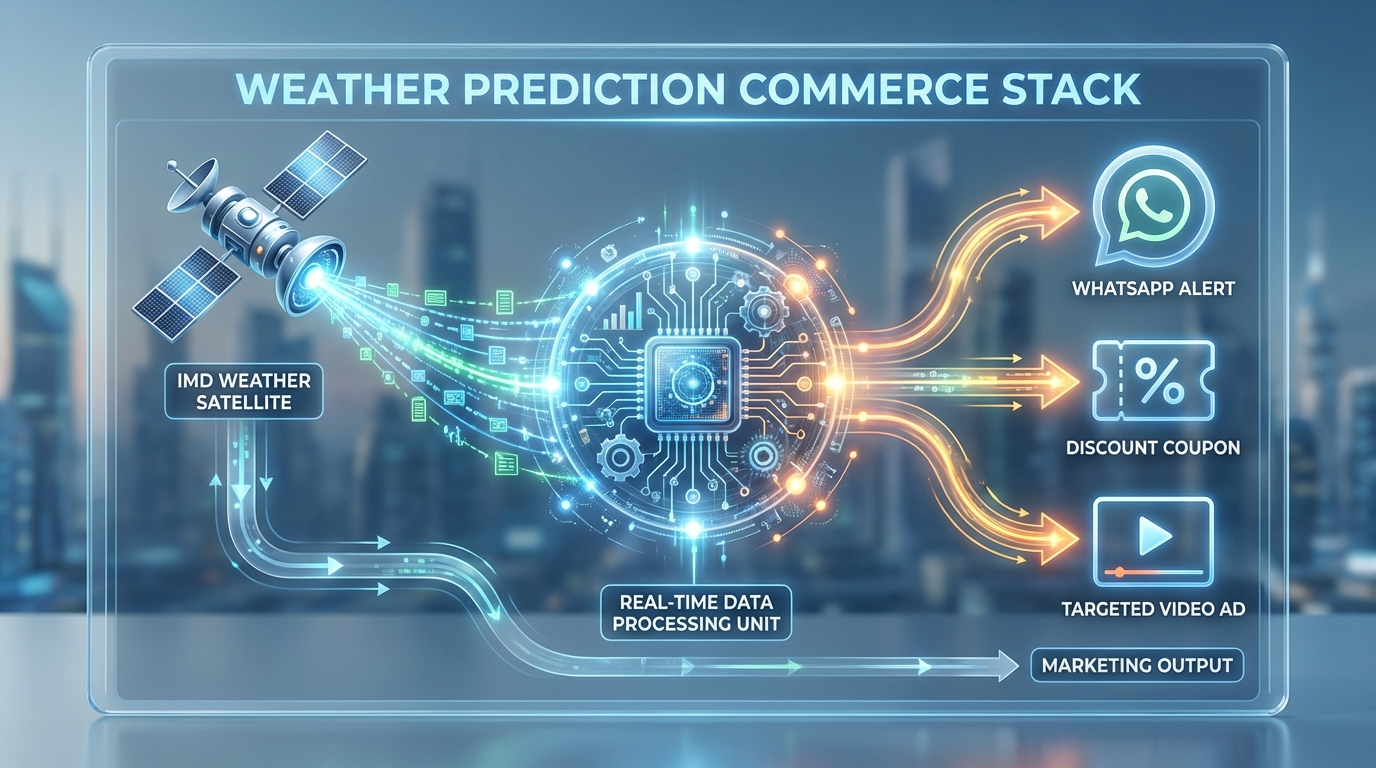
To master weather prediction commerce, an enterprise must move beyond simple thermometers. The 2026 stack requires a sophisticated integration of data inputs, decisioning logic, and multi-channel delivery. The goal is to predict demand surges before they happen, allowing for seasonal inventory optimization and pre-emptive marketing.
The Data Input Layer
The foundation of this stack is high-fidelity meteorological data. Enterprises should integrate:
- IMD Mausam API: For city-level heatwave guidance and extended-range forecasts that allow for 7-to-14-day advance planning.
- MOSDAC-LIVE: Utilizing satellite products to monitor evolving heat patterns and cloud cover, which can influence the effectiveness of air coolers versus air conditioners.
The Decisioning Engine
Once data is ingested, it must be categorized into actionable bands. A standard 2026 framework includes:
- Band A (35–37°C): Priming mode. Focus on "Pre-summer maintenance" and "Early bird EMI offers."
- Band B (38–40°C): Nudge mode. Highlight energy efficiency and 48-hour installation guarantees.
- Band C (41–42°C): Urgency mode. Deploy "Cooling Hour" flash sales and 24-hour installation promises.
- Band D (>42°C/Red Alert): Emergency relief mode. Priority delivery, 0% EMI, and "Instant Cooling" alternatives if AC stock is low.
3. Regional Heat Targeting and Tier-2 Summer Offers
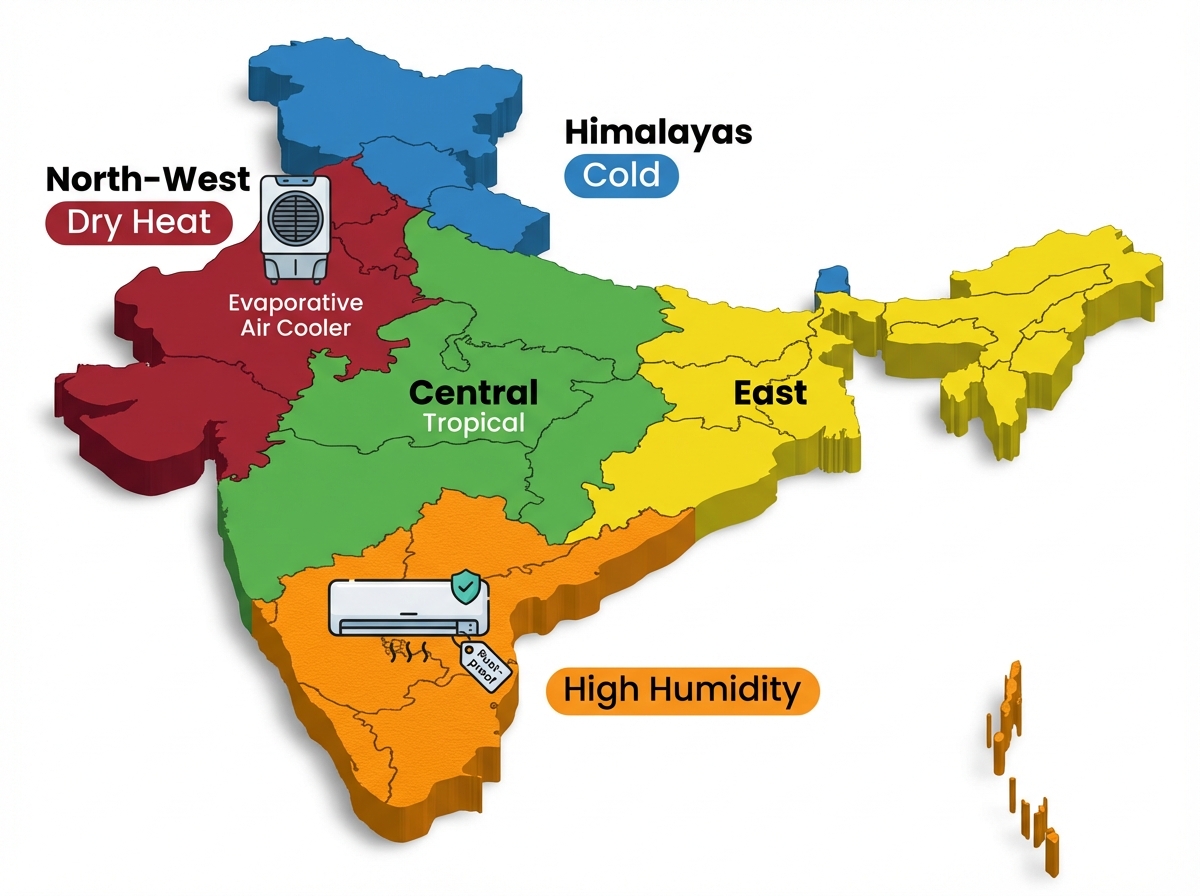
Effective regional heat targeting recognizes that India is a subcontinent of microclimates. The marketing strategy for the dry, searing heat of Rajasthan must differ fundamentally from the humid, oppressive atmosphere of coastal Andhra Pradesh. In 2026, the most successful brands are those that localize not just their language, but their product recommendations based on these environmental factors.
Tier-2 and Tier-3 Strategy
The growth engine for consumer durables has shifted toward Tier-2 and Tier-3 cities. In these markets, the approach must be "language-first." Creative assets should be rendered in regional dialects, and financing offers must be tailored to local economic realities. This includes longer EMI tenures and tie-ups with local NBFCs that have a stronger presence in smaller towns than national banks.
4. Offer Mechanics: Weather-Responsive Offers and EMI Personalization
The heart of conversion lies in the offer. Weather-responsive offers are dynamic incentives that fluctuate based on the severity of the local heat. As the mercury rises, the friction to purchase must decrease. This is achieved through a combination of price incentives, service guarantees, and financial flexibility.
EMI Offer Personalization Summer
In 2026, the "how to pay" is as important as "what to buy." EMI offer personalization summer involves tailoring the financing tenure (3, 6, 12, or 24 months) based on the customer's profile and the urgency of the weather. For instance, during a Band C heatwave (41°C+), an enterprise might offer a "0% Downpayment, 0% Interest" scheme for 12 months to remove all barriers to an immediate AC purchase.
5. Creative That Converts: Summer Appliance Urgency Videos
In a mobile-first market like India, static banners are no longer sufficient. Summer appliance urgency videos are the gold standard for 2026. These are short, shoppable, and hyper-personalized video creatives that dramatize the relief of a cool home while providing a direct path to purchase.
Script Frameworks for 2026
A successful urgency video follows a tight 15-second structure:
- The Hook (0-3s): "Nagpur is at 44°C today. Why are you still sweating?"
- The Value (3-10s): "Get this 5-star Inverter AC. Saves 30% on bills and cools your room in 5 minutes."
- The CTA (10-15s): "Tap now for 0% EMI and installation by tomorrow morning."
Energy-Efficient Appliance Videos
As electricity prices rise alongside temperatures, "bill anxiety" becomes a major barrier. Energy-efficient appliance videos address this by spotlighting BEE star ratings and lifetime savings. By showing the customer exactly how much they will save over three summers, the brand shifts the conversation from "expensive luxury" to "smart investment."
6. Seasonal Inventory Optimization and Pre-Summer Sale Automation
The most sophisticated marketing campaign will fail if the product is out of stock. Seasonal inventory optimization is the "back-end" of heat wave commerce automation. It involves using predictive weather models to rebalance stock across the country. If the IMD predicts an early heatwave in Central India, the supply chain must move units from southern warehouses to northern distribution centers weeks in advance.
7. Enterprise Implementation and AC Cooler Personalization Campaigns
Implementing AC cooler personalization campaigns at an enterprise scale requires a partner that can handle the complexity of real-time data and massive content volume. Solutions like TrueFan AI demonstrate ROI through their ability to render and deliver personalized videos in sub-30 seconds, ensuring the "heat trigger" is still relevant when the user sees the ad.
Conclusion: Winning the Summer of 2026
The brands that dominate the Indian summer of 2026 will be those that treat weather not as a seasonal backdrop, but as a real-time commercial trigger. By integrating IMD data, personalized video creative, and flexible EMI offers, you can transform a period of consumer distress into a season of unprecedented growth.
Ready to automate your summer?
Book an enterprise demo with TrueFan AI to launch your heat wave commerce automation before the first 40°C day hits.
Frequently Asked Questions
What if the weather forecast is wrong?
Use high-frequency Nowcasts from IMD and MOSDAC and gate activations behind verified thresholds. If temperature or heat index does not cross the trigger band, the journey pauses and creative/offers are held back, preventing wasted spend.
How do we handle high humidity in coastal cities?
Switch to a Heat Index trigger. When humidity makes 34°C feel like 40°C, activate campaigns that prioritize ACs with superior dehumidification, anti-corrosion coils, and fast-install SLAs. Messaging should emphasize comfort over raw cooling capacity.
Which KPIs should we track during heat-triggered campaigns?
Track band-wise CTR and CVR, cost-per-acquisition during peak hours, install lead time adherence, stock-to-heat-band availability, and EMI plan uptake. Tie these to city-level heat alerts for true incrementality.
How do we integrate IMD and MOSDAC data into our CDP?
Ingest API feeds into your data lake, normalize by city/geo, and map to user/device locations. Build rule-based segments per temperature band and push to ad platforms, CRM, and onsite personalization in near real time.