DPDP Act marketing compliance India 2026: A consent-first playbook for enterprise AI video personalization
Estimated reading time: ~12 minutes
Key Takeaways
- India’s DPDP enforcement timeline makes consent-first marketing a 2026–2027 imperative, with Consent Managers operational by Nov 2026.
- AI videos must include synthetic media labels, support rapid takedowns, and maintain auditable consent artefacts.
- Purpose limitation and data minimization govern how personal data powers personalization across channels.
- Shift to first/zero‑party data, template-based AI video, and privacy-preserving incrementality measurement.
- Select vendors with ISO 27001 and SOC 2, enforce DPIAs, and run a CMO-led compliance dashboard.
DPDP Act marketing compliance India 2026 is now a board-level priority as India activates consent managers in November 2026 and moves to full enforcement by May 2027. This guide shows CMOs and legal leaders how to deliver data privacy personalized video marketing India with consent-first, purpose-linked AI video at enterprise scale—while preserving campaign performance.
As the digital landscape shifts, the Digital Personal Data Protection (DPDP) Act of 2023 transitions from a legislative framework into a rigorous operational reality. For enterprise marketing teams, this necessitates a fundamental redesign of how customer data is harvested, processed, and deployed for high-engagement formats like AI-generated video.
Essential Definitions for DPDP Compliance
Before navigating the strategic shifts, enterprise leaders must align on the core terminology defined under the Act and subsequent 2025-2026 rules.
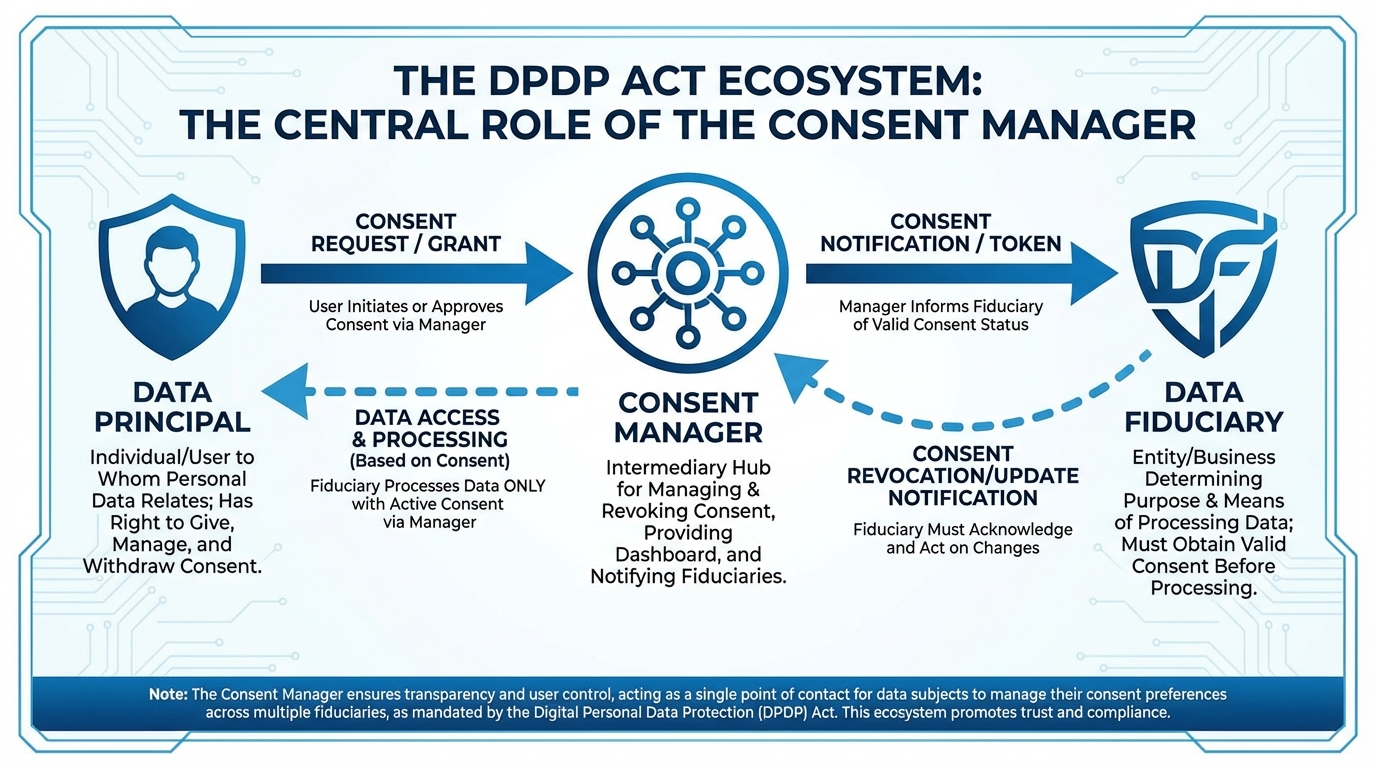
- Data Principal: An identifiable individual to whom personal data relates; they hold absolute rights over consent, data access, and grievance redressal.
- Data Fiduciary: The entity (your brand) that determines the purpose and means of processing personal data, bearing primary accountability for compliance.
- Significant Data Fiduciary (SDF): High-volume data processors designated by the government who must appoint a Data Protection Officer (DPO) and undergo independent audits.
- Consent Manager: A registered, interoperable entity that manages, logs, and facilitates user consents and withdrawals across multiple platforms at scale.
- Purpose Limitation: The legal mandate to process personal data only for specific, clear, and lawful purposes explicitly stated at the time of collection.
- Data Minimization: The requirement to collect and process only the absolute minimum amount of data necessary to achieve the stated marketing objective.
- DPIA (Data Protection Impact Assessment): A mandatory risk assessment for high-risk processing activities, such as large-scale AI video personalization or profiling.
- ISO 27001: The international standard for information security management systems (ISMS), serving as a benchmark for “reasonable security safeguards.”
- SOC 2: An audit framework assessing security, availability, and privacy controls, with Type II reports validating operating effectiveness over time.
Source: EY India: India’s data privacy shift; LawSikho: DPDP Act 2023 Compliance Guide
1. AI video marketing legal framework India 2026
The AI video marketing legal framework India 2026 is a dual-layered structure comprising the DPDP Act and the evolving Information Technology (Intermediary Guidelines and Digital Media Ethics Code) Rules. By late 2025, the Ministry of Electronics and Information Technology (MeitY) introduced specific amendments targeting synthetic media and deepfakes to prevent consumer deception.
For marketers, this means that any AI-generated video content must now carry clear, indelible labels identifying it as synthetic media. This is not merely a best practice but a regulatory requirement to ensure that Data Principals are not misled regarding the authenticity of the media they consume.
The Delhi High Court has already established a precedent for expedited takedowns of non-consensual or deceptive synthetic media. Brands must now maintain a “takedown playbook” that allows them to remove content within hours if a Data Principal withdraws consent or if a platform flags a violation.
Furthermore, the DPDP Act marketing compliance India 2026 standards require that any AI model used for personalization must be vetted for algorithmic bias. If your AI video engine uses personal attributes to generate content, the underlying logic must be documented and ready for inspection by the Data Protection Board (DPB).
Intermediary due diligence has also escalated, meaning social media and messaging platforms (like WhatsApp or Instagram) will demand proof of consent before allowing the distribution of personalized AI videos. Failure to provide this “consent artefact” can lead to immediate account suspension and significant brand damage.
Source: Khurana & Khurana: Deepfake Regulation India 2025; Ikigai Law: TechTicker June 2025
2. DPDP consent-first marketing guide
A robust DPDP consent-first marketing guide begins with the architecture of the notice itself. Under the Act, consent must be free, specific, informed, unconditional, and unambiguous, accompanied by a clear affirmative action.
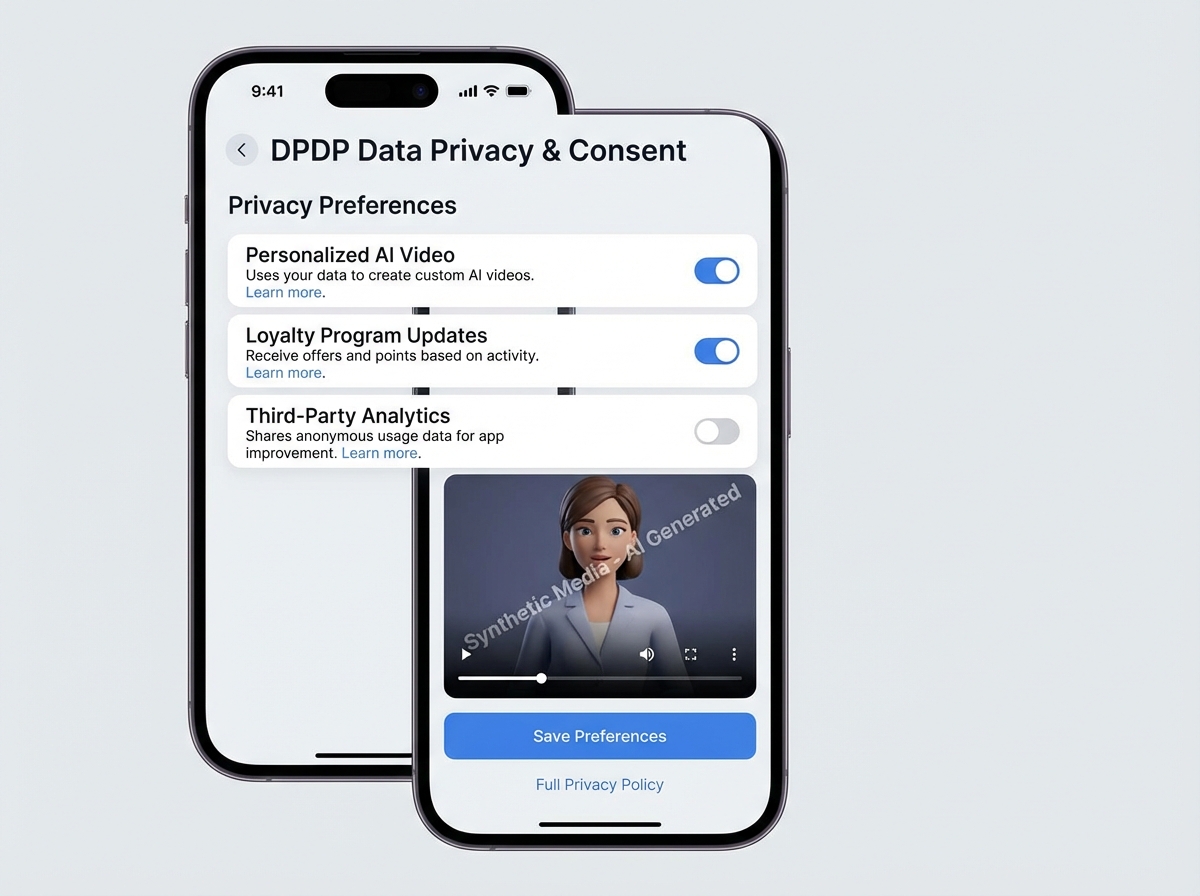
Enterprise marketers must move away from “bundled” consent, where a user agrees to the privacy policy and marketing communications in a single checkbox. Instead, you must offer itemized choices, allowing a user to consent to “Personalized Video Offers” while opting out of “Third-Party Data Sharing.”
The role of the Consent Manager becomes critical by November 2026. These entities act as a single point of truth for the Data Principal, meaning your marketing stack must be able to sync with these managers in real-time to respect withdrawals.
If a customer withdraws consent through a registered Consent Manager at 10:00 AM, your AI video rendering queue must reflect that change by 10:01 AM. This requires a level of technical interoperability that most legacy CRM systems were not designed to handle, necessitating a shift toward consent management video personalization platforms.
Data minimization is the second pillar of this guide. When generating a personalized video, ask: “Do I really need the user's date of birth, or is their first name and last purchased category sufficient?” By reducing the data points used in the AI prompt, you significantly lower your compliance risk and the impact of any potential data breach.
Source: Tsaaro: Why Awareness is No Longer Enough; Consent.in: Understanding Consent Managers
3. DPDP Act personalization impact marketing
The DPDP Act personalization impact marketing strategy focuses on the transition from third-party behavioral tracking to first-party, purpose-linked engagement. The era of “shadow profiling”—where brands buy data from third-party aggregators to target users without their knowledge—is effectively over in India.
Under the new rules, every piece of personal data used for data privacy personalized video marketing India must be linked to a specific “Purpose Tag.” If data was collected for “Order Fulfillment,” it cannot be repurposed for “AI Video Marketing” unless a fresh, specific consent is obtained.
This “Purpose Limitation” creates a significant hurdle for retargeting. For instance, if a user browses a luxury watch on an e-commerce site, the brand cannot send a personalized celebrity video via WhatsApp unless the user explicitly opted into “Personalized Marketing via Messaging Apps” during the browsing session.
The Act also introduces strict rules for processing children's data. Any marketing directed at minors requires verifiable parental consent, and profiling or behavioral tracking of children is strictly prohibited. For brands in the FMCG or EdTech sectors, this means implementing robust age-gating and “Zero-Data” creative strategies for younger audiences.
Furthermore, the Data Protection Board (DPB) expects Data Fiduciaries to maintain detailed logs of all processing activities. This includes the logic used to segment audiences and the specific “Consent Artefact ID” associated with every personalized video rendered and sent.
Source: Bellwether India: DPDP Act for E-commerce 2026; Progressive.in: DPDP Act Compliance Roadmap
4. Privacy-first AI video campaigns India
Designing privacy-first AI video campaigns India requires a shift in creative philosophy. Instead of maximizing data usage, marketers must maximize “Value Exchange.” When a user understands that providing their name and preference will result in a high-value, personalized experience, they are more likely to provide high-quality, consented data.
Platforms like TrueFan AI enable brands to bridge this gap by offering a seamless way to integrate celebrity-led personalization with strict data governance. By using “Zero-Party Data”—data that the customer intentionally and proactively shares with a brand—marketers can create hyper-relevant videos without the legal risks of third-party tracking.
A successful privacy-first campaign uses a “Template-Based” approach to AI video. In this model, the core creative is pre-approved and fixed, with only specific, consented fields (like First Name or City) being dynamically injected by the AI. This limits the “creative surface area” that the AI can manipulate, ensuring brand safety and compliance.
Measurement also evolves in this environment. Traditional attribution models that rely on cross-site tracking are being replaced by privacy-preserving measurement techniques. Marketers are now looking at “Holdout Tests” and “Incrementality Studies” within consented cohorts to prove the ROI of their personalized video efforts.
Operational controls are equally vital. Your campaign workflow must include automated “Suppression Syncs.” If a user opts out of your loyalty program, their data must be immediately purged from the AI video rendering queue to prevent a “Non-Consensual Processing” violation, which carries penalties of up to ₹250 crore.
Source: DPO India: DPDP Act Penalty Trap; Storyboard18: DPDP Enforcement and Penalties
5. CMO data protection compliance India
The CMO data protection compliance India mandate is no longer just about checking boxes; it is about building a “Privacy-by-Design” operating model. This requires a RACI (Responsible, Accountable, Consulted, Informed) matrix that spans Marketing, Legal, Security, and Data Engineering teams.
The CMO must take the lead in appointing “Privacy Champions” within the marketing department. These individuals are responsible for ensuring that every new campaign—especially those involving AI and personalization—undergoes a Data Protection Impact Assessment (DPIA) before launch.
Training is another critical pillar. Agencies and channel partners often handle the “last mile” of campaign execution. If an agency sends a personalized video to a suppressed list, the brand (as the Data Fiduciary) is legally liable. Therefore, CMOs must mandate that all partners undergo DPDP compliance training and sign updated Data Processing Agreements (DPAs).
To maintain DPDP compliant customer engagement, the CMO's office should institute a “Compliance Dashboard.” This dashboard should track metrics such as:
- Consent Opt-in vs. Opt-out rates.
- Average time to fulfill a Data Subject Request (DSR).
- Number of “Purpose-Linked” segments in the CDP.
- Audit status of third-party AI video vendors.
Quarterly executive reviews are essential to ensure the organization is ready for the May 2027 full enforcement deadline. These reviews should focus on the “Evidence Trail”—the collection of consent logs, DPIAs, and audit reports that the Data Protection Board will demand in the event of an inquiry.
Source: Induji Technologies: 2026 DPDP Act Technical Checklist; DPDPA.com: 50-Point Compliance Checklist
6. ISO 27001 marketing platform compliance
When selecting a partner for AI video, ISO 27001 marketing platform compliance and SOC 2 video personalization security are non-negotiable. These certifications provide independent verification that the vendor has implemented “reasonable security safeguards” to protect the personal data you entrust to them.
TrueFan AI's 175+ language support and Personalised Celebrity Videos are delivered through a platform that prioritizes these global security standards. When evaluating any AI video vendor, CMOs should ask for their SOC 2 Type II report, which proves that their security controls have been operating effectively over a period of 6-12 months.
Key questions for your platform due diligence include:
- Data Residency: Does the vendor store and process data within India, as preferred by certain sectoral regulators?
- Encryption: Is data encrypted both in transit and at rest using industry-standard protocols (AES-256)?
- Sub-processor Disclosure: Who are the vendor's cloud and AI providers, and are they also DPDP-compliant?
- Audit Logs: Does the platform provide granular logs of who accessed user data and when?
- AI Provenance: How does the vendor ensure the “likeness” of the talent (celebrities) is used legally and with explicit consent?
Solutions like TrueFan AI demonstrate ROI through high-performance personalization while ensuring that every video rendered is backed by a legal contract with the talent and a consent-first data flow from the brand. This level of governance is what separates enterprise-grade AI from experimental tools that could expose a brand to ₹250 crore penalties.
By integrating your Consent Manager directly with a secure AI video API, you create an automated, compliant loop. The Consent Manager provides the “Green Light,” the AI platform renders the “Purpose-Bound” video, and the delivery channel ensures the “Opt-out” link is always present.
Source: TrueFan AI Enterprise Documentation; EY India: Cybersecurity Insights
7. Enterprise marketing data privacy India 2027
The roadmap to enterprise marketing data privacy India 2027 requires immediate action. By Q4 2026, the “Consent Manager” ecosystem will be fully operational, and the Data Protection Board will begin active monitoring of large-scale data fiduciaries.
The DPDP Marketing Audit Checklist
To ensure your organization is prepared, use this DPDP marketing audit checklist for all AI video and personalization campaigns:
Pre-Flight (Planning Phase):
- Define the “Lawful Basis” (Consent) for every data field used in the AI prompt.
- Draft a “Plain Language” notice that explains why the video is being generated.
- Map the data flow from collection point to the AI video vendor.
- Conduct a DPIA for any campaign targeting more than 1 million users.
In-Flight (Execution Phase):
- Ensure real-time sync between your CRM and the AI rendering queue.
- Apply “Synthetic Media” labels to all AI-generated video content.
- Monitor for “Grievance Redressal” tickets related to privacy or content.
- Enforce frequency caps to prevent “Intrusive Profiling” claims.
Post-Flight (Review Phase):
- Purge personal data from the vendor's system once the campaign window closes.
- Archive consent logs for at least three years (or as prescribed by rules).
- Review the “Accuracy” of the data used—did the AI correctly pronounce the user's name?
- Prepare a “Board-Ready” compliance report summarizing the campaign's privacy metrics.
Frequently Asked Questions
What records will the Data Protection Board expect from marketing?
The DPB will expect comprehensive consent logs with timestamps, copies of the notices provided to users, evidence of suppression for withdrawn consents, and Data Protection Impact Assessments (DPIAs) for high-risk personalization.
Can we personalise without explicit consent?
For identifiable personalization (using a name, location, or purchase history), explicit consent is mandatory. You may only personalize without consent if you are using completely anonymized, aggregate, or contextual signals (e.g., “Users in Mumbai” rather than “Rahul in Bandra”).
How do deepfake/AI labelling rules affect brand videos?
Under the IT Rules trajectory for 2026, all AI-generated or modified media must be clearly labeled. This ensures transparency and helps brands avoid “Deceptive Marketing” charges under the Consumer Protection Act.
Is TrueFan AI compliant with the DPDP Act?
Yes, TrueFan AI is designed with a “Privacy-First” architecture. It supports consent management video personalization, uses purpose-bound APIs, and maintains ISO 27001 and SOC 2 certifications to ensure enterprise-grade security and compliance.
What is the penalty for non-compliance in marketing?
Failure to implement “Reasonable Security Safeguards” to prevent a data breach can result in penalties up to ₹250 crore. Violations of consent or notice requirements can also lead to significant fines and a “Cease and Desist” order on your marketing activities.
Source: Progressive.in: Roadmap; LiveLaw: AI-Generated Content Trends
Disclaimer: This article is informational and does not constitute legal advice. Organisations should consult with qualified legal counsel to interpret DPDP Act obligations for their specific enterprise use cases and technical architectures.
Ready to audit your personalization strategy? Book a compliance-first AI video review with TrueFan AI today and ensure your 2026 campaigns are both high-performance and DPDP-ready.
Recommended Internal Links
- DPDP Compliant Personalization: Privacy-First Marketing
- C2PA watermarking AI video marketing: enterprise guide
- Digital India compliance marketing 2026: privacy-first video
- Data Minimization Personalized Video: DPDP Act Guide 2026
- Enterprise AI Video Platform: Real-Time API for Scale
- Enterprise AI Video Platform: Secure, Scalable Solutions
Frequently Asked Questions
What records will the Data Protection Board expect from marketing?
Expectations include timestamped consent logs, copies of notices served, suppression evidence for withdrawn consents, data flow maps, DPIAs for high-risk processing, and vendor audit reports.
Can we personalise without explicit consent?
Not for identifiable personalization. You need explicit consent for names, locations, or purchase history. Contextual or aggregate messaging may proceed without identifying a person.
How do synthetic media labeling rules impact brand videos?
All AI-generated or modified videos must carry clear, persistent labels. Maintain rapid takedown workflows and provenance documentation to avoid deceptive marketing and platform penalties.
Is TrueFan AI DPDP compliant?
TrueFan AI supports consent-first workflows, provides purpose-bound APIs, and aligns with ISO 27001 and SOC 2 controls for enterprise-grade security and compliance.
What are the penalties for non-compliance?
Penalties can reach ₹250 crore for failing to implement reasonable security safeguards, with additional sanctions for consent, notice, or children’s data violations.