AI video agency adoption India 2026: How scalable personalization is reshaping pitches, production, and the agency P&L
Estimated reading time: ~17 minutes
Key Takeaways
- Agencies are shifting from manpower-scaled production to model-and-data scaled creation, redefining unit economics and speed-to-market.
- Personalization at scale drives pitch win-rates and ROI, with multilingual, data-fed variants delivered in hours—not weeks.
- The 2026 composable martech stack links CDP data to AI video engines and analytics for continuous optimization.
- Compliance and consent are non-negotiable for celebrity avatars, requiring clear rights, disclosure, and secure pipelines.
- Outcome-based and SKU-priced models replace time-and-materials, expanding margins and accelerating growth.
The landscape of the Indian creative industry has reached a definitive turning point, where AI video agency adoption India 2026 is no longer a speculative trend but a core operational mandate. As we navigate this fiscal year, the convergence of enterprise-ready generative models and a robust national policy framework has fundamentally altered how agencies conceive, produce, and distribute content. For Indian creative leaders, the transition from manpower-scaled production to model-scaled creation represents the most significant shift in agency economics since the advent of digital advertising.
Recent data underscores this momentum, with the Cloud9Digital AI Marketing Statistics India 2026 report indicating a 45% increase in ROI for campaigns utilizing AI-driven personalization. This shift is further bolstered by the New Delhi Declaration from the 2026 AI Impact Summit, which established clear ethical guidelines and infrastructure support for synthetic media. Furthermore, the Union Budget 2026 has been widely recognized as an inflection point, providing significant tax incentives for agencies investing in AI-based R&D and talent upskilling.
For agencies like Ogilvy India, Dentsu Creative, and Schbang, the pressure to deliver hyper-personalized, multilingual content at scale has made traditional production workflows obsolete. The need to demonstrate personalization at the pitch stage, coupled with procurement's scrutiny of production costs, has necessitated a move toward automated, data-fed video ecosystems. Platforms like TrueFan AI enable agencies to bridge the gap between creative ideation and high-volume execution, ensuring that "scalable creation" becomes the new industry standard.
The Structural Shift: Indian Advertising Agency AI Transformation
The Indian advertising agency AI transformation is characterized by the move toward "scalable creation"—a model where production throughput is governed by reusable video models and data integrations rather than incremental headcount. In this new paradigm, agencies are evolving into technology-enabled creative partners that manage complex model-and-data stacks. This evolution is visible in the strategic pivots of major network agencies and agile independent shops alike.
Dentsu Creative India has led this charge with the launch of Dentsu AMP, an AI-powered, video-first content engine. This platform serves as a full-stack backbone for the entire creative lifecycle, from automated storyboarding to real-time versioning and optimization. By blending human creativity with an AI-driven editing suite, Dentsu has demonstrated that speed and scale can coexist without compromising brand integrity. This structural change allows for a "record once, generate many" approach that is essential for the fragmented Indian market.
Ogilvy India’s "Shah Rukh Khan-My-Ad" campaign remains the gold standard for consumer acceptance of AI-led personalization. By utilizing AI to generate hyper-personalized advertisements for thousands of local retailers, Ogilvy proved that consented talent and sophisticated compliance discipline could drive massive engagement. This campaign signaled to the industry that agency scalable video creation India was not just possible but highly effective at driving local commerce through celebrity-led trust.
Independent agencies are also rapidly integrating these capabilities. Schbang has successfully embedded AI video creation into its core brand strategies, moving beyond experimental pilots to full-scale campaign deployments. The 2026 guide to AI video generation in India highlights how these agencies are using AI to bypass traditional production bottlenecks, allowing them to compete with global networks on both speed and creative depth. This democratization of high-end production tools is leveling the playing field across the Indian ecosystem.
Sources:
- Cloud9Digital AI Marketing Statistics India 2026
- WEF India AI Impact Summit Recap
- Dentsu India Launches AMP - Exchange4Media
- Ogilvy Shah Rukh Khan-My-Ad Case Study
- Top AI Video Generation Agencies India 2026 Guide
Production Economics: Creative Agency AI Video Production and Automation
The shift in creative agency AI video production has fundamentally redesigned the cost stack of modern advertising. Traditionally, production budgets were dominated by labor-intensive processes, including multi-city shoots, manual editing, and expensive post-production versioning. In 2026, advertising agency production automation India has shifted these costs toward model development, data processing, and compute power, resulting in superior unit economics for both the agency and the client.
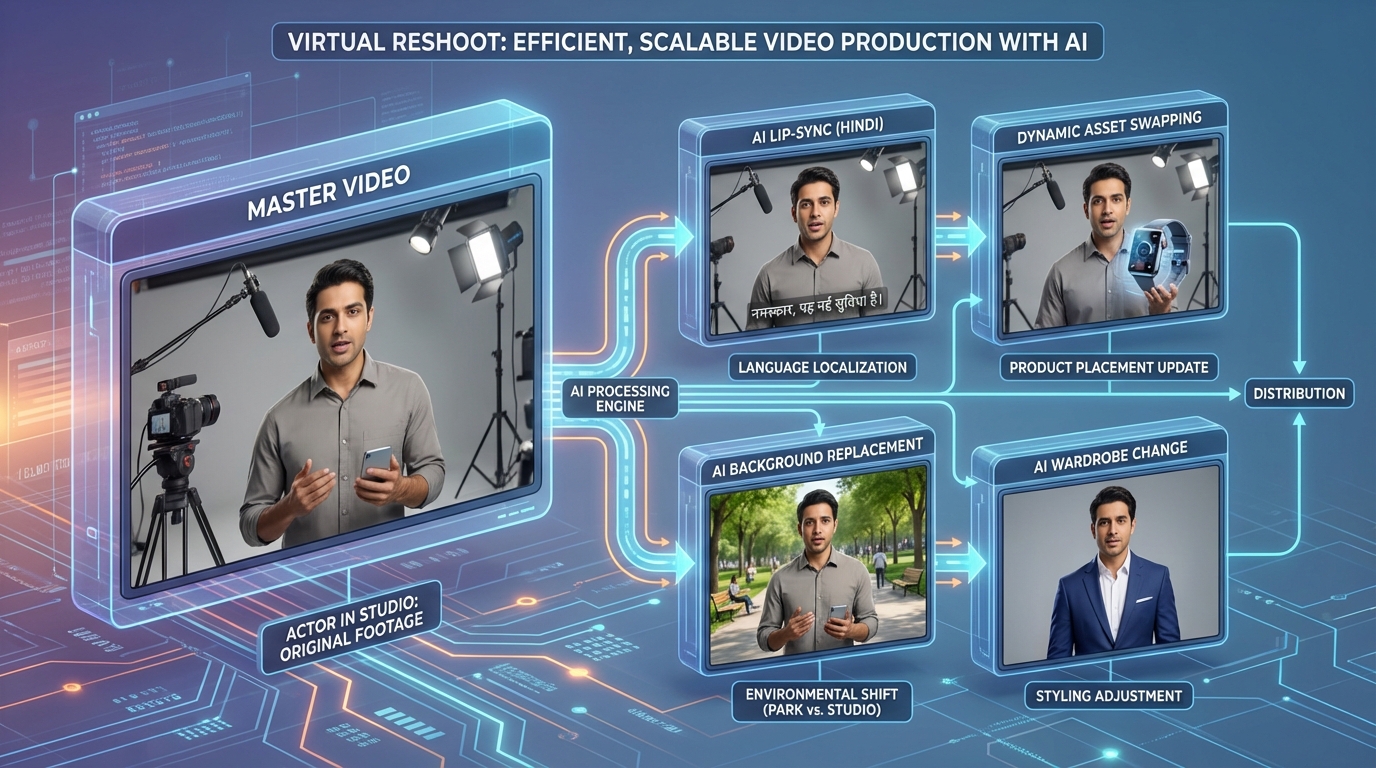
One of the most potent levers in this new economic model is the "virtual reshoot." Agencies can now swap lines, offers, or product placements within a video without the need for a physical set. By maintaining perfect lip-sync and voice fidelity through AI models, agencies can update campaigns in real-time to reflect changing market conditions or inventory levels. This capability significantly reduces the "waste" associated with outdated creative assets and allows for a more agile response to consumer trends.
AI video production cost reduction agencies are achieving these efficiencies through template-driven versioning. Instead of treating every video as a bespoke piece of craft, agencies develop "master models" that can be SKU-ized for different products, cohorts, and regional markets. This approach is particularly effective in India, where a single campaign may require versions in 15+ languages and dozens of cultural nuances. Automated language normalization and HDR upscaling ensure that every variant meets the highest quality standards without manual intervention.
Solutions like TrueFan AI demonstrate ROI through significant reductions in production timelines and the elimination of physical reshoots. For instance, TrueFan’s enterprise capabilities allow for under-30-second personalized renders, which has collectively saved over 3,888 hours of creative time across its client base. This level of efficiency allows agencies to reallocate their human talent toward high-level strategy and ideation, while the "heavy lifting" of versioning and distribution is handled by the AI engine.
Sources:
Pitch Transformation: Using AI Video for Client Pitches Agencies
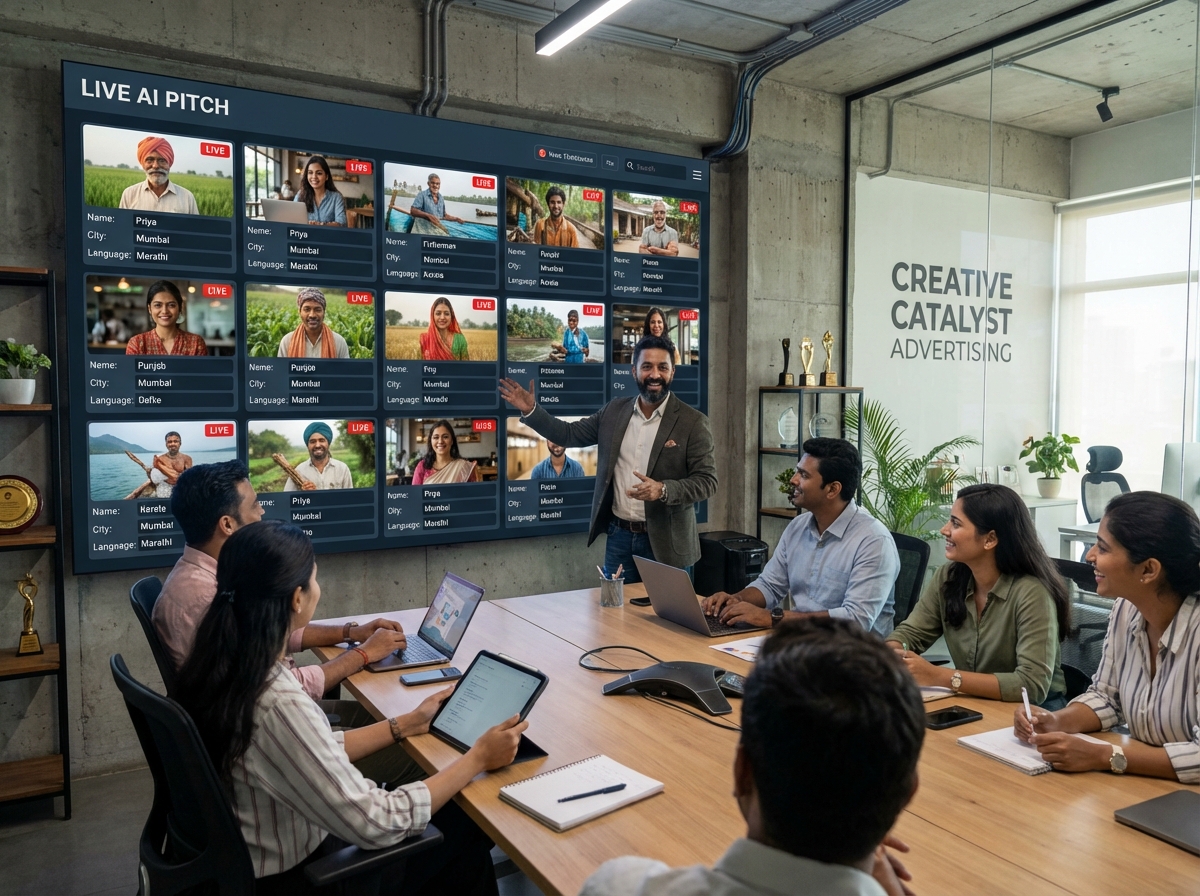
The competitive landscape for new business has been transformed by the use of AI video for client pitches agencies. In 2026, walking into a boardroom with static mood boards or a single "hero" film is no longer sufficient. Leading agencies are now presenting live-personalized, vernacular-ready prototypes that demonstrate exactly how a campaign will scale across India’s diverse demographics. This ability to show, rather than tell, has significantly increased agency pitch win-rate AI video metrics.
The new pitch motion involves generating 10–50 spec variants aligned to multiple audience personas within hours of receiving a brief. By feeding industry-specific data and regional insights into AI video engines, agencies can create narratives that feel deeply relevant to the client’s specific business challenges. For example, a pitch for a national retail chain might include personalized video greetings for store managers in 10 different cities, each in their local dialect, to prove the feasibility of a hyper-local strategy.
The framework for a successful AI-driven pitch focuses on four key pillars: speed, relevance, personalization, and proof. Speed is achieved by reducing the time-to-first-cut from weeks to hours. Relevance is ensured by using data-fed narratives that incorporate the client's product USPs. Personalization is demonstrated through on-the-fly name and city insertions. Finally, proof is provided by showing anonymized CTR and VTR lift ranges from previous AI-powered campaigns, providing the client with a data-backed rationale for the investment.
Furthermore, the "decision latency" of clients is reduced when they can see a finished product during the initial presentation. Post-pitch follow-ups have also evolved; agencies now send shareable, stakeholder-personalized recap videos via WhatsApp (WhatsApp Business Commerce Automation 2026: Growth Playbook). This ensures that the pitch's impact continues to resonate with multi-stakeholder committees long after the meeting has ended. As Google’s India AI Impact Summit partnerships suggest, the ecosystem's seriousness about AI integration means that clients now expect this level of technological sophistication from their agency partners.
Sources:
The Personalization Frontier: Agency AI Celebrity Avatar Campaigns
The most visible frontier of AI video is the rise of agency AI celebrity avatar campaigns. This involves the licensed and consented use of a celebrity’s likeness and voice to generate thousands of hyper-personalized videos. In the Indian context, where celebrity endorsement is a powerful driver of consumer behavior, this technology allows brands to deliver a "one-on-one" experience with a superstar at a population scale. However, this frontier requires a rigorous approach to rights management and compliance.
A robust compliance checklist is essential for any agency embarking on celebrity avatar projects. This includes securing explicit written consent for synthetic media usage, defining clear usage windows, and establishing protocols for data minimization. Disclosure is also paramount; 2026 regulations require clear on-screen badges or watermarks to indicate when media is synthetically generated. Agencies must also conduct cultural and linguistic QA to ensure that vernacular variants maintain the celebrity’s authentic tone and regional nuances.
Personalized video agency partnerships are becoming the preferred route for managing these complexities. Rather than building these capabilities in-house, agencies are partnering with enterprise-grade platforms that offer pre-cleared talent rosters and secure rendering pipelines. These partners provide the necessary security certifications, such as ISO 27001 and SOC 2, which are critical for protecting both the celebrity’s IP and the client’s data. This partnership model allows agencies to focus on creative strategy while the platform handles the technical and legal heavy lifting.
Supari Studios has been a pioneer in this space, experimenting with various AI video formats to create high-velocity, personalized content. Their work demonstrates how indie studios can leverage AI to create "boutique" experiences at scale. By integrating these personalized videos into broader omnichannel strategies—including WhatsApp Business API delivery (WhatsApp Catalog Video Marketing)—agencies can drive significant lifts in conversion rates. The ability to have a celebrity call a consumer by their name and mention their local city is a level of personalization that was previously impossible.
Sources:
The 2026 Stack: Creative Agency Martech Stack and Business Model Disruption
The creative agency martech stack 2026 has evolved into a composable, agentic architecture where data and production are inextricably linked. In this ecosystem, the Customer Data Platform (CDP) or CRM feeds audience-level attributes directly into creative templates. This "data-to-creative" lineage ensures that every video generated is tailored to the specific needs and behaviors of the recipient. This integration is the backbone of modern, high-performance marketing.
A typical 2026 stack includes a Digital Asset Management (DAM) system that enforces rights and usage windows, an AI video engine (like TrueFan) that handles the rendering of variants, and an analytics loop that feeds performance data back into the CDP. This allows for real-time optimization, where the system can automatically iterate on creative elements based on VTR and CTR performance. FCB/SIX has been a global leader in this space, demonstrating how a data-first approach can reinforce creative output and drive measurable business results.
This technological shift is causing a significant agency business model AI disruption India. The traditional "time-and-materials" billing model is being replaced by outcome-based or SKU-based pricing. Agencies are now charging per variant generated or based on the performance lift achieved through personalization. This shift allows agencies to capture more value from their technological investments and move away from the "commodity" trap of manual production.
New revenue streams are also emerging, including AI template licensing and managed AI services. Agencies are now offering "Model Ops" and "Rights Ops" as specialized service lines, helping clients navigate the complexities of synthetic media and vernacular QA. The P&L impact is clear: margin expansion through automation and faster cycle times that increase pitch throughput. As the cost of AI tools continues to decrease—a trend highlighted in the Budget 2026 outlook—agencies that have mastered these stacks will see significant competitive advantages.
Sources:
The Execution Roadmap: Indian Creative Agencies AI Adoption Playbook
For agencies looking to lead in this new era, a structured Indian creative agencies AI adoption playbook is essential. This roadmap transitions the agency from experimental pilots to scaled operations, ensuring that risk is managed while value is maximized. The process begins with a "Crawl" phase, focused on governance and initial pilot projects. During the first 90 days, agencies should establish an AI policy, approve a vetted tool list, and execute a pitch acceleration pilot to test time-to-first-cut improvements.
The "Walk" phase (90–180 days) involves the first full-scale production use case. This typically involves a lifecycle or promotional campaign that integrates CDP attributes and utilizes WhatsApp for distribution (WhatsApp Catalog Video Marketing: Automation Strategies). During this stage, agencies must focus on talent upskilling, creating "producer playbooks" and prompt libraries that standardize the use of AI tools across the organization. Metrics such as VTR lift and cost-per-variant become the primary KPIs for measuring success.
In the "Run" phase (180–365 days), AI video becomes a standardized part of the agency’s offering. Templates are SKU-ized, and the AI engine is fully interlocked with the agency’s DAM and analytics systems. At this stage, the agency can begin co-selling with enterprise AI partners and developing proprietary IP around reusable models. This level of maturity allows the agency to deliver 1,000+ vernacular variants overnight, a feat that would have been impossible just two years ago.
The success of this playbook depends on a commitment to transparency and brand safety. As the New Delhi Declaration emphasizes, the ethical use of AI is not just a regulatory requirement but a cornerstone of consumer trust. Agencies that prioritize disclosure, consent, and cultural sensitivity will be the ones that thrive in the 2026 market. By following this staged approach, Indian agencies can transform their operations and deliver unprecedented value to their clients.
Sources:
Partnering for Scale: The TrueFan AI Enterprise Model
For agencies seeking to implement these strategies at scale, the personalized video agency partnerships offered by TrueFan AI provide a robust, enterprise-grade solution. TrueFan AI is designed to handle the complexities of high-volume, celebrity-led video creation, offering a secure and scalable API-driven platform. This allows agencies to white-label the technology and offer it as a seamless part of their creative services.
TrueFan AI's 175+ language support and Personalised Celebrity Videos allow brands to speak to consumers in their native dialects with localized context. With a roster of over 100 onboarded Indian celebrities, the platform ensures that all likeness and voice usage is fully licensed and consented. The platform’s ability to render variants in under 30 seconds means that agencies can respond to market changes with unprecedented speed, delivering thousands of personalized messages across WhatsApp, email, and microsites (Conversational Cricket Commerce India: WhatsApp Playbook; Guide to conversational cricket shopping India on WhatsApp).
The economics of the TrueFan AI model are equally compelling. By documented efficiency gains—such as the 3,888 hours of creative time saved for enterprise clients—the platform allows agencies to improve their margins while delivering superior results. TrueFan’s enterprise readiness, including ISO 27001 and SOC 2 certifications, provides the peace of mind that global brands and procurement departments require. This partnership model is the most efficient way for agencies to unlock the full potential of AI video without the overhead of building a proprietary tech stack.
Conclusion: The New Standard of Creative Excellence
By 2026, the definition of a "top-tier" agency in India has been rewritten. The transition from manpower-scaled production to model-and-data-scaled creation is complete. Agencies that have embraced AI video agency adoption India 2026 are no longer just making ads; they are building dynamic, personalized communication ecosystems that live and breathe with the consumer.
The vision of a modern Indian agency is one where a single creative spark can be transformed into 1,000+ vernacular variants overnight, each QA’d and shipped with analytics-driven precision. This is the era of "Scalable Creation," where the boutique craft of the past meets the population-scale personalization of the future. For agency leaders, the path forward is clear: integrate, automate, and partner to lead the next decade of Indian advertising.
Ready to transform your agency's production and pitch win-rates?
Book an Agency AI Video Blueprint session and request our "AI Celebrity Avatar Compliance Checklist" and "AI Pitch Win-Rate Calculator" today.
Recommended Internal Links
Frequently Asked Questions
How does AI video agency adoption India 2026 impact traditional production jobs?
The shift is not about replacing talent but evolving roles. Producers are becoming "AI Orchestrators," and editors are focusing on high-level creative direction while AI handles the repetitive versioning tasks. The demand for creative strategy and prompt engineering is higher than ever.
What are the legal requirements for using celebrity avatars in India?
Agencies must have explicit, written consent for synthetic media use, clearly defined usage windows, and must adhere to the disclosure guidelines set by the New Delhi Declaration and ASCI.
Can AI video production really reduce costs for small-scale campaigns?
Yes. While the initial setup of a model has a cost, the per-variant cost of AI video is significantly lower than traditional production. This makes hyper-personalization viable even for niche cohorts or local market tests.
How does TrueFan AI ensure brand safety and content moderation?
TrueFan AI employs rigorous moderation filters and audit logs to ensure that all generated content aligns with brand guidelines. The platform’s enterprise-grade security ensures that only approved assets and scripts are used in the generation process.
What is the typical ROI lift for personalized AI video campaigns?
Based on 2026 industry benchmarks from Cloud9Digital, agencies are seeing an average ROI lift of 45%, driven by higher VTRs and significantly lower CPAs compared to generic video assets.