Corporate Training Video AI: The Enterprise Playbook for Onboarding, Compliance, and Continuous Skills
Estimated reading time: ~14 minutes
Key Takeaways
- Corporate training video AI enables personalization at scale across onboarding, compliance, and skills—turning static libraries into dynamic learning assets.
- High-impact enterprise use cases include automated role-based onboarding, audit-ready compliance refreshes, and adaptive skill paths.
- Engagement-first formats like Virtual Instructor AI and microlearning improve retention while multilingual content ensures inclusion.
- Advanced training ROI measurement links engagement and proficiency to business KPIs, enabling data-driven L&D investments.
- Select an enterprise-grade platform with robust security, integrations, governance, and execute a 90-day pilot to scale confidently.
The landscape of human capital management is undergoing a seismic shift as we move into 2026. For CHROs and L&D leaders at global enterprises and Indian GCCs, the mandate has evolved from simple content delivery to driving “speed-to-productivity” in an era where AI fluency is the new baseline. Implementing corporate training video AI is no longer a luxury for innovative firms; it is a strategic necessity to manage the 30–40% pay premiums now commanded by AI-skilled talent in the Indian market.
By leveraging an AI-powered L&D platform, organizations can finally solve the “personalization at scale” paradox. Traditional video production is too slow for the rapid policy changes of 2026, and generic modules fail to engage a workforce that expects hyper-relevant, role-specific content. This playbook explores how corporate training video AI enables automated onboarding, audit-ready compliance, and measurable skill development that aligns directly with business outcomes.
Sources:
- People Matters: The Future of Learning and Development 2026 and Beyond
- EY/People Matters: India’s 2026 Salary Increases to Reward Skills Over Seniority
What is Corporate Training Video AI? How it Personalizes, Automates, and Measures Learning
To lead a modern L&D function, one must first define the technology. Corporate training video AI is the application of generative AI, orchestration agents, and analytics to automate the creation, personalization, localization, delivery, and measurement of training videos across onboarding, compliance, and ongoing skill development. It transforms static training libraries into dynamic, living assets that evolve with the business.
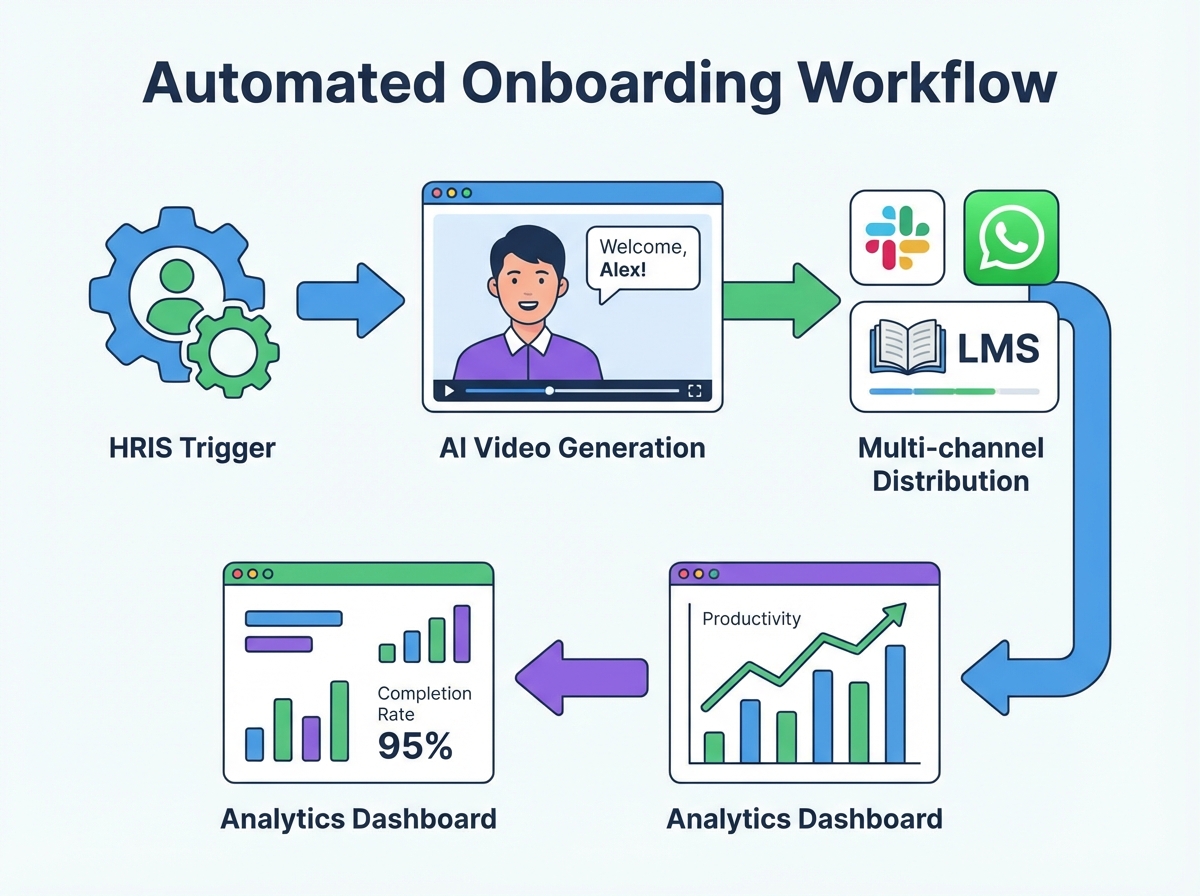
The architecture of a high-performing AI-powered L&D platform consists of five core pillars:
- Generation: This involves the automated creation of scripts, visuals, and voiceovers from existing documentation. In 2026, enterprise agents can ingest a 50-page SOP or a new regulatory filing and produce a high-fidelity training video in minutes, significantly reducing the burden on Subject Matter Experts (SMEs).
- Personalization: This moves beyond “Hello [Name].” It involves creating personalized learning videos where the content itself changes based on the learner’s role, seniority, and even their current tech stack. Platforms like TrueFan AI enable these dynamic variables to be injected into video templates at scale.
- Localization: For global GCCs, multilingual training content is essential. AI now allows for instant video localization into 175+ languages while preserving the original speaker’s tone and brand-specific terminology.
- Delivery: Integration is the bridge to adoption. The AI must connect seamlessly with your LMS, LXP, or HRIS to trigger videos based on specific employee lifecycle events, such as a promotion or a relocation.
- Measurement: Advanced training ROI measurement now tracks more than just “completion rates.” It monitors view-level engagement, proficiency gains through integrated assessments, and the eventual impact on on-the-job KPIs.
In the Indian context, the move toward “Agentic AI” is already operationalizing these workflows. Large enterprises are no longer just experimenting; they are building learning ecosystems where 90% of the workforce is AI-certified, as seen in recent industry benchmarks.
Sources:
- Analytics India Magazine: How to Successfully Deploy AI Assistants in Enterprises
- People Matters: How Hexaware Built a Learning Ecosystem Where 90% of Employees are AI-Certified
Enterprise Use Cases That Move the Needle
The true value of corporate training video AI is found in its application to high-stakes business processes. When L&D leaders move away from generic “off-the-shelf” content and toward automated, role-specific assets, the impact on the bottom line becomes undeniable.
Automated Employee Onboarding Videos (By Role, Function, and Geo)
Automated employee onboarding videos are AI-generated, role-specific welcome and enablement videos that stitch together IT setup steps, policy primers, tool walkthroughs, and manager introductions. These are triggered automatically by HRIS events, ensuring that a developer in Bangalore and a sales lead in London receive equally high-quality, relevant introductions to the firm.
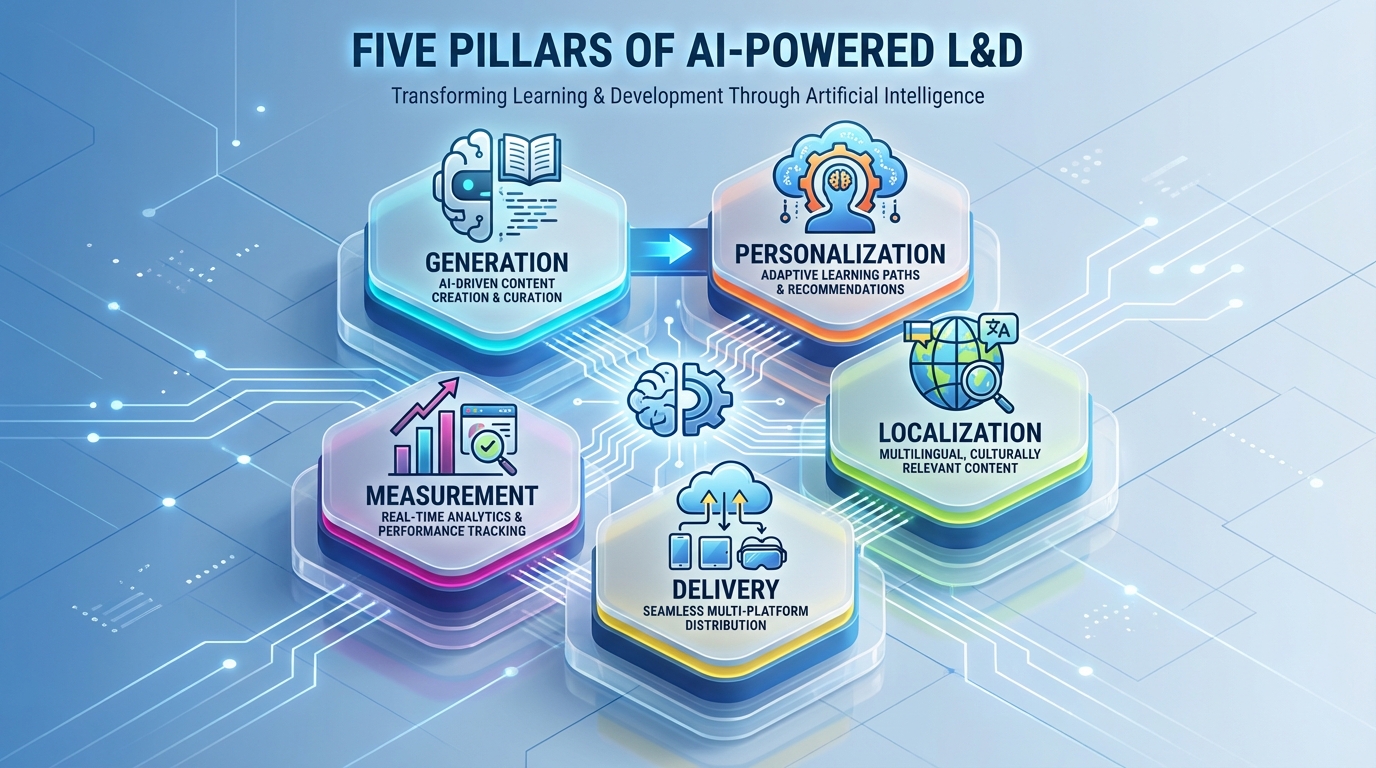
The workflow is highly efficient:
- Trigger: An HRIS event (e.g., “New Hire Joined”) initiates the process.
- Generation: A video template is populated with dynamic fields such as the hire's name, their specific manager’s video greeting, and the software tools they will use.
- Distribution: The personalized learning videos are delivered via the LMS or enterprise messaging apps like WhatsApp or Slack.
- Analytics: L&D dashboards track “time-to-productivity” metrics, such as how quickly the new hire resolves their first ticket or completes their first sales call.
Compliance Training Automation (Auto-Updates and Audit Trails)
In regulated sectors like BFSI, healthcare, and pharma, compliance is a moving target. Compliance training automation uses AI to convert policy updates into refreshed training videos with localized narration and automated assignment. This eliminates the 6-month lag time usually associated with re-filming compliance modules.
When a regulation changes, the AI performs a “script diff” to identify exactly what needs to be updated. It then performs a virtual reshoot of only those specific lines, updates the multilingual training content, and pushes the new version to the LMS. This ensures that the organization remains audit-ready at all times, with a clear digital trail of who has viewed the updated material.
Skill Development Personalization (Adaptive Paths and Proficiency)
Skill development personalization tailors micro-curricula to each employee’s proficiency levels and performance data. In 2026, as Indian GCCs transition into global product ownership roles, the need for specialized skills is paramount. AI-driven platforms analyze an employee’s current output and suggest specific video modules to bridge capability gaps. This “skills-first” approach is critical when AI and cloud skills command such high market premiums.
Sources:
Formats That Drive Engagement and Retention
The medium is as important as the message. To combat “Zoom fatigue” and digital distraction, corporate training video AI utilizes specific formats designed for the modern attention span and cognitive load.
Virtual Instructor AI for Interactive Coaching
Virtual instructor AI pairs video-led lessons with AI assistants that can answer questions in real-time. This format augments traditional Instructor-Led Training (vILT) by providing a persistent, 24/7 expert that learners can interact with. If a learner is confused by a concept in the video, they can ask the embedded assistant for a deeper explanation or a different example, creating a branching, interactive experience.
Microlearning Video Automation for Ongoing Reinforcement
The “forgetting curve” is the enemy of L&D. Microlearning video automation creates 1–3 minute concept bursts sequenced through spacing and retrieval practice. Instead of one long annual training session, employees receive short, high-impact videos every few weeks. These snippets are batch-generated from existing SOPs and playbooks, ensuring that reinforcement is both continuous and effortless for the content creators.
Employee Engagement Videos and Multilingual Content
Culture is the glue of the enterprise. Employee engagement videos allow leadership to deliver personalized messages regarding change management or cultural shifts. For a pan-India workforce, multilingual training content is the only way to ensure true inclusion. By localizing videos into Hindi, Tamil, Telugu, and other regional languages with perfect lip-sync and voice retention, organizations demonstrate a commitment to their people that transcends language barriers. TrueFan AI's 175+ language support and Personalised Celebrity Videos provide a unique edge here, allowing for high-engagement content that resonates on a personal level.
Sources:
Performance Coaching AI and Training ROI Measurement
The final frontier of L&D is moving from “learning” to “performance.” This requires a closed-loop system where training is directly tied to job execution.
Performance Coaching AI: Practice and Remediation
Performance coaching AI simulates real-world scenarios—such as a difficult customer service interaction or a safety hazard check—and captures the learner's response via video or audio. The AI then grades the response against a predefined rubric and provides instant feedback. If the learner fails to meet the standard, the system automatically serves a targeted remediation video. This adaptive coaching model ensures that learning velocity is maximized and that employees are truly “job-ready.”
Training ROI Measurement: From Views to Value
To justify L&D budgets in 2026, CHROs must provide rigorous training ROI measurement. This involves linking content analytics to business outcomes.
- Content Metrics: Watch-through rates, drop-off points, and CTA clicks.
- Proficiency Metrics: Assessment scores and simulation performance.
- Business Metrics: Reduction in safety incidents, improvement in first-call resolution, or faster time-to-market for new products.
Solutions like TrueFan AI demonstrate ROI through detailed variant-level analytics, allowing L&D teams to see which versions of a training video are most effective across different regions or departments.
Sources:
- Analytics India Magazine: SAS Academy for Data & AI Excellence is Training India’s Workforce
- People Matters: Curiosity and Adaptability Become Core Predictors of Success in 2026
What CHROs Should Require From an AI-Powered L&D Platform
Selecting the right AI-powered L&D platform is a high-stakes decision involving security, governance, and technical integration. An enterprise-grade solution must meet the following criteria:
Security, Privacy, and Compliance
In the era of deepfakes and data breaches, security is non-negotiable. Any platform must be ISO 27001 and SOC 2 certified. Furthermore, it must operate on a “consent-first” basis, ensuring that any likeness or voice used in the videos is fully authorized. Built-in moderation tools are also essential to prevent the generation of unapproved or biased content.
Integrations and Governance
The platform must fit into your existing stack. This means robust APIs for LMS/LXP integration (supporting SCORM/xAPI) and HRIS triggers. Governance features should include:
- Role-Based Access Control (RBAC): Ensuring only authorized personnel can create or approve content.
- Brand Control: Locked templates and brand kits to ensure every video—regardless of who creates it—remains on-brand.
- Accessibility: Automated captions, transcripts, and keyboard-friendly navigation to meet global accessibility standards.
Risk Management and Ethical Guardrails
Ethical AI is a business imperative. This includes cultural sensitivity in localizations and the explainability of any AI-driven coaching feedback. For sensitive sectors like BFSI, a rigorous review workflow must be in place before any AI-generated content is rolled out to the mass workforce.
Implementation Blueprint: Your 90-Day Pilot
Transitioning to corporate training video AI should be a structured process. We recommend a 90-day pilot focused on high-impact “quick wins.”
Phase 1: Content Audit and Backlog (Days 1–30)
Identify your top 20 SOPs, policies, or enablement assets. Focus on high-volume roles (e.g., front-line sales or customer support) and compliance hotspots. Create a backlog of microlearning video automation items that can be quickly generated from these assets.
Phase 2: Pilot Cohorts and Success Metrics (Days 31–60)
Select 2–3 roles across 2 different regions. Deploy personalized learning videos and track specific KPIs:
- Did the automated employee onboarding videos reduce time-to-productivity?
- Did the compliance training automation improve pass rates on the first attempt?
- Is there a measurable uplift in skills aligned with the 2026 pay premiums?
Phase 3: Scale and Continuous Optimization (Days 61–90)
Expand the pilot to more languages and departments. Institute a “governance ritual” where you review AI-generated outputs for cultural sensitivity and accuracy. Use the training ROI measurement data to retire low-performing video variants and double down on what works.
Conclusion
The future of enterprise learning is personalized, automated, and data-driven. By adopting corporate training video AI, CHROs can move beyond the limitations of traditional L&D and build a workforce that is agile, compliant, and ready for the challenges of 2026. Whether it is through automated employee onboarding videos that welcome new hires in their native language or performance coaching AI that provides real-time feedback, the technology is here to transform human potential into business performance.
Ready to scale your L&D impact?
- Request a TrueFan AI enterprise demo tailored to your onboarding and compliance needs
- Download the Enterprise Buyer’s Checklist for an AI-Powered L&D Platform
Frequently Asked Questions
How does corporate training video AI handle complex technical topics?
The AI uses SME-provided documentation (SOPs, whitepapers, code repositories) as the “ground truth.” By ingesting these materials, the AI-powered L&D platform can generate scripts that are technically accurate, which are then reviewed by a human expert before final rendering.
Can we use our own executives' voices and likenesses for these videos?
Yes, provided there is a “consent-first” framework in place. Platforms like TrueFan AI allow for the secure cloning of executive voices and likenesses to create highly engaging, personalized leadership messages at scale.
How does this integrate with our existing LMS like Cornerstone or SAP SuccessFactors?
Most enterprise AI video platforms use standard APIs or webhooks to push content directly into the LMS. They also support SCORM or xAPI formats to ensure that tracking and completion data are centralized in your primary system of record.
Is the localization just a “Google Translate” voiceover?
No. Modern multilingual training content utilizes advanced neural voice synthesis that retains the original speaker’s tone, emotion, and cadence. It also includes perfect lip-syncing, so the video looks natural in every language, from Hindi to Japanese.
What is the typical ROI of switching to AI-driven video training?
Enterprises typically see a 60–80% reduction in video production costs and a 40–50% reduction in “seat time” for employees, as the content is more concise and relevant. Additionally, the speed of deployment for compliance updates significantly reduces regulatory risk.



