Predictive Wellness Marketing B2B 2026: AI Health Risk Predictions to Personalize Preventive Care Videos, Gamified Challenges, and 30% Cost Reductions
Estimated reading time: ~14 minutes
Key Takeaways
- By 2026, Indian enterprises will leverage AI health risk predictions to automate preventive care journeys and reduce costs by up to 30%.
- Personalized video campaigns (mental health, yoga, insurance literacy) increase engagement and measurable wellness ROI.
- A robust pipeline spanning data compliance (DPDP), feature engineering, and trigger logic ensures timely, relevant interventions.
- A preventive care personalization platform enables multi-channel delivery (email, WhatsApp, HR apps) and closed-loop outcome tracking.
- 90-day rollouts with burnout prevention automation and ISO/SOC2-aligned governance drive adoption and trust.
Predictive wellness marketing B2B 2026 represents a fundamental shift in how Indian enterprises manage human capital, moving from reactive insurance to proactive health orchestration. By 2026, the integration of employee-level predictive signals—ranging from claims trends and biometric data to real-time wearable summaries—will allow HR leaders to auto-orchestrate preventive care personalization platform workflows. This evolution ensures that every employee receives the right intervention at the precise moment of need, significantly reducing long-term healthcare liabilities and absenteeism.
The promise of this new era is an end-to-end implementation playbook where raw data is transformed through AI health risk assessment automation into actionable health score personalization. These scores trigger automated video campaigns, including mental health support video campaigns and corporate meditation yoga videos, designed to drive engagement. By grounding these strategies in Indian benchmarks, organizations can achieve up to a 30% reduction in healthcare costs while simultaneously boosting workplace productivity.
1. The 2026 Inflection Point for Preventive Healthcare B2B Marketing in India
The landscape of preventive healthcare B2B marketing in India has reached a critical inflection point as we head into 2026. CHROs and CFOs are no longer satisfied with “check-the-box” wellness programs; they are demanding measurable ROI frameworks that link well-being directly to business strategy. Recent data suggests that approximately 40% of Indian workers struggle with well-being, making proactive care a financial necessity rather than a perk.
Market signals indicate that 30–40% of Indian employees now expect sophisticated wellness facilities and digital health experiences as part of their standard employment package. This readiness for proactive programs is driving the adoption of predictive wellness marketing B2B 2026 strategies that utilize hyper-personalized models. These models serve as powerful ROI levers, moving beyond basic health insurance to comprehensive, video-based personalization flows that resonate with a diverse workforce.
Organizations are increasingly adopting frameworks that measure wellness program ROI through participation rates, productivity metrics, and claims trend analysis. By treating well-being as a core business strategy, Indian firms are finding that flexible, proactive care models are the only way to contain rising insurance premiums. This shift necessitates a move toward workplace wellness ROI videos that can transparently communicate these gains to stakeholders.
Sources:
- People Matters: Measuring ROI of employee wellness programs in India
- People Matters: The ROI of Care — proactive well-being as a business strategy
- YourStory: Future of urban coworking and wellness expectations
2. Engineering the AI Health Risk Assessment Automation Pipeline
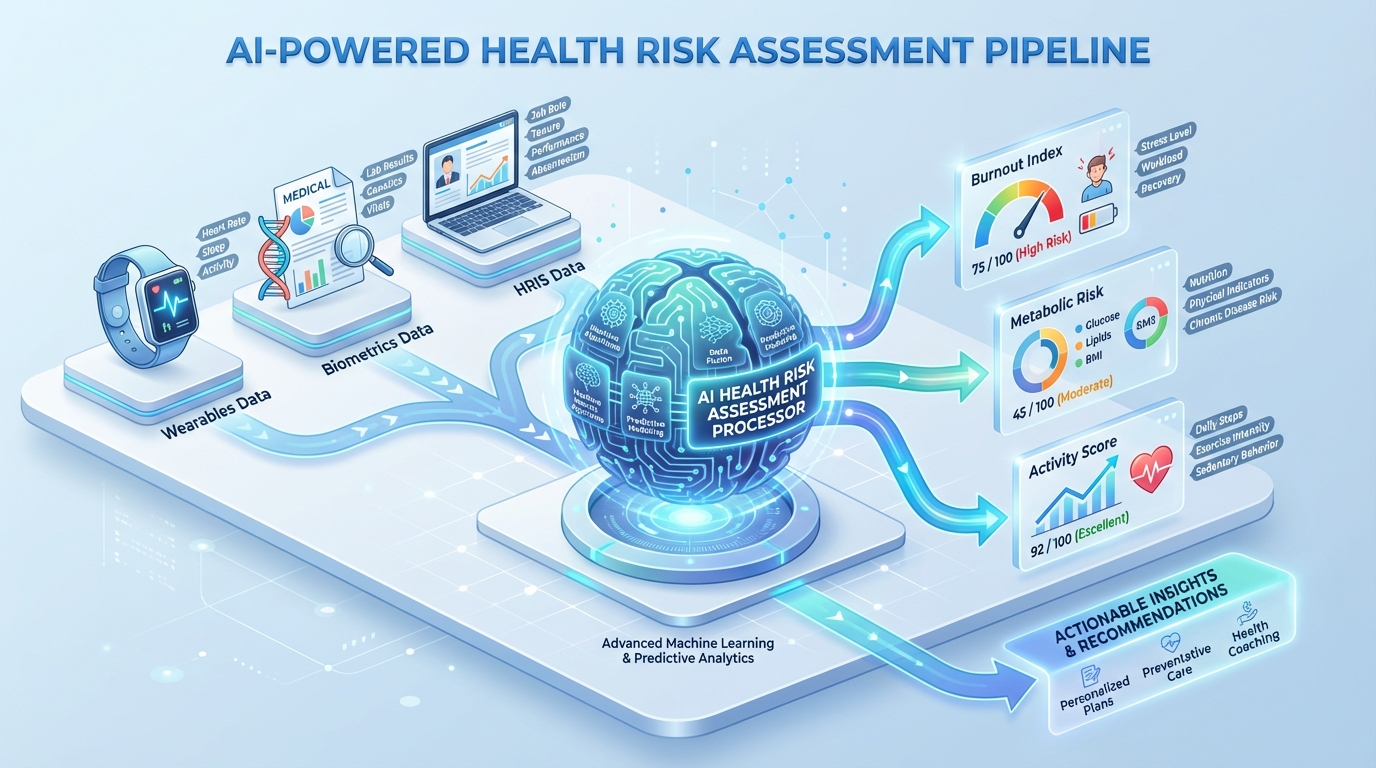
At the heart of a successful 2026 strategy lies AI health risk assessment automation, a sophisticated pipeline that ingests multi-source data to generate predictive insights. This system integrates HRIS demographics, HRA responses, biometric lab results, and even sentiment analysis from consented digital check-ins. By tokenizing and minimizing data, enterprises can maintain strict compliance with India’s DPDP Act while building a comprehensive view of population health.
The technical core involves feature engineering where time-window aggregations, such as rolling 90-day sleep or activity trends, are used to calculate health score personalization vectors. These vectors might include a cardiometabolic risk index (0–100), an MSK (musculoskeletal) risk score, or a burnout index. Classification models then tier employees into low, medium, or high-risk categories, while uplift modeling determines the likelihood of an individual engaging with specific interventions.
The triggering logic is the “brain” of the operation. For instance, if an employee’s burnout index exceeds a specific threshold and their sleep scores have trended downward for 14 consecutive days, the system automatically triggers stress prediction intervention videos. Similarly, if cardiometabolic risk is rising, the platform initiates corporate employee health videos focused on screenings and lifestyle adjustments. This level of automation ensures that preventive care is never manual or delayed.
Governance is equally critical, requiring secure connectors to TPA/insurer extracts and EAP dashboards. Every step must be governed by consent capture, opt-out mechanisms, and audit logs aligned with ISO 27001 and SOC 2 standards. This secure infrastructure allows for the seamless delivery of health insurance optimization videos that help employees navigate their benefits more effectively, reducing out-of-pocket costs and claims leakage.
Sources:
- People Matters: ROI of a healthy organisation through hyper-personalisation
- People Matters: Wellness-driven productivity strategies in India
3. Architecting a Preventive Care Personalization Platform
A preventive care personalization platform serves as the orchestration layer that bridges the gap between raw risk scores and multi-channel employee journeys. This architecture includes a profile store that maintains per-employee risk vectors and content preferences. A journey engine then uses rules and machine learning to select the most appropriate content type, such as corporate meditation yoga videos for stress or fitness plans for metabolic health.
The content graph is a modular system where video scenes are dynamically swapped based on health score personalization. For example, a video intro for an employee with high MSK risk might focus on ergonomic relief, while the same video for a low-risk employee might focus on performance optimization. This modularity allows for the mass production of unique video variants that feel deeply personal to the recipient.
Delivery is executed across multiple touchpoints, including WhatsApp (WhatsApp catalog video marketing guide), email, HR app push notifications, and even office kiosks. The platform doesn't just send content; it measures closed-loop outcomes by tracking event data like video completion and subsequent actions, such as booking an EAP session or completing a screening. These metrics are then aggregated to generate workplace wellness ROI videos for executive review.
By 2026, these platforms will be essential for managing the complexity of large-scale corporate wellness. They allow for the automation of wellness challenge gamification, where participation is driven by personalized nudges and real-time leaderboard updates. This holistic approach ensures that every employee feels supported, leading to higher engagement and a more resilient workforce.
4. Campaign Playbooks for Corporate Employee Health Videos
Effective predictive wellness marketing B2B 2026 relies on specific, trigger-based campaign playbooks. These playbooks define the goals, triggers, scripts, and metrics for various wellness interventions. Platforms like TrueFan AI enable the batch generation of these personalized videos at scale, ensuring that every employee receives a message that resonates with their specific health profile and language preference.
Mental Health Support Video Campaigns
The primary goal of mental health support video campaigns (employee wellness video campaigns (Q4 2025)) is to increase EAP utilization and encourage early counseling. Triggers include elevated burnout indices, low mood check-ins, or significant sleep deficits. A typical script might say: “Hi [Name], we’ve noticed things have been intense lately. Remember, confidential support is available 24/7. Here is how you can start a session in under 60 seconds.” Metrics for success include EAP bookings, session attendance, and a measurable reduction in absenteeism.
Stress Prediction Intervention Videos
Stress prediction intervention videos (predictive wellness marketing 2026 guide) are designed to interrupt stress escalation before it leads to clinical burnout. These are triggered by sudden spikes in burnout indices or meeting overload signals. Content variants often include box-breathing demonstrations or micro-break protocols. Success is measured by the immediate start of micro-practices and subsequent improvements in next-day sentinel measures like heart rate variability (HRV) or sleep quality.
Corporate Meditation Yoga Videos
To reduce stress and improve focus, corporate meditation yoga videos (employee wellness video campaigns (Q4 2025)) offer culturally resonant practices tailored to the Indian workforce. Triggers include self-reported anxiety or high stress levels in employees who may not yet be ready for formal counseling. Personalization factors include language, time of day, and difficulty level. TrueFan AI's 175+ language support and Personalised Celebrity Videos can be used here to deliver these routines through familiar, motivating voices, driving higher completion rates and 7-day streak challenges.
Wellness Challenge Gamification
Wellness challenge gamification (employee wellness video campaigns (Q4 2025)) drives participation through squads, points, and rewards. These campaigns are triggered by low activity levels or as part of a broader company-wide health initiative. The focus is on habit loops—cue, routine, reward. Metrics include participation rates and cohort engagement lifts. Automated kickoff videos and weekly leaderboard highlights keep the momentum high, turning individual health goals into a collective team effort.
Corporate Fitness Program Automation
Corporate fitness program automation targets metabolic markers and MSK risk reduction. When an employee’s step count drops or their cardiometabolic risk rises, the system enrolls them in a 4-week progressive plan. The videos provide personalized warm-up and cool-down sets. Success is tracked through step deltas and a reduction in MSK-related leave, ensuring the program delivers tangible physical health improvements.
Employee Productivity Campaigns
Employee productivity campaigns focus on energy management and sleep hygiene to reduce presenteeism. Triggers include late-night work patterns or calendar overload. Content focuses on deep-work sprints and “nap science.” By adopting these rituals, employees report higher focus and output. Metrics include self-reported productivity gains and a reduction in unnecessary meeting hours across the organization.
Health Insurance Optimization Videos
Health insurance optimization videos (January 2026 insurance renewal automation strategies) aim to improve benefit literacy and steer employees toward in-network, cashless care. These are triggered when employees visit the benefits portal or after a claim is filed. The content explains how to find providers and use preventive entitlements. This reduces out-of-pocket costs for employees and lowers the average claim cost for the employer, directly impacting the bottom line.
Sources:
- YourStory: Hyderabad startup metabolic health innovation
- People Matters: Wellness-driven productivity strategies
5. Driving ROI with Workplace Wellness ROI Videos
The ultimate validation of predictive wellness marketing B2B 2026 is the ability to demonstrate a clear pathway to a 30% reduction in healthcare costs. This is achieved through several savings levers: increased preventive uptake (screenings/vaccinations), better network steerage to cashless providers, and improved chronic condition management. By reducing high-cost medical episodes and exacerbations, the organization sees a direct impact on insurance premiums.
Solutions like TrueFan AI demonstrate ROI through automated rendering of analytics into workplace wellness ROI videos. These 60–90 second executive summaries provide CFOs and CHROs with transparent metrics on participation, engagement, and clinical proxies. Instead of static reports, leadership receives dynamic video updates that highlight net savings and productivity gains, making the case for continued budget expansion.
The measurement framework must be robust, mapping inputs like video play rates to lagging outcomes like reduced ER claims and lower absenteeism. In the Indian context, where 40% of workers are struggling, the productivity gains from reduced presenteeism can be even more significant than the direct medical savings. Modeling different sensitivity bands (10/20/30%) allows organizations to set realistic targets and track their progress over time.
Beyond financial metrics, these ROI videos also capture employee sentiment and NPS (Net Promoter Score). When employees feel that their health is a priority for the organization, retention rates improve. This holistic view of ROI—combining hard cost savings with “soft” cultural benefits—is essential for securing long-term buy-in for advanced preventive care personalization platform initiatives.
Sources:
- People Matters: Measuring ROI of employee wellness programs
- People Matters: The ROI of Care as a business strategy
6. Implementation and Burnout Prevention Automation
A successful 90-day enterprise rollout of a predictive wellness program begins with data readiness and DPDP alignment. During the first 15 days, organizations must map their data sources—HRIS, TPA, and wellness apps—and establish secure SSO/SCIM setups. This phase also involves defining the target conditions, such as cardiometabolic or mental health risks, that will serve as the primary KPIs for the program.
Days 16–60 focus on model configuration and pilot testing. This is where the risk feature store is built and content taxonomies are established. TrueFan AI's 175+ language support and Personalised Celebrity Videos are integrated during this phase to ensure the content is culturally and linguistically relevant for a pan-India workforce. A/B testing different video hooks allows the team to optimize for maximum engagement before the full-scale rollout.
The final 30 days are dedicated to scaling and burnout prevention automation. This involves setting up always-on monitoring of burnout indices and role-specific interventions for both managers and individual contributors. Managers receive coaching videos on early detection and workload redistribution, while employees get micro-rest practices. This multi-level approach ensures that stress is managed at the organizational, team, and individual levels.
Governance and change management are the final pieces of the puzzle. Transparent communication about how data is used is vital for building employee trust. By following ISO 27001 and SOC 2 standards, and providing clear opt-out mechanisms, HR leaders can ensure that their predictive wellness marketing B2B 2026 initiatives are both effective and ethically sound. The result is a high-performance culture where health is seamlessly integrated into the daily workflow.
Recommended Internal Links
- Predictive Wellness Marketing 2026: AI Strategies That Win
- Employee Wellness Video Campaigns Q4 2025: Personalization
- WhatsApp Catalog Video Marketing: Tactics for 2026
- WhatsApp Catalog Video Marketing: Automation Strategies
- January 2026 Insurance Renewal Automation Strategies
Frequently Asked Questions
What is predictive wellness marketing B2B 2026?
It is the practice of using AI-driven predictive signals (like claims data, biometrics, and wearable trends) to automatically deliver personalized health interventions and video content to employees. The goal is to prevent health issues before they occur, thereby reducing corporate healthcare costs and improving productivity.
How does AI health risk assessment automation protect employee privacy?
The system uses data minimization, tokenization, and secure connectors to ensure compliance with India's DPDP Act. It operates on a consent-first basis, where employees must opt-in to share their data, and all information is handled according to ISO 27001 and SOC 2 security standards.
Can these programs really reduce healthcare costs by 30%?
Yes, by increasing the uptake of preventive screenings, steering employees toward in-network cashless providers, and improving the management of chronic conditions, organizations can significantly lower their high-cost medical claims and insurance premiums.
How does TrueFan AI help in these wellness campaigns?
TrueFan AI provides an enterprise-grade platform for generating personalized videos at scale. Whether it is a celebrity-led fitness nudge or a localized mental health message, the platform's ability to render unique videos in 175+ languages ensures high engagement and measurable ROI for corporate wellness programs.
What are the key metrics for workplace wellness ROI videos?
Key metrics include participation rates, video completion rates, EAP booking increases, in-network insurance utilization, and lagging indicators like reduced absenteeism and lower year-over-year claims costs.
How long does it take to implement a preventive care personalization platform?
A standard enterprise rollout typically takes 90 days. This includes 15 days for data discovery, 45 days for model configuration and pilot testing, and a final 30 days for full-scale automation and the launch of burnout prevention protocols.



