Automated customer onboarding videos: India-first AI playbook to lift activation 40–60% in the first 90 days
Estimated reading time: ~17 minutes
Key Takeaways
- Automated onboarding videos drive a 40–60% lift in activation within 90 days by guiding users to first value.
- An India-first approach prioritizes WhatsApp delivery, regional languages, and DPDP compliance.
- A proven 7-touch welcome sequence maps to key lifecycle moments from sign-up to churn risk.
- Video-as-Code architecture connects product events, CDPs, an AI video engine, and analytics for scale.
- Measure success with activation, TTFV, feature adoption, and 90-day churn, not vanity metrics.
Automated customer onboarding videos are the fastest way for India SaaS and D2C teams to compress time-to-value. In this India-first guide to AI video for SaaS onboarding India, we show how custom avatars and automated workflows lift activation 40–60% in the first 90 days, ensuring that your users don't just sign up, but actually find success with your product.
The digital landscape in 2026 has shifted. The “leaky bucket” syndrome—where high acquisition is met with immediate churn—is no longer a problem you can solve with more ad spend. In the Indian market, where competition is fierce and attention spans are fragmented across WhatsApp, LinkedIn, and in-app notifications, the first 72 hours of a user's journey are the most critical. According to recent 2026 industry benchmarks, 82% of users are more likely to complete an onboarding journey when guided by automated customer onboarding videos compared to static text-based documentation (Source: Guidde 2026).
For SaaS founders and D2C growth leaders, the challenge is no longer if you should use video, but how to scale it without hiring a 20-person production team. This guide provides the enterprise-ready blueprint for implementing a personalized welcome videos automation strategy that respects Indian compliance laws, leverages local communication habits, and drives measurable ROI.
1. Defining Automated Customer Onboarding Videos & The 90-Day Retention Window
To build a high-performing system, we must first define what we mean by “automated customer onboarding videos.” These are not generic “Welcome to the App” videos hosted on YouTube. Instead, they are data-triggered, multi-step, personalized video messages that guide a new user from sign-up to their first “Aha!” moment. These videos are rendered dynamically via AI avatars and voices, integrated directly into your lifecycle events (email, in-app, WhatsApp).
Why the First 90 Days Decide Your Fate
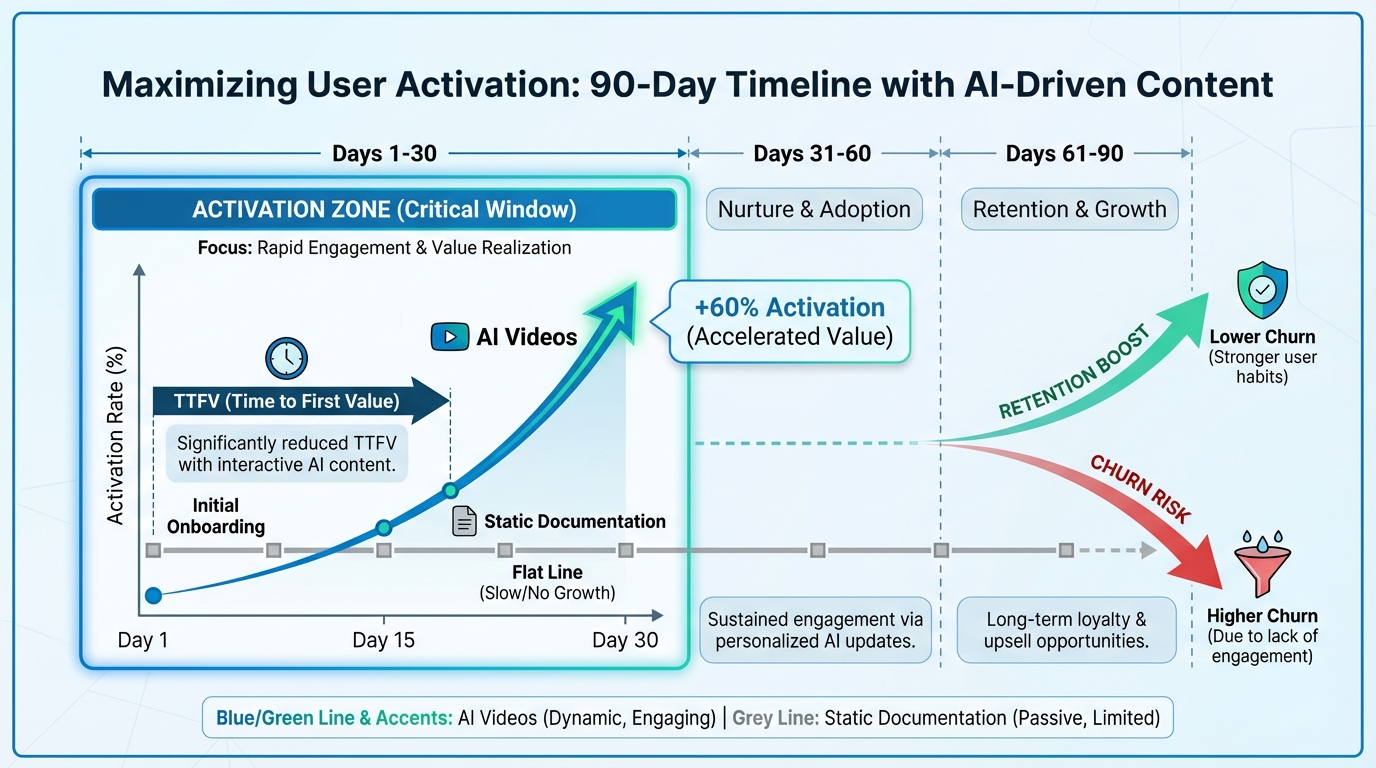
In the Indian SaaS ecosystem, the first 90 days represent the “activation or death” zone. If a user doesn't reach a core value milestone within this window, the probability of churn exceeds 70%. By 2026, the industry has moved away from “Days Since Sign-up” as a metric, focusing instead on Time-to-First-Value (TTFV).
Key Metrics to Track in 2026:
- Activation Rate: The percentage of users who complete a “core action” (e.g., setting up their first campaign or importing their first data set).
- TTFV (Time-to-First-Value): The hours or days it takes for a user to realize the product's promise.
- Early Feature Adoption: The number of secondary features used within the first 14 days.
- 90-Day Churn: The ultimate health indicator of your onboarding efficacy.
Platforms like Studio by TrueFan AI enable growth teams to create these personalized touchpoints at scale, ensuring that every user feels like they have a dedicated success manager from day one. By replacing static nurture sequences with a personalized welcome videos automation flow, brands are seeing a significant reduction in support tickets and a marked increase in long-term retention.
(Source: OnRamp 2026 Onboarding Metrics)
2. The India-First Blueprint: WhatsApp, Regional Languages, and DPDP Compliance
Building an onboarding strategy for the Indian market requires a fundamentally different approach than a global “US-centric” model. In India, the browser is often secondary to the smartphone, and email is often secondary to WhatsApp.
The WhatsApp-First Delivery Model
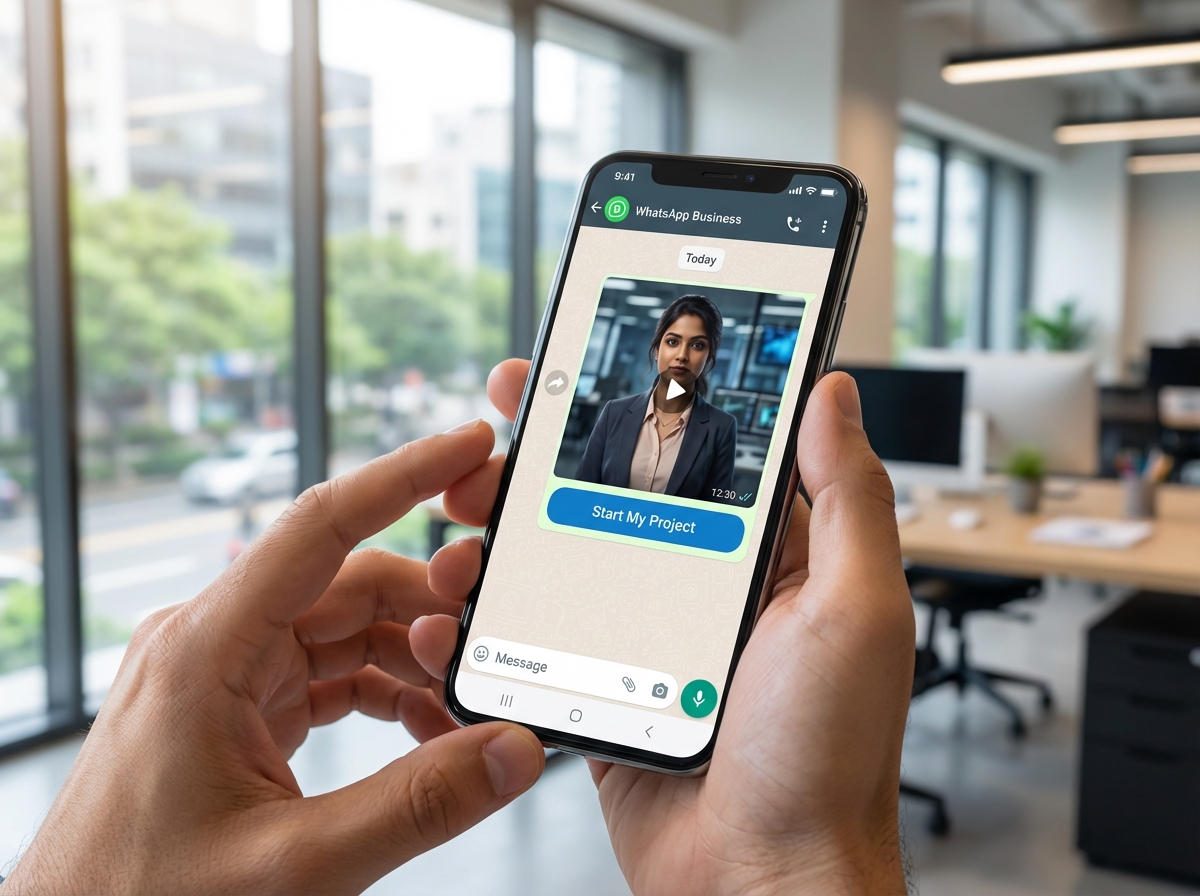
In 2026, WhatsApp has become the primary surface for customer activation in India. Research into fintech and banking sectors shows that onboarding journeys delivered via WhatsApp Business API see 3x higher engagement than those delivered via email (Source: Times Mobile x Jupiter Money Case Study). Cart recovery video automation guide
Your automated customer onboarding videos should be optimized for vertical (9:16) viewing and delivered as media templates within WhatsApp. This allows users to watch a 45-second tutorial and immediately click a deep link that takes them to the exact screen in your app where they need to take action.
Multilingual AI Avatars for Tier 2 and Tier 3 Growth
India is not a monolith. As SaaS and D2C brands expand into Bharat, the ability to communicate in Hindi, Tamil, Telugu, and Marathi becomes a competitive moat. Studio by TrueFan AI’s 175+ language support and AI avatars allow brands to instantly localize their onboarding content. AI voice cloning for Indian accents A user in Kanpur receiving a personalized welcome video in Hindi is far more likely to trust the platform than one receiving a generic English message. Real-time interactive AI avatars in India
Compliance: The DPDP Act (2023)
One often-overlooked aspect of AI video for SaaS onboarding India is the Digital Personal Data Protection (DPDP) Act. When generating personalized videos that include a user's name, company, or usage data, you must ensure:
- Explicit Consent: Capture consent for data processing at the sign-up stage.
- Transparency: Clearly state that the video is AI-generated for their benefit.
- Opt-out Mechanisms: Provide an easy way for users to stop receiving personalized video content.
(Source: MoEngage DPDP Compliance Commentary)
3. The 7-Touch Automated Video Welcome Sequence: A Proven Blueprint
To achieve a 40–60% lift in activation, you cannot rely on a single video. You need an automated video welcome sequence that mirrors the user's journey through the product. Here is the 2026 “Gold Standard” sequence:
Day 0: The “Human” Welcome
- Trigger: Account creation.
- Content: A 30-second video featuring a brand-aligned AI avatar. “Hi [Name], I'm [Avatar Name] from the Success Team. We're thrilled to have [Company Name] on board!”
- CTA: “Click here to set up your first project.”
T+24 Hours: The Micro-Demo (Non-Activation)
- Trigger: User has signed up but hasn't completed the core action.
- Content: A 60-second screen-share overlay with the avatar. “I noticed you haven't started your first project yet. Here is how you can do it in 3 clicks.”
- Goal: Reduce friction and technical anxiety.
Day 3: The “First Win” Celebration
- Trigger: User completes the core action.
- Content: A celebratory 20-second clip. “Great job, [Name]! You've just [Action Completed]. You're now in the top 10% of our power users.”
- Goal: Positive reinforcement and dopamine hit.
Day 7: Feature Adoption Explainer
- Trigger: 7 days post-sign-up.
- Content: Tailored to the user's ICP (Ideal Customer Profile). If they are a Manager, show them the reporting dashboard. If they are a Maker, show them the integration tools.
- Goal: Expanding the surface area of product usage.
Day 14: The Integration Nudge
- Trigger: User is active but hasn't connected external tools (Slack, CRM, etc.).
- Content: “Did you know [Product] works better with your existing stack? Here is how to connect [Tool].”
- Goal: Increasing “stickiness” through ecosystem integration.
Day 30: The Value Recap
- Trigger: 30-day milestone.
- Content: A data-driven summary. “This month, you saved [X] hours and completed [Y] tasks.”
- Goal: Justifying the ROI before the first renewal or month-end.
Day 60–90: The Churn Rescue
- Trigger: Usage drops below a certain threshold.
- Content: A proactive, empathetic check-in. “We missed you, [Name]. Is there something we can help with? Here’s a quick video on our newest update.”
- Goal: To reduce churn AI video sequences are specifically designed for this high-risk window.
4. Expanding the Playbook: Customer Success & D2C Automation
While SaaS onboarding is the most common use case, the customer success video AI playbook extends far beyond the initial 90 days.
Customer Success Micro-Tutorials
Support teams are often overwhelmed by the same “How do I...?” questions. By creating a library of 30-60 second AI-generated micro-tutorials, you can deflect up to 40% of support tickets. When a user submits a ticket, the automated system can reply with a personalized video showing them exactly how to solve their specific problem.
D2C Customer Onboarding Automation
For D2C brands, “onboarding” is the journey from purchase to repeat buyer.
- The Unboxing Video: A personalized video sent via WhatsApp the moment the package is delivered, showing the user how to use the product for the best results.
- Habit-Building Reminders: For consumable products (skincare, health supplements), a 15-second video nudge on Day 15 to remind them to stay consistent.
- The Reorder Prompt: A personalized video on Day 25 showing the specific product they bought and offering a “one-click reorder” discount. Social commerce shoppable videos (2026)
This D2C customer onboarding automation strategy ensures that the brand remains top-of-mind in a crowded marketplace, directly impacting the Customer Lifetime Value (CLV). Personalized checkout reminder videos YouTube Shorts product tagging in India
(Source: Litmos 2026 SaaS & D2C Trends)
5. Architecture & Implementation: Scaling with AI Video Creators
Building this system requires a robust “Video-as-Code” stack. You cannot manually record these videos. You need an architecture that connects your product data to an AI video engine.
The 2026 Onboarding Tech Stack
- Event Stream: Tools like Segment or RudderStack capture user actions (e.g.,
user_signed_up,feature_used). - CDP/Marketing Automation: Platforms like WebEngage, MoEngage, or Braze process these events and hold the user's metadata (Name, Language, Plan).
- AI Video Engine: The “brain” that renders the video. This is where you use an API to send data to a platform like TrueFan AI.
- Delivery Layer: The WhatsApp Business API or Email Service Provider (ESP) that sends the final video link to the user.
- Analytics Loop: Feeding video watch data (25%, 50%, 100% completion) back into your CDP to trigger the next step in the journey.
Choosing an AI Video Creator for Startups vs. Enterprise
When selecting an AI video creator for startups, speed and cost-per-render are the primary concerns. You need a tool that allows you to iterate on scripts quickly without a massive upfront investment.
For enterprises, the criteria shift toward:
- Security: ISO 27001 and SOC 2 certification are non-negotiable.
- Governance: The ability to set brand guidelines so that AI avatars never deviate from the corporate tone.
- Scalability: The infrastructure to render thousands of HD or 4K videos simultaneously during peak sign-up periods.
Solutions like Studio by TrueFan AI demonstrate ROI through their ability to handle these enterprise-grade requirements while maintaining the agility that growth teams need to A/B test their onboarding sequences.
6. Measurement, ROI, and FAQs
To prove the success of your automated customer onboarding videos, you must move beyond “vanity metrics” like views and focus on “impact metrics.”
The ROI Calculation
The true value of this playbook is found in the incremental lift in activation.
- Control Group: Users receiving standard email-only onboarding (e.g., 20% activation).
- Treatment Group: Users receiving the 7-touch automated video sequence (e.g., 32% activation).
- Lift: A 60% relative increase in activated users.
If each activated user has a Lifetime Value (LTV) of ₹50,000, and you activate an extra 100 users per month through video, the monthly incremental revenue is ₹5,000,000. When compared to the cost of AI video credits, the ROI often exceeds 10x within the first quarter.
Implementation Checklist: Your 4-Week Plan
- Week 1: Define your “Activation Milestone.” What is the one thing a user must do to see value? Draft your 7-touch script sequence.
- Week 2: Select your AI avatar. Ensure the tone matches your brand (e.g., professional for Fintech, energetic for D2C). Set up your DPDP consent logs.
- Week 3: Technical integration. Connect your CDP to the TrueFan AI API. Approve your WhatsApp media templates.
- Week 4: Launch an A/B test. Send 50% of your new sign-ups through the video journey and 50% through your old sequence. Measure the D14 activation lift.
By following this playbook, Indian SaaS and D2C brands can move from “hoping” users find value to “guaranteeing” it through personalized, automated, and localized video experiences. The future of onboarding isn't just digital—it's personal, it's visual, and it's automated.
Sources:
- Guidde 2026: Automated onboarding videos benefits (complete guide)
- OnRamp 2026: Customer onboarding metrics
- Times Mobile: Jupiter Money WhatsApp onboarding case study
- MoEngage: DPDP compliance commentary
- Litmos: Top SaaS onboarding trends
Frequently Asked Questions
How long should each onboarding video be?
In 2026, the sweet spot is 45–75 seconds. Anything longer than 90 seconds sees a significant drop-off in completion rates. Each video should focus on exactly one core action or “win.”
Do AI avatars look “fake” or uncanny?
Modern AI video technology has moved past the uncanny valley. By using digital twins of real people rather than CGI characters, realism becomes indistinguishable from a recorded video. This is why Studio by TrueFan AI uses licensed virtual humans based on real actors to maintain high trust levels.
Is integration with my CRM difficult?
No. Most modern AI video platforms offer robust APIs and webhooks. If you use a CDP like Segment or a marketing automation tool like MoEngage, you can trigger video renders as easily as you trigger an automated email.
Can these videos work for D2C unboxing experiences?
Absolutely. D2C brands use these to show customers how to use a product the moment it arrives. This reduces buyer's remorse and significantly lowers the rate of returns and exchanges.
How do I handle regional languages in India?
Use a platform that supports “Script-to-Video” in multiple languages. Write your script in English and have the AI automatically translate and lip-sync the avatar in Hindi, Marathi, or any of the 175+ supported languages.



