Answer Engine Optimization Video: Enterprise Playbook for AI Overviews, Featured Snippets, and Zero-Click Wins
Estimated reading time: ~11 minutes
Key Takeaways
- Engineer videos for zero-click environments by delivering direct, machine-readable answers in the first 10–20 seconds.
- Use VideoObject, SeekToAction, and chapter markup so AI can cite precise “Key moments.”
- Scale production of FAQ, HowTo, and PAA micro-videos to match conversational, voice-first queries.
- Prove E-E-A-T with expert credentials, on-screen definitions, and robust organization/person schema.
- Track success via citations, featured snippet occupancy, key moments visibility, and brand search lift.
The digital landscape is undergoing a seismic shift from traditional search engines to sophisticated answer engines. In this new era, answer engine optimization video is defined as the strategic practice of scripting, producing, structuring, and marking up video content so that AI systems—such as Google AI Overviews, featured snippets, and voice assistants—can extract precise, citation-ready answers.
By engineering video for these AI-native surfaces, enterprises can secure brand mentions and visibility even when users never click through to a website. Platforms like TrueFan AI enable brands to scale this high-authority video content across thousands of queries, ensuring they remain relevant in an increasingly zero-click world.
As we move into 2026, the urgency for this strategy is underscored by the fact that AI Overviews are already live with ad formats in India. This signals a future where AI-first Search Engine Results Pages (SERPs) prioritize multimodal content that can be cited and monetized directly within the interface.
What is AEO for Video and Why Zero-Click Optimization Strategies Matter Now
To thrive in 2026, enterprises must master zero-click optimization strategies, which are methods designed to earn visibility and trust directly within search and assistant experiences. These experiences include AI Overviews, featured snippets, People Also Ask (PAA) panels, and voice results where users receive immediate answers without clicking a link.
The shift is driven by a fundamental change in user behavior; projections suggest that by the end of 2026, zero-click searches will account for over 70% of all search queries. Traditional SEO focuses on driving traffic to a landing page, but AEO for video focuses on delivering machine-readable answers in the first 10–20 seconds of a clip.
Video has become the pivotal medium for this transition because search engines and AI assistants now possess the capability to parse transcripts and chapters with extreme precision. In India, for instance, Gemini in Chrome can now summarize YouTube videos and highlight key moments, making the technical fidelity of your video more important than ever.
Indian SEO practitioners are increasingly emphasizing that foundational elements like transcripts, metadata, and structured data are no longer optional. They are the primary signals that allow an AI to deep-link a user to a specific timestamped answer within your video content.
Unlike legacy video marketing, which often relies on long introductions and “fluff,” AEO-driven video requires an answer-first approach. This means scripting clean, concise segments that match the exact phrasing of user queries to ensure the AI identifies your content as the definitive source.
By engineering your video assets for extraction rather than just consumption, you position your brand as a cited authority in the AI's response. This preserves brand attribution in mixed organic and AI surfaces, which is critical as Gartner forecasts a 25% decrease in traditional search traffic by 2026.
Sources:
- Google Ads in AI Overviews India
- Gemini in Chrome India Multilingual Support
- Video Optimization Strategies 2026
AI Overviews Video SEO Signals and How to Surface in AI Answer Panels
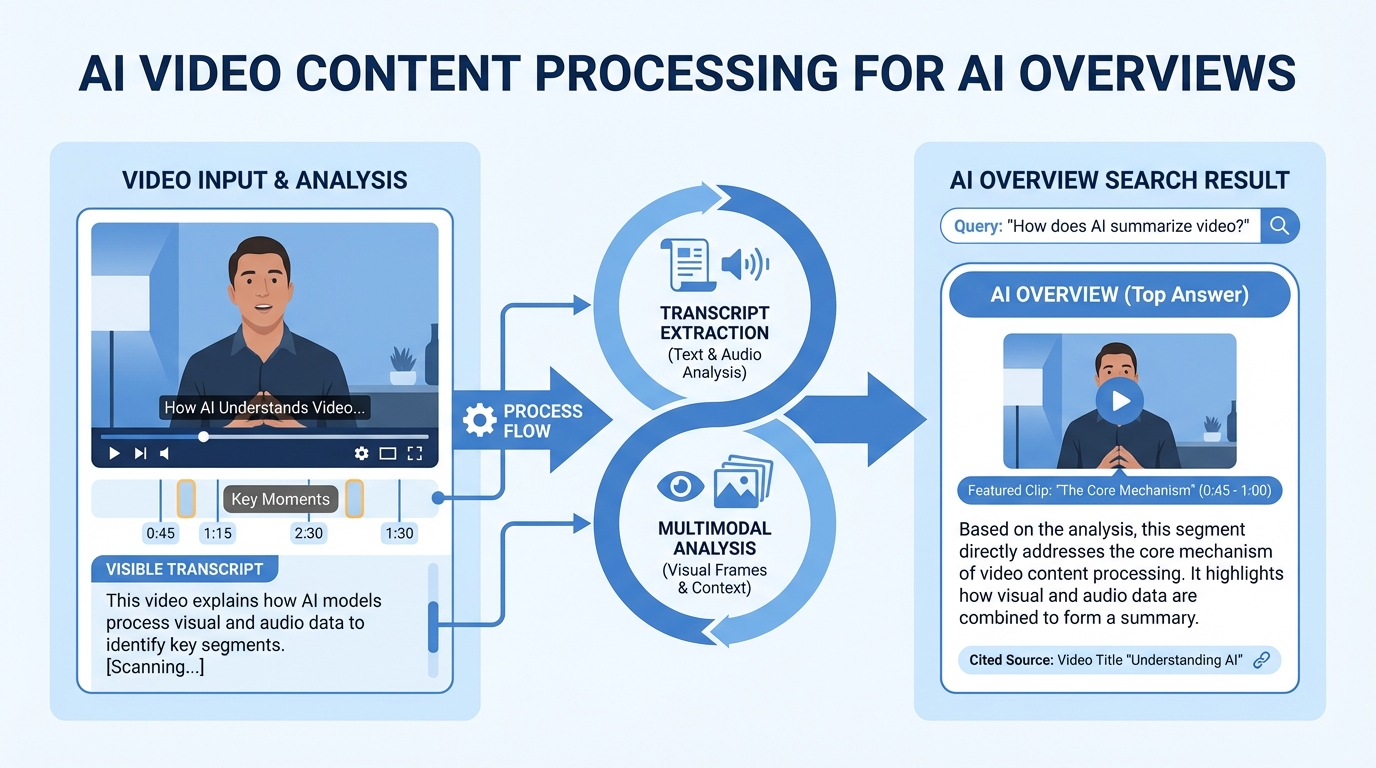
Surfacing in AI answer panels requires a deep understanding of AI Overviews video SEO signals. AI systems do not “watch” videos in the human sense; instead, they extract facts from a combination of audio transcripts, on-screen text, and structured metadata.
The primary input signal is an accurate, high-fidelity transcript that uses clear, natural language. To optimize for extraction, your video should feature “answer-first” scripting where the first 10–20 seconds provide a direct, one-sentence definition or answer to a specific query.
Technical signals are equally vital, particularly the implementation of VideoObject schema and SeekToAction markup. These allow Google to identify “Key moments” within a video, enabling the AI to cite a specific segment rather than the entire file.
In the Indian market, where AI Overviews are rapidly evolving with ad formats, precision is the only way to maintain organic visibility. When your video provides a clear, citation-ready answer, the AI is more likely to feature your brand logo and a link to the video as a supporting source.
To enhance E-E-A-T video authority, enterprises should include on-screen definition cards and expert credentials from the very first frame. This visual reinforcement helps the AI's multimodal sensors confirm that the spoken content matches the visual context, increasing the likelihood of a featured placement.
Another critical signal is the alignment of video chapters with common question-and-answer pairs. Instead of generic titles like “Introduction” or “Conclusion,” use human-readable titles such as “What is the best way to save for retirement?” or “How to install a smart thermostat step-by-step.”
By mirroring the user's query phrasing in your chapter titles and on-screen text overlays, you create a “perfect match” for the AI's retrieval system. This strategy is essential for capturing the 85% of informational queries that are expected to trigger an AI Overview by 2026.
Sources:
Structuring Featured Snippet Video Content and Conversational SEO Videos for PAA
Creating featured snippet video content requires a modular approach to production where each video is engineered to be excerpted into snippet panels. The goal is to provide a concise, authoritative response that the search engine can lift and present as a “Key moment” or a direct answer.
A successful snippet-ready video follows a strict formatting checklist: a direct definition in 1–2 sentences, followed by visual overlays of numbered steps or comparison lists. List formats are particularly effective for snippet extraction because they provide a clear structure for the AI to follow.
Beyond snippets, enterprises must focus on conversational SEO videos designed for People Also Ask (PAA) targeting and voice search. These are typically short, single-intent clips (30–60 seconds) that mirror the natural, spoken-language phrasing of modern searchers.
For PAA targeting, you should build clusters of micro-videos where each clip answers exactly one question. The question should be spoken verbatim in the first five seconds, and the answer should be delivered with high-clarity audio to ensure voice assistants can parse the information accurately.
In India, voice search video marketing must account for multilingual variants, including Hindi and regional languages. Explore multilingual voice marketing automation. As Gemini and other AI tools expand their multilingual support, having localized transcripts and lip-synced video content becomes a major competitive advantage.
TrueFan AI's 175+ language support and Personalised Celebrity Videos allow enterprises to create these conversational clusters at scale, ensuring that every regional query has a high-quality, authoritative video answer ready for extraction.
By sequencing these micro-videos to match multi-turn AI behavior, you can encourage users to stay within your brand's ecosystem. If a user asks a follow-up question, the AI can surface the next clip in your sequence, creating a seamless, zero-click brand journey.
Sources:
Schema Markup Video Implementation: VideoObject, FAQ, and HowTo Optimization
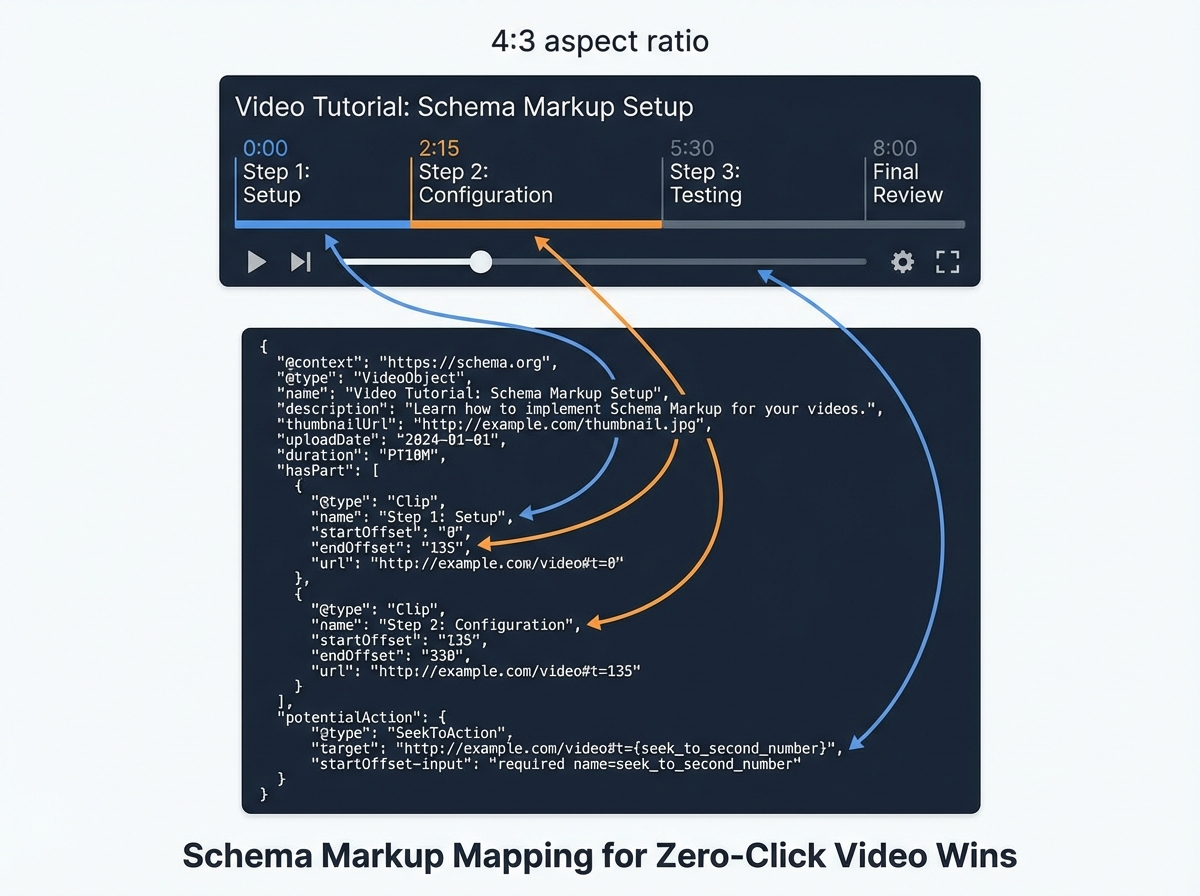
The backbone of any AEO strategy is a robust schema markup video implementation. Without structured data, even the highest-quality video remains “invisible” to the sophisticated extraction algorithms used by modern answer engines.
The VideoObject schema is the primary requirement for both onsite and YouTube-embedded content. Enterprises must specify properties such as name, description, thumbnailUrl, uploadDate, and duration. To unlock “Key moments,” you must also implement hasPart (for chapters) and SeekToAction markup.
For informational content, FAQ schema video markup is a powerful tool for securing zero-click wins. By wrapping on-page Q&As in FAQPage JSON-LD and linking the answers to precise video timestamps using #t= markers, you provide the AI with a direct map to your content's value.
Similarly, HowTo schema optimization allows you to map each step of a process to a specific video chapter. Each HowToStep should include a name, estimated time, and visual cues that match the on-screen labels in the video, ensuring perfect alignment between the code and the content.
To maximize AI answer citation strategies, you should use the CreativeWork.citation property within your JSON-LD to list the authoritative sources referenced in your video. This transparency builds trust with both the AI and the end-user, reinforcing your brand's expertise.
In the 2026 landscape, technical SEO and publishing operations must be perfectly synchronized. This includes maintaining a video sitemap with accurate lastmod dates and ensuring that all transcripts are clean, formatted for HTML, and accessible to search crawlers.
Validation is the final, non-negotiable step. Use the Google Rich Results Test to confirm that your markup is valid and monitor the Search Console Video indexing report to identify any enhancements that could improve your visibility in AI-native surfaces.
Sources:
How TrueFan AI Operationalizes Answer Engine Optimization Video at Enterprise Scale
Scaling an AEO video strategy across thousands of queries and multiple languages is a massive operational challenge. Solutions like TrueFan AI demonstrate ROI through their ability to mass-produce FAQ and HowTo micro-videos using advanced generative AI and API-driven workflows.
TrueFan AI's platform allows enterprises to transform a single 15-minute celebrity or expert shoot into an infinite library of personalized, query-specific videos. This enables brands to cover the entire “People Also Ask” tree for their industry without the prohibitive costs of traditional production.
One of the most significant advantages for enterprise teams is the ability to perform virtual reshoots. If an AI Overview test reveals that a different opening sentence or a specific list format performs better, the messaging can be updated via AI-driven lip-sync and voice cloning without bringing talent back to the studio.
This agility is critical for maintaining E-E-A-T video authority at scale. TrueFan AI ensures that all content is brand-safe and compliant, with ISO 27001 and SOC 2 certifications, which is a prerequisite for any enterprise-grade AI implementation in 2026.
The impact of this scale is evident in real-world results. For example, Zomato used TrueFan AI to generate 354,000 personalized videos in a single day for a Mother's Day campaign, while Hero MotoCorp delivered 2.4 million festive greetings to its customer base.
These campaigns achieved engagement rates far beyond traditional video ads, such as Goibibo's 17% higher WhatsApp read rate and Dainik Bhaskar's 3.2x higher participation. By automating the production of answer-first content, enterprises can save thousands of hours in creative production while dominating the SERPs.
Sources:
Measuring Success: KPIs and AI Answer Citation Strategies for E-E-A-T Video Authority
Measuring the success of an answer engine optimization video strategy requires a shift from traditional click-based metrics to visibility and attribution-based KPIs. In a zero-click environment, the goal is to maximize brand mentions and citations within AI answers.
Key performance indicators for 2026 include AI Overviews citation occurrences, featured snippet occupancy, and “Key moments” visibility. You should also track brand search lift—the increase in users searching for your brand name after seeing it cited in an AI answer.
To improve your AI answer citation strategies, you must provide explicit, machine-readable methods for the AI to credit your brand. This includes on-screen citations, clear lower-thirds with expert credentials, and a comprehensive list of sources in the video description.
Establishing E-E-A-T video authority is not just about the content; it's about the technical proof of expertise. Link your Person schema to authoritative sameAs profiles like LinkedIn or academic publications, and ensure your Organization schema is robust and well-defined.
Regular experimentation is essential. Enterprises should A/B test different script structures—such as definition-first versus benefits-first—and monitor how these changes affect their appearance in AI Overviews and PAA panels across different regions and languages.
As the search landscape continues to evolve, those who prioritize answer-first video content and technical schema rigor will be the ones who define the future of digital discovery. By focusing on zero-click wins today, you ensure your brand remains the definitive answer for tomorrow.
Sources:
- Google Ads in AI Overviews India
- Gemini in Chrome India Multilingual Support
- Video Optimization Strategies 2026
- Google AI Features Guidance
- Video Structured Data Documentation
- Google Raters Guidelines for E-E-A-T
Recommended Internal Links
- Answer Engine Optimization Video 2026: The Enterprise Playbook for AI Overviews and Voice Search
- Answer Engine Optimization Video Content Guide 2026
- AI Overviews Optimization 2026: Advanced AEO Strategies
- AI Overviews SEO Strategy: Video Tactics for 2026 Success
- Regional Language Video SEO: Strategies for 2026 Growth
- Multilingual Voice Marketing Automation: Tactics for 2026
Frequently Asked Questions
What is the difference between traditional Video SEO and Answer Engine Optimization Video?
Traditional Video SEO focuses on ranking a video in search results to drive clicks to a website or YouTube channel. In contrast, answer engine optimization video is designed to provide immediate, excerptable answers that AI systems can use to satisfy a user's query directly on the search page, often resulting in a zero-click interaction where the brand is cited as the source.
How do zero-click optimization strategies impact brand ROI?
While zero-click strategies may reduce direct website traffic, they significantly increase brand authority and mental availability. By being the cited source in an AI Overview, your brand gains high-level trust and visibility. Solutions like TrueFan AI help maintain this ROI by scaling production and ensuring that your brand is the one providing the answer across millions of potential queries.
Why is schema markup video implementation so important for AI Overviews?
Schema markup provides the “map” that AI systems use to understand the structure and content of your video. Without properties like SeekToAction and hasPart, an AI may struggle to find the specific “answer moment” within your video, making it less likely to cite your content in an AI Overview or featured snippet.
Can conversational SEO videos help with voice search in India?
Yes, conversational SEO videos are specifically designed to match the natural, spoken-language phrasing used in voice search. In India, where multilingual search is prevalent, producing these videos in regional languages with high-clarity audio and accurate transcripts is essential for being captured by voice assistants like Gemini or Siri.
How does E-E-A-T video authority affect my ranking in AI-native surfaces?
Google's AI systems prioritize content that demonstrates Experience, Expertise, Authoritativeness, and Trustworthiness. By including expert credentials, on-screen citations, and robust structured data that links to verified profiles, you signal to the AI that your video is a reliable source of information, increasing your chances of being featured as a primary answer.