Answer Engine Optimization Video: The Enterprise Playbook for AI Overviews, Featured Snippets, and Voice Search in 2026
Estimated reading time: ~14 minutes
Key Takeaways
- Zero-click discovery dominates in 2026—optimize answer-first video to win AI Overviews, PAA, and voice results.
- Structure scripts for answer extraction and implement VideoObject, Clip, and FAQPage schema.
- Match real user intent with transcripts, conversational titles, and metadata; localize for India’s regional languages.
- Scale with PAA trees, dual publishing (YouTube + owned site), and robust governance/compliance.
- Measure success via citation share, featured snippet wins, PAA coverage, and voice assistant recognition.
The digital landscape in 2026 has shifted fundamentally from traditional search engine results pages (SERPs) to a synthesized, multimodal ecosystem. For enterprise search leaders in India, the primary challenge is no longer just ranking in the “blue links” but securing visibility within AI-generated summaries. Answer engine optimization video AEO video strategy for AI Overviews has emerged as the critical frontier for maintaining brand authority in an era where zero-click searches dominate more than 50% of all queries.
Platforms like TrueFan AI enable enterprises to bridge the gap between static content and the dynamic, conversational requirements of modern answer engines. By structuring video content specifically for extraction by AI models, brands can ensure they are cited as the primary source in Google’s AI Overviews and ChatGPT’s search interfaces. This strategic shift requires a move away from long-form, generic video toward modular, “answer-first” assets that satisfy the algorithmic preferences of 2026.
In India, the urgency is particularly acute. According to the ETBrandEquity x Ipsos India report, “The State of Digital Marketing in India 2025–26,” Indian marketers are reporting a massive surge in discovery occurring via conversational interfaces. As mobile-first users increasingly rely on voice assistants and AI chatbots for immediate assistance, the ability to provide concise, video-based answers is the new benchmark for SEO success.
Sources:
Where Zero-Click Visibility Comes From: Mapping the 2026 Surfaces
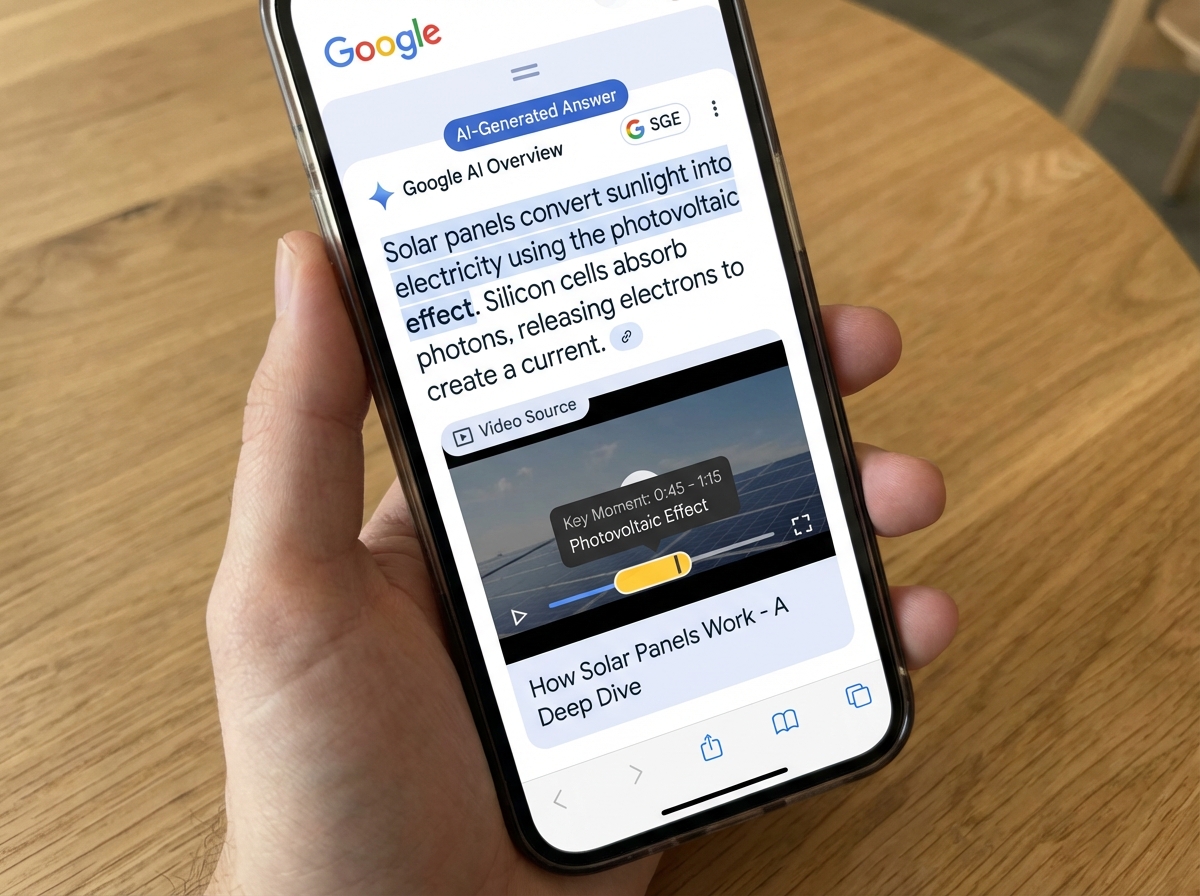
To win in the current environment, enterprises must understand the specific surfaces where AI Overviews video SEO AI Overviews video SEO tactics and zero-click optimization strategies intersect. Google’s AI Overviews (SGE) now prioritize multimodal content, often embedding a video “key moment” directly within the synthesized answer to provide visual proof or instructional clarity.
AI Overviews Video SEO Fundamentals
AI Overviews do not simply “watch” videos; they ingest transcripts, metadata, and structured data to determine if a video segment provides the most authoritative answer to a user's prompt. In 2026, data suggests that over 40% of AI Overviews in the “How-to” and “Product Comparison” categories now feature a video citation. To capture this, brands must adopt a dual-publishing strategy: hosting on YouTube for broad discovery and on-site for maximum schema control.
Featured Snippet Video Content and “Key Moments”
Featured snippets video content have evolved into “Answer Clips.” When a user asks a specific question, Google identifies the exact timestamp—or “key moment”—within a video that answers it. Winning these snippets requires a specific structure: a 5-second hook that mirrors the user's question, followed by a 30-second direct answer. This high level of precision ensures that the algorithm can confidently extract the segment for zero-click display.
People Also Ask Targeting with Short Video Answers
The “People Also Ask” (PAA) PAA optimization guide for 2026 feature has become a primary driver of conversational discovery. By building a “PAA tree”—a map of all related questions surrounding a core topic—enterprises can produce a series of 60-second answer clips. Each clip should be optimized to stand alone, providing a crisp response to a single PAA node, thereby creating a web of authoritative citations across the SERP.
Voice Search Video Marketing for Conversational Assistants
Voice search in 2026 is no longer just about text-to-speech; it is about assistant-led video playback on smart displays and mobile devices. Voice search video marketing Regional language video SEO strategies focuses on natural language patterns. If a user asks, “What is the best way to secure a home loan in Mumbai?”, the answer engine looks for a video that begins with that exact phrasing, ensuring the transcript matches the conversational intent of the query.
Sources:
How to Structure Conversational SEO Videos That Win
Creating content for answer engines requires a departure from traditional creative storytelling. Conversational SEO videos Conversational SEO video playbook must be engineered for clarity, speed, and algorithmic confidence. The goal is to provide the “canonical answer” that an AI model can trust and cite without hesitation.
Scripting for Answer Extraction
The most effective script template for 2026 follows a “Direct-Response” architecture. Start with a hook that restates the question, provide a 15-second “Featured Snippet” style answer, and then offer 45 seconds of supporting context. This structure allows AI engines to easily identify the “answer block” while still providing enough depth to satisfy E-E-A-T (Experience, Expertise, Authoritativeness, and Trustworthiness) requirements.
E-E-A-T Video Authority and Trust Signals
In a landscape crowded with AI-generated content, human expertise is the ultimate differentiator. E-E-A-T video authority E-E-A-T video authority techniques is signaled through on-screen credentials, such as titles and professional affiliations in lower-thirds, and by citing reputable external sources within the video description. For the Indian market, this also involves cultural localization. TrueFan AI's 175+ language support and Personalised Celebrity Videos allow brands to leverage recognizable authority figures who speak the local dialect, significantly boosting trust scores in regional markets.
Metadata That Matches User Intent
Metadata must reflect how users actually speak in 2026. This means moving beyond keyword stuffing to “Intent Mapping.” Titles should be phrased as questions, and the first 140 characters of the video description should provide a complete, standalone answer. This ensures that even if the video doesn't play, the answer engine can still extract the text-based answer and attribute it to your brand.
Sources:
- Google Search Central: Video structured data (VideoObject, Clip)
- Semrush: Video schema implementation guide
Technical Foundations: Schema Markup Video Implementation
The technical layer is the “instruction manual” that tells answer engines how to interpret your video. Without robust schema markup video implementation Schema markup implementation for AEO, even the best content will struggle to appear in AI Overviews or featured snippets.
VideoObject Essentials
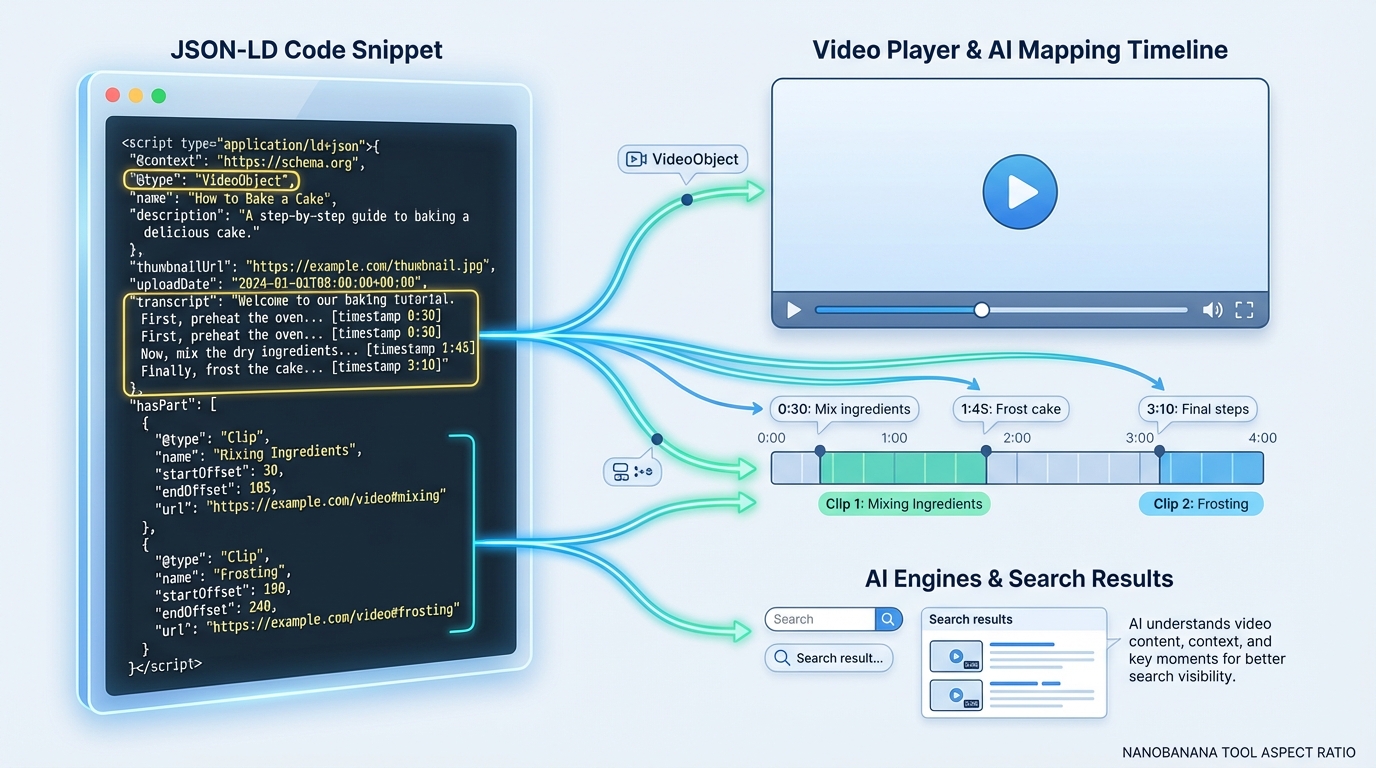
The VideoObject JSON-LD is the baseline requirement. In 2026, Google requires more than just a title and description. Critical properties now include transcript, inLanguage, and potentialAction. Including the full transcript within the schema allows AI models to index the spoken content without needing to process the audio file in real-time, significantly increasing the chances of a citation.
Clip Markup for “Key Moments”
To win featured snippet video content, you must use Clip markup. This tells Google exactly where an answer begins and ends. For example, if your video covers “How to apply for a GST refund,” you should create a Clip node titled “Steps to apply for GST refund” with a specific startOffset and endOffset. This precision is what triggers the “Key Moments” timeline in the SERP.
FAQ Schema Video Markup
A powerful but often overlooked strategy is pairing video with FAQ schema video markup FAQ schema + video best practices. By placing 3–5 specific questions and answers directly below the video embed and marking them up with FAQPage schema, you create a “relevance cluster.” Each answer in the FAQ should summarize the video's response and include a deep link to the relevant timestamp, reinforcing the video's authority to the answer engine.
Performance and Accessibility
Answer engines prioritize pages that load quickly and are accessible. Ensure your video pages have a Largest Contentful Paint (LCP) of under 2.5 seconds. Use lazy-loading for embeds and provide high-quality SRT files for captions. These accessibility signals are core components of E-E-A-T in 2026, as they ensure the content is consumable by all users, including those using assistive technologies or voice-only interfaces.
Sources:
Zero-Click Optimization Strategies for Enterprise Scale
For large organizations, the challenge is not just creating one “answer video,” but creating thousands. Zero-click optimization strategies Enterprise zero-click strategy guide at the enterprise level require a systematic approach to content production and governance.
PAA Tree Mining and Content Calendars
Enterprises should begin by mining “People Also Ask” data for their core product categories. By mapping these questions into a hierarchy, you can identify the “high-value” nodes that trigger the most zero-click impressions. This data-driven approach ensures that your video production efforts are focused on the queries that actually drive brand visibility in AI Overviews.
Dual Publishing for Maximum Citations
To maximize your footprint, every answer clip should be dual-published. YouTube provides the reach and the infrastructure for Google's video carousels, while your owned site provides the schema control and E-E-A-T reinforcement. Solutions like TrueFan AI demonstrate ROI through this multi-channel approach, allowing brands to automate the creation of localized, persona-specific variants that can be distributed across both platforms simultaneously.
Localization and Regional Relevance in India
In the Indian context, AEO cannot be English-only. AEO cannot be English-only With the rise of voice search in regional languages, enterprises must produce content in Hindi, Tamil, Bengali, and other major languages. This isn't just about translation; it's about cultural adaptation. Using local examples, currency, and scripts (including Hinglish) ensures that your content is the most relevant answer for a diverse user base.
Governance and Compliance
At scale, brand safety and compliance become paramount. Enterprise AEO strategies must include rigorous moderation filters and ISO-certified data handling. This is especially true when using AI-generated or AI-enhanced video content. Ensuring that all talent has provided consent and that all claims are verifiable is essential for maintaining the “Trust” component of E-E-A-T.
Measurement, Targets, and Iteration
In the world of answer engine optimization video, traditional metrics like “clicks” are secondary to “citation share.” If your brand is the cited source in an AI Overview, you have won the impression, even if the user never visits your site.
KPIs for AEO Video Success
- AI Overview Citation Share: The percentage of target queries where your video is the primary citation.
- Featured Snippet Wins: The number of “Key Moment” snippets triggered by your content.
- PAA Coverage: How many nodes in a topical PAA tree are occupied by your brand's videos.
- Voice Assistant Recognition: Testing if voice assistants (Alexa, Siri, Google) cite your brand when asked specific questions.
- Assisted Conversions: Tracking users who engage with an answer clip and later convert via a direct search or branded query.
The Experiment Backlog
AEO is not a “set and forget” strategy. Enterprises must constantly test different variables to see what the algorithms prefer. This includes testing different hook lengths (3s vs 5s), the density of chapters, and the phrasing of transcripts. In India, testing bilingual titles (English + Hindi) often yields higher visibility in voice search results than English-only titles.
How TrueFan AI Accelerates AEO for Video
TrueFan AI provides the technological backbone for enterprises looking to dominate the AEO landscape. By automating the production of high-authority, conversational video content, TrueFan AI allows brands to scale their zero-click optimization strategies without a proportional increase in resources.
Scalable Creation for PAA
TrueFan AI can take a PAA tree and automatically generate hundreds of 60-second answer clips. These clips can be personalized with dynamic tokens—such as the user's city or industry—making them more relevant to both the user and the answer engine's local intent filters.
Multilingual and India-First Localization
With support for over 175 languages, TrueFan AI ensures that your AEO strategy covers the full linguistic diversity of the Indian market. The platform’s native lip-sync and voice-cloning capabilities allow brands to maintain a consistent, authoritative voice across all regional variants, which is a key signal for E-E-A-T video authority.
Virtual Reshoots for Rapid Iteration
The search landscape changes weekly. If a new statistic emerges or a competitor captures a featured snippet, TrueFan AI’s “Virtual Reshoot” technology allows you to update the specific “answer line” in your video without a full production cycle. This agility is critical for maintaining the “Freshness” signal that AI answer engines prioritize.
Real-World Impact: The Indian Context
Major Indian brands have already demonstrated the power of scaled, personalized video. Zomato used these capabilities to generate 354,000 videos in a single day, while Hero MotoCorp delivered 2.4 million festive greetings. For AEO, this same technology is used to create a “video answer” for every possible customer query, ensuring that the brand is always the first and most authoritative voice the AI engine finds.
Practical Templates and FAQ
To begin your AEO journey, use the following checklists to ensure every video is optimized for the 2026 search environment.
AEO Video Brief Template
- Target Question: (e.g., “How do I calculate GST on services?”)
- The 15-Second Answer: (The concise, standalone response)
- Supporting Points: (3 bullet points for context)
- E-E-A-T Signals: (Expert name, title, and 2 external citations)
- Localization: (Target languages and regional examples)
Metadata and Schema Checklist
- Title: Starts with the primary question.
- Description: First sentence is the full answer; includes full transcript.
- Chapters: 3–7 answer-labeled timestamps.
- JSON-LD:
VideoObjectwithClipandFAQPagemarkup. - Validation: Pass the Google Rich Results Test.
Recommended Internal Links
Frequently Asked Questions
What is the difference between SEO and Answer Engine Optimization video?
Traditional SEO focuses on driving clicks to a website via search results. Answer engine optimization video focuses on providing the most authoritative answer so that AI models (like Google AI Overviews or Perplexity) cite your video directly within their synthesized responses, often resulting in a zero-click experience that builds brand authority.
How does Google decide which video to feature in an AI Overview?
Google looks for “Algorithmic Confidence.” This is determined by the clarity of the transcript, the presence of specific schema markup video implementation schema markup signals, the authority of the speaker (E-E-A-T), and how precisely the video's “Key Moments” match the user's specific question.
Can small enterprises compete with large brands in AEO?
Yes. Answer engines prioritize the “best” answer, not the biggest brand. A highly specific, well-structured video that uses conversational SEO videos conversational AEO techniques can often outrank a generic video from a much larger competitor.
How does TrueFan AI help with People Also Ask targeting?
TrueFan AI's 175+ language support and Personalised Celebrity Videos allow brands to rapidly produce hundreds of unique answer clips tailored to specific PAA questions. This ensures that no matter what follow-up question a user asks, your brand has a high-quality, localized video answer ready to be cited.
Is zero-click optimization bad for website traffic?
While it may reduce traditional click-through rates, it significantly increases brand impressions and “assisted conversions.” In 2026, being the cited authority in an AI Overview is more valuable for brand recall and trust than a standard blue link click, especially in mobile and voice-led markets like India.



