Answer engine optimization video: The enterprise playbook to win AI Overviews, featured snippets, and voice answers in India (2026)
Estimated reading time: ~12 minutes
Key Takeaways
- Adopt a video-first AEO strategy to win AI Overviews, featured snippets, and voice answers across India’s 2026 search landscape.
- Structure pages with an H2 question, a 40–60 word canonical answer, aligned transcripts, and VideoObject + Clip schema.
- Prioritize multilingual captions (en-IN, hi-IN), fast delivery, and mobile performance for voice search parity.
- Strengthen E-E-A-T and entity hygiene with verified experts, consistent naming, and robust structured data.
- Scale production and governance via API-first workflows, analytics, and 30/60/90 refresh cycles for durable visibility.
Answer engine optimization video is the strategic process of structuring video assets, transcripts, and metadata so generative engines like Google AI Overviews, Gemini, and Perplexity can extract authoritative answers and surface clips at position zero. See the answer engine optimization video (2026) guide. For SEO directors in 2026, the primary goal is to capture over 50% of search real estate across zero-click summaries and voice readouts using a video-first, India-centric approach. This playbook provides the technical schema, E-E-A-T frameworks, and multilingual tactics required to dominate this new generative search landscape.
Why answer engine optimization video matters now (2026, India-first)
A zero-click SEO strategy is a proactive framework designed to secure brand visibility when users receive complete answers directly on the search results page without clicking through to a website. In 2026, this shift is driven by the maturation of generative AI, where search engines prioritize extractable content blocks that provide immediate utility. For enterprises in India, this reality is compounded by a mobile-first population that increasingly relies on visual and auditory cues rather than traditional text-based browsing.
Videos are now the preferred medium for AI Overviews, especially for how-to and high-intent visual queries where a 30-second clip provides more clarity than a 1,000-word article. By creating chapterized video assets with question-led titles, brands can feed the LLMs that power these answer engines with precise, verifiable data. This approach ensures that your brand remains the cited authority even as traditional organic click-through rates (CTR) face downward pressure from AI-generated summaries. Explore the AI Overviews optimization (2026) guide.
The Indian market presents a unique challenge and opportunity due to its massive vernacular growth and voice search adoption. With voice search users in India projected to exceed 500 million by 2026, the demand for content in Hindi, Tamil, Telugu, and other regional languages is at an all-high. Tactical success requires producing short clips with 40–60 word canonical answer blocks that can be easily read aloud by voice assistants or displayed as text snippets in AI Overviews.
Sources:
- Answer Engine Optimization explained for marketers
- India 2026 GEO/AEO shift and tactics
- Voice commerce and vernacular India 2026 guide
AI Overviews video SEO and position zero optimization
AI Overviews video SEO involves optimizing video transcripts, chapters, and metadata so that search engines can extract authoritative snippets and link directly to precise timestamps. Learn more in the AI Overviews SEO strategy guide. Google’s AI features prioritize videos that offer clear, concise definitions within the first 60 seconds of playback. To win these placements, enterprises must structure their video pages with an H2 question, followed immediately by a 40–60 word answer and a supporting video clip with timestamp anchors.
Position zero optimization is the art of formatting these answers so they are selected as the primary summary at the top of the Search Engine Results Page (SERP). This requires a video + transcript synergy where the spoken word in the video matches the on-page text verbatim. When an AI engine identifies this semantic congruence, it gains the confidence needed to cite the video as a primary source, often resulting in a featured snippet or an AI Overview citation. See the featured snippet video content playbook.
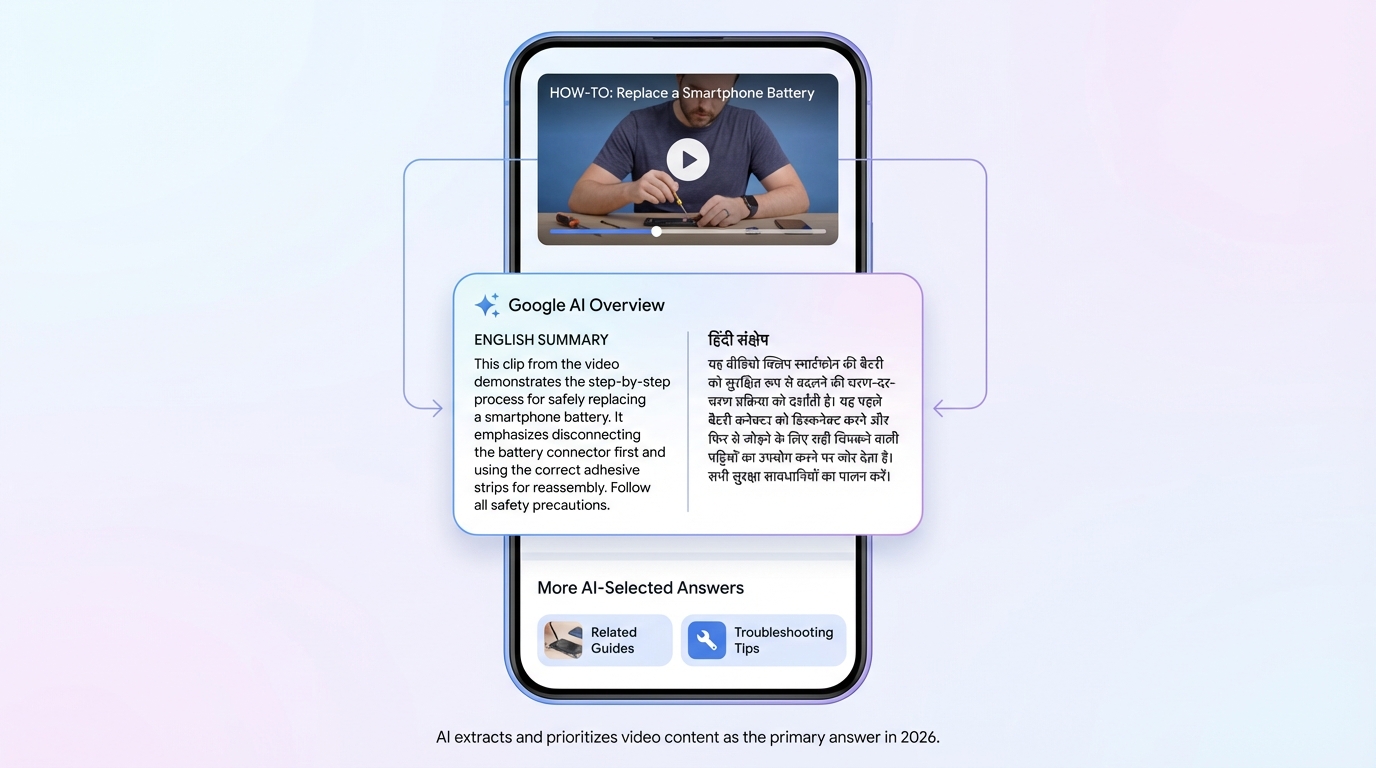
To implement this effectively, brands should publish both YouTube and on-site embeds, ensuring that titles and descriptions are perfectly aligned with the target query. Providing multilingual captions (en-IN, hi-IN) and using inLanguage tagging is essential for the Indian context, as it allows AI engines to serve the content to users searching in their native tongue. Furthermore, adding VideoObject schema with Clip markup is no longer optional; it is the technical bridge that allows AI to see the specific moments of value within your footage.
Sources:
- Google AI features and best practices
- Multilingual subtitling for discoverability
- Practical India-focused AEO guide
Voice search SEO India: Multilingual, mobile-first, and fast
Voice search SEO India is defined as the optimization of content for natural-language queries issued in English, Hindi, and regional languages via mobile devices and smart assistants. Read the voice SEO for regional languages guide. As of 2026, voice interactions account for a significant portion of search volume in Tier 2 and Tier 3 Indian cities. Explore the regional language voice shopping guide. Success in this segment requires a shift from keyword-stuffing to scripting for speech, using simple vocabulary and short sentences that can be read aloud in 8–12 seconds. See also regional language video SEO tactics.
Technical performance is a critical pillar of voice search, as assistants prioritize results from pages that load instantly on 4G and 5G networks. This necessitates aggressive video compression, lightweight thumbnails, and the use of Content Delivery Networks (CDNs) with India-based edge locations. Platforms like TrueFan AI enable enterprises to automate the creation of these localized video assets, ensuring that every voice query can be met with a relevant, high-quality video response in the user's preferred dialect. Learn more in the conversational shopping AI (Hindi) guide.
Accessibility and SEO are deeply intertwined in the voice landscape; indexable captions and downloadable transcripts provide the text-based grounding that AI models need to understand audio content. Testing is the final step in this workflow, where SEO teams must validate answers using both Hindi and English prompts on Android devices. By recording the readout text and comparing it against the canonical answer, brands can iterate on their scripts to ensure maximum parity and clarity for the end-user.
Sources:
- Understanding captions vs. subtitles
- Google launches new AI in India: SEO impact
- Voice search statistics 2026
Technical Architecture: Schema markup video implementation and FAQ strategies
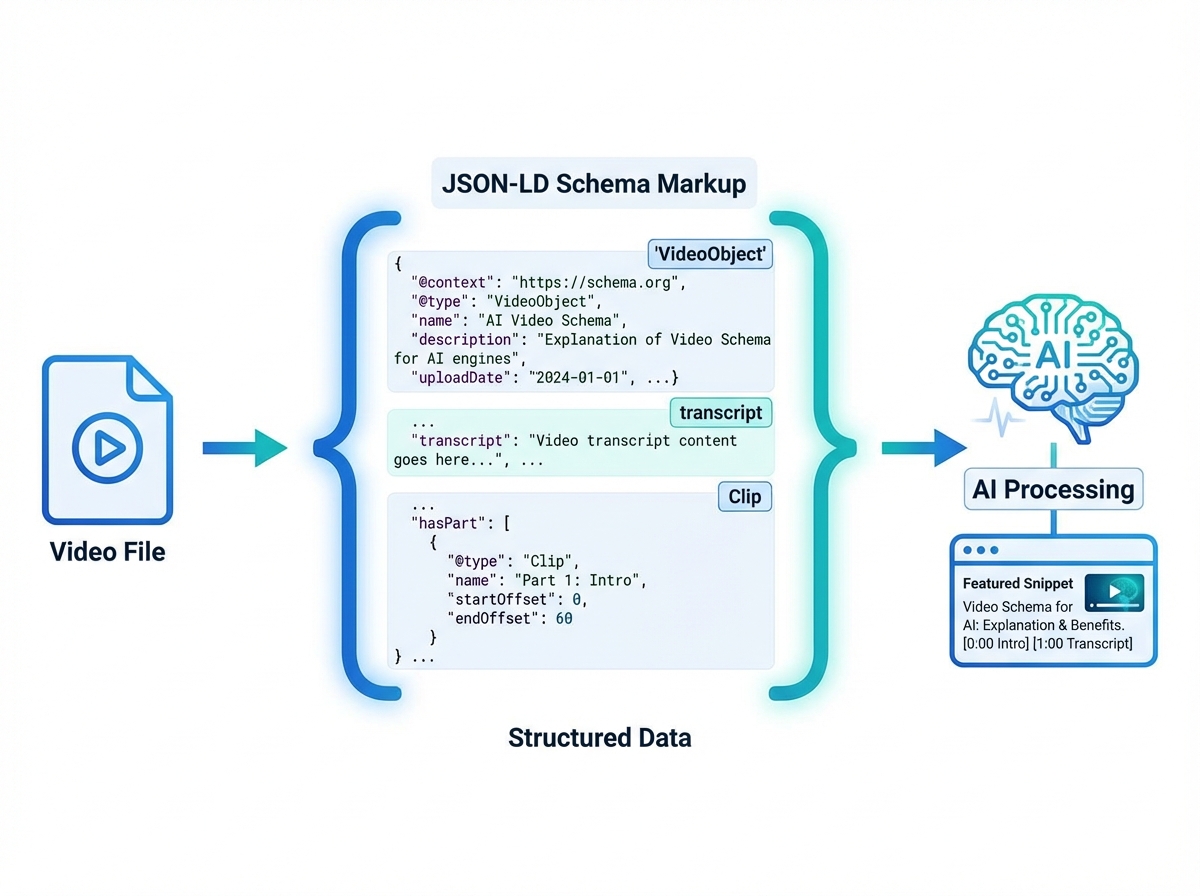
Schema markup video implementation is the process of adding JSON-LD structured data to video pages to help answer engines interpret timestamps, languages, and Q&A relationships. The VideoObject property must include essential fields such as name, description, thumbnailUrl, and uploadDate. For AEO success, the transcript property should be populated with human-reviewed text that highlights the 40–60 word canonical answers designed for extraction. Reference the AEO video 2026 guide.
FAQ schema video markup takes this a step further by nesting FAQPage JSON-LD on the same URL as the video. This allows each Question/Answer pair to link to an exact clip timestamp, significantly improving the chances of the video being surfaced in People Also Ask blocks and AI Overviews. Each acceptedAnswer.text must match the on-page text and the video transcript exactly to provide the machine-readable evidence that modern LLMs require to reduce hallucinations.
Validation is a non-negotiable step in the technical workflow. Using tools like the Google Rich Results Test and the Schema.org validator ensures that there are no syntax errors that could prevent an engine from indexing the video. For enterprises managing thousands of assets, using a JSON-LD generator to standardize fields across the site is the only way to maintain the scale required for a comprehensive GEO (Generative Engine Optimization) strategy.
Sources:
- Google video structured data requirements
- Video schema implementation guide
- Using JSON-LD to enhance video search appearance
E-E-A-T, LLM optimization, and generative search optimization (GEO)
E-E-A-T video authority refers to the signals of Experience, Expertise, Authoritativeness, and Trustworthiness that answer engines use to rank and cite video content. In 2026, this is achieved by featuring named experts with verifiable credentials and displaying organizational compliance badges like ISO 27001 and SOC 2. Transparency regarding production—such as disclosing the use of AI for captioning or localization—further builds trust with both the algorithm and the human viewer. See the AI Overviews SEO strategy.
An LLM optimization strategy focuses on structuring content with consistent entities and linked citations to improve model grounding. This involves mapping 10–20 FAQ clusters per topic and ensuring each has a dedicated micro-clip and a canonical answer. Generative search optimization (GEO) specifically targets AI-generated summaries by providing evidence-rich data points and cite-after-claim patterns that make it easy for an LLM to attribute information to your brand.
Entity hygiene is the foundation of GEO; brands must ensure that company, product, and celebrity names are consistent across all platforms. Adding Organization and Product schema with sameAs links to authoritative profiles like LinkedIn or Crunchbase helps search engines connect the dots between your video content and your established brand identity. This holistic approach ensures that your videos are not just seen as isolated files, but as integral parts of a trusted knowledge graph.
Sources:
- India AI marketing/SEO 2026 landscape
- Brand entity optimization for AI
- TrueFan AI Enterprise Compliance: ISO 27001 and SOC 2 Certification Documentation.
How TrueFan AI Enterprise operationalizes AEO for video at scale
TrueFan AI's 175+ language support and Personalised Celebrity Videos allow enterprises to operationalize AEO by programmatically injecting transcripts and structured metadata into millions of video assets. The platform’s API-first architecture enables the batch generation of question-led micro-clips, which are essential for fueling FAQ clusters and AI Overviews. By using virtual reshoots, brands can refresh their canonical answers to reflect new data or market shifts without the need for expensive and time-consuming physical production. Review the featured snippet video content guide.
Solutions like TrueFan AI demonstrate ROI through low-latency delivery and deep integration with existing marketing stacks. With the ability to render personalized videos in under 30 seconds, enterprises can trigger video responses in real-time based on user search interactions or WhatsApp queries. This speed is critical for maintaining the fast requirement of voice search SEO in India, where users expect immediate gratification on mobile devices.
The platform also provides robust analytics dashboards that track engagement, watch-through rates, and conversion lifts. By tagging experiments where the canonical answer appears in the first 10 seconds versus later in the clip, SEO teams can refine their production scripts for maximum AEO impact. Furthermore, TrueFan’s consent-first celebrity pipeline and built-in moderation filters ensure that all generated content remains compliant with brand guidelines and legal standards, protecting the enterprise's E-E-A-T standing.
Sources:
- TrueFan Enterprise Product Intelligence
- Zomato case study: 354,000 personalized videos in one day
- Hero MotoCorp case study: 2.4 million festive greetings
Governance, measurement, and the 2026 AEO checklist
Measuring the success of an answer engine optimization video strategy requires a shift from tracking clicks to tracking citations and readouts. Key Performance Indicators (KPIs) should include featured snippet ownership, AI Overview citation frequency, and voice answer parity. Learn more about voice commerce personalization in India (2026). Enterprises must conduct regular audits to ensure that their canonical answers are being read correctly by assistants in both Hindi and English, with a target of less than 10% variance between the written text and the spoken output.
Governance involves a 30/60/90-day refresh cycle for all canonical answers to ensure they remain accurate and relevant. A quarterly entity hygiene audit should be performed to validate that all schema markup is functioning and that thumbnails are optimized for fast loading on 4G networks. This disciplined approach to maintenance ensures that your video assets continue to serve as high-quality training data for the generative engines that dominate the 2026 search landscape.
Technical Implementation Checklist
- H1 includes "answer engine optimization video" and India context.
- Each H2/H3 question is followed by a 40–60 word canonical answer.
- VideoObject schema includes name, description, duration, and full transcript.
- Clip schema is used to define start/end offsets for every chapter.
- FAQPage schema is nested on the page and matches the video content.
- inLanguage tags are set for en-IN and hi-IN variants.
- Page passes the Google Rich Results Test with zero warnings.
- Video thumbnails are under 50 KB for fast mobile loading.
Sources:
- India 2026 GEO strategy and KPIs
- SEO trends 2026: Win Google AI Overviews
- YouTube SEO in the age of AI Overviews
Conclusion
By aligning your answer engine optimization video strategy with the evolving requirements of AI Overviews, featured snippets, and voice search, your enterprise can secure a dominant position in the 2026 Indian search market. Capturing zero-click visibility requires a sophisticated blend of high-quality video production, precise technical schema, and a deep commitment to multilingual accessibility.
To operationalize these tactics at scale, explore TrueFan AI Enterprise for API-first video workflows, batch answer clips, and consent-first compliance. Our platform provides the infrastructure needed to transform your brand into the primary authority for generative engines, ensuring your message is heard—and seen—across every AI-driven touchpoint.
Recommended Internal Links
- Answer engine optimization video (2026) guide
- AI Overviews optimization (2026)
- AI Overviews SEO strategy
- Featured snippet video content
- Regional language video SEO
- Voice SEO for regional languages
- Conversational shopping AI (Hindi)
- Regional language voice shopping guide
Frequently Asked Questions
What is the difference between traditional Video SEO and AEO for video?
Traditional Video SEO focuses on ranking in search results (SERPs), while AEO for video focuses on being the extracted answer within an AI-generated summary or voice response. AEO requires more structured data and concise, 40–60 word canonical answers.
How does multilingual support affect AI Overviews in India?
AI engines in India are increasingly polyglot. Providing captions in Hindi and regional languages allows Google’s AI to cite your video for vernacular queries, significantly expanding your reach beyond English-speaking audiences.
Can I use AI-generated videos for AEO without hurting my E-E-A-T?
Yes, provided you maintain transparency and use high-quality, consent-based platforms. TrueFan AI ensures E-E-A-T by using formal celebrity contracts and providing the technical metadata required for search engines to trust the content.
What are the most important schema properties for video AEO?
The most critical properties are VideoObject (with transcript), Clip (for timestamped chapters), and FAQPage (to link specific questions to video segments).
How do I measure the ROI of a zero-click SEO strategy?
ROI is measured through brand lift, share of voice in AI summaries, and conversion rates from users who interact with your video on the SERP or via voice assistants, even if they don't visit your website immediately.