URL-to-video AI generator for India: Turn Amazon/Flipkart/Shopify product links into 15‑second ads
Estimated reading time: ~9 minutes
Key Takeaways
- Turn product URLs into ads: Paste Amazon, Flipkart, or Shopify links to auto-generate 15‑second videos in under a minute.
- Massive cost and time savings: Shift from ₹5,000+ per video to ₹150–₹500 with instant scalability across SKUs.
- Marketplace compliance built-in: Templates follow Amazon/Flipkart specs, captions, and safe zones automatically.
- Vernacular advantage: Generate Hindi, Tamil, Bengali, and Hinglish variants to boost CTR in Tier 2/3 India.
- Omnichannel ready: Sync Shopify feeds, update prices in real-time, and remarket via WhatsApp video.
With a URL-to-video AI generator, paste any Amazon, Flipkart, or Shopify product link and get a marketplace-ready 15-second ad—no shoots, no freelancers, in minutes. In the hyper-competitive landscape of 2026, the URL-to-video AI generator India market has shifted from a luxury to a survival necessity for D2C founders and e-commerce sellers. Platforms like Studio by TrueFan AI enable brands to bypass the traditional ₹5,000+ per video freelancer costs, allowing for instantaneous scale across thousands of SKUs without ever picking up a camera.
1. The Rise of the URL-to-Video AI Generator in India 2026
The e-commerce landscape in India has undergone a seismic shift. As of early 2026, video commerce in India is projected to reach a staggering $15 billion, driven by a consumer base that no longer “reads” listings but “watches” them. Data from recent industry reports suggests that 82% of Indian D2C shoppers now prefer video content over static images when making a purchase decision. This shift has created a massive content gap: how does a seller with 500 SKUs create high-quality video for every single listing?
Enter the URL-to-video AI generator. Unlike generic text-to-video tools, an AI video generator from URL is specifically engineered for the e-commerce ecosystem. It doesn't just “make a video”; it ingests a product link, parses the structured data (price, specs, reviews), and synthesizes a conversion-optimized advertisement.
Why “URL-to-Video” is the New Standard
For years, sellers relied on “text-to-video AI for sellers,” which required manual scriptwriting and asset uploading. In 2026, the workflow has evolved. By using an AI video from product link workflow, the AI acts as a digital merchandiser. It identifies the “Hero” images on your Amazon or Shopify page, extracts the most compelling customer benefits from the description, and even pulls in real-time discount badges to create a sense of urgency.
Key 2026 Statistics for Indian E-commerce:
- ROI Boost: AI-generated video content has been shown to boost ROI by 82% compared to traditional production methods (Source: Adobe Digital Trends 2026).
- Engagement: Short-form video ads (15 seconds) see 4.5x higher engagement rates on platforms like Instagram Reels and YouTube Shorts than static carousels.
- Vernacular Impact: Vernacular video ads (Hindi, Tamil, Bengali) see a 3x higher CTR in Tier 2 and Tier 3 Indian cities compared to English-only ads.
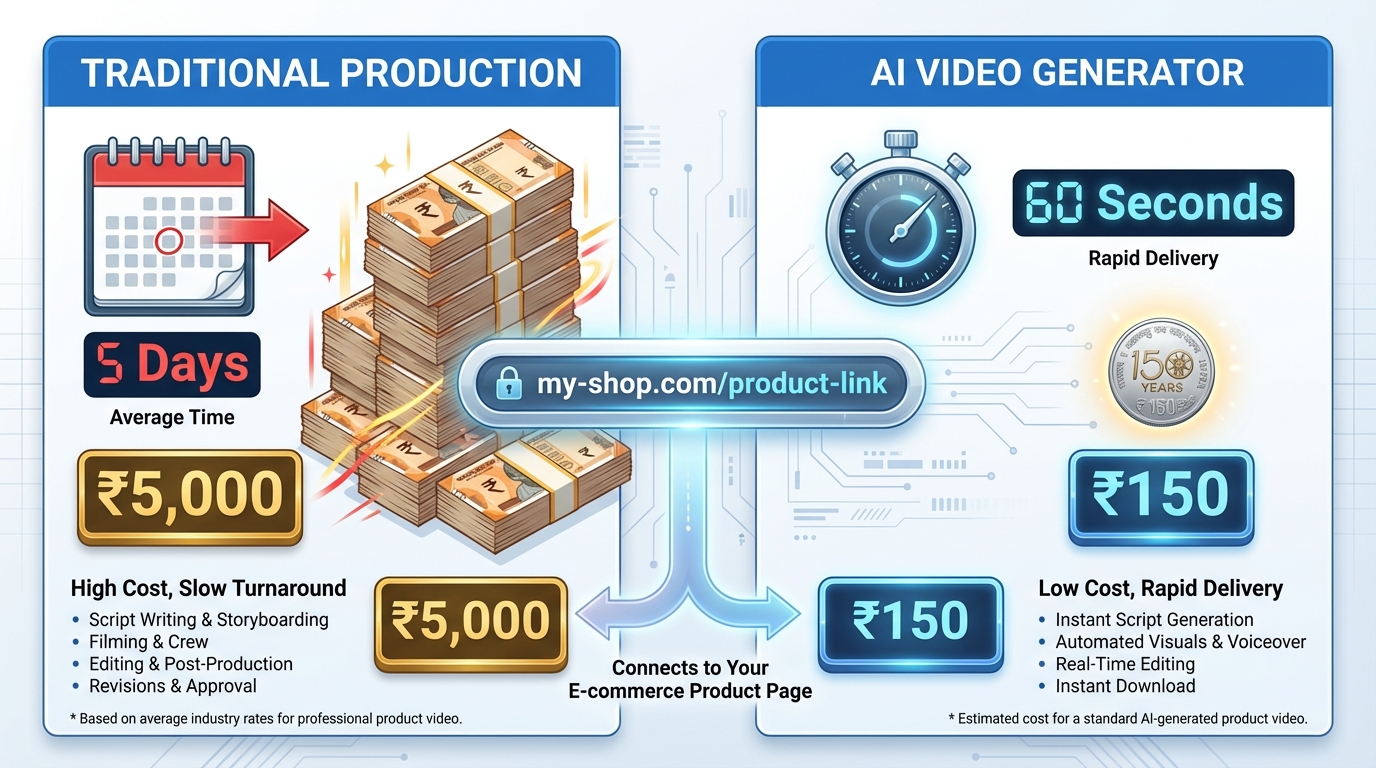
- Speed: The average production time for a marketplace-ready video has dropped from 72 hours (freelancer) to under 60 seconds (AI).
- Cost Efficiency: Automation has reduced the cost per video asset to as low as ₹150 for enterprise-scale sellers.
2. ROI Analysis: Why Manual Video Production is Obsolete for D2C
For the modern D2C founder, the math behind manual video production no longer adds up. Historically, a single 15-second product video cost upwards of ₹5,000, involving a scriptwriter, an editor, and potentially a voiceover artist. When you multiply this by a catalog of 50 SKUs, you’re looking at a ₹2.5 lakh investment and a 3-week lead time.
Solutions like Studio by TrueFan AI demonstrate ROI through radical cost compression and “Launch-to-Live” speed. By automating the creative process, brands can redirect their budgets from “production” to “distribution,” ensuring their ads actually reach the target audience.
The Math of E-commerce Video Automation India 2026
| Metric | Traditional Freelancer | URL-to-Video AI |
|---|---|---|
| Cost per Video | ₹5,000 - ₹7,500 | ₹150 - ₹500 |
| Turnaround Time | 3 - 5 Days | 30 - 60 Seconds |
| Scalability | Limited by human hours | Infinite (Batch processing) |
| Language Variants | Extra cost per language | Included in one click |
| Compliance Check | Manual/Prone to error | Automated via templates |
Scenario: Scaling a Beauty Brand in India
Imagine a D2C beauty brand launching a new “Monsoon Glow” collection with 20 SKUs.
- Traditional Route: 20 videos x ₹5,000 = ₹1,00,000. Time: 2 weeks.
- AI Route: 20 URLs x ₹200 = ₹4,000. Time: 10 minutes.
The “soft” benefits are even more compelling. In the fast-paced world of D2C video marketing automation, the ability to update a video instantly when a price changes or a festival sale (like Big Billion Days) begins is a competitive edge that manual production cannot match.
3. The Technical Pipeline: How AI Video from Product Link Works
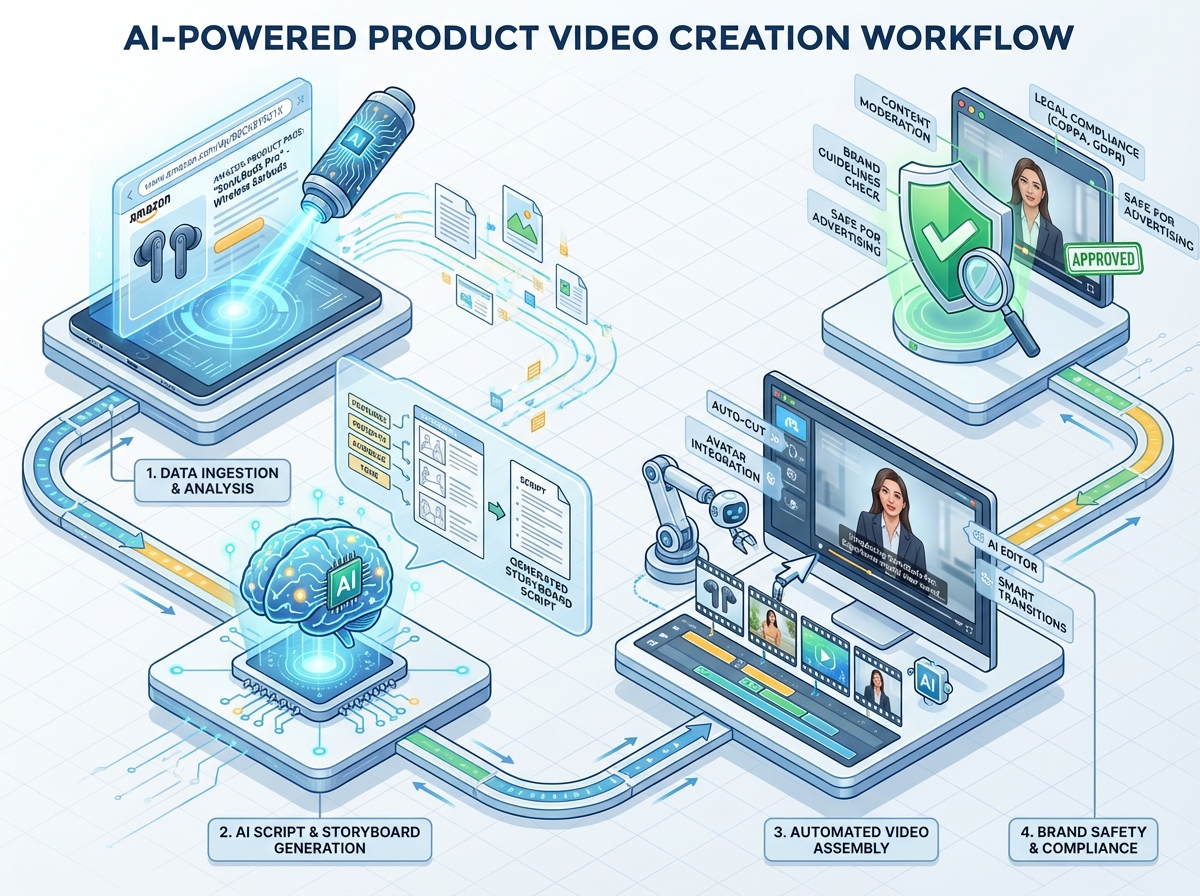
Understanding the “magic” behind a URL-to-video AI generator is crucial for sellers who want to maintain brand integrity while scaling. The process is a sophisticated orchestration of web scraping, Large Language Models (LLMs), and cloud-based video rendering.
Step 1: Crawl and Parse
When you paste a link from Amazon, Flipkart, or Shopify, the AI initiates a “deep crawl.” It doesn't just look at images; it looks at the schema.org data. It identifies the product title, the current selling price, the “MSRP” (to calculate the discount percentage), and the key bullet points. Studio by TrueFan AI's 175+ language support and AI avatars then come into play to ensure the extracted data is ready for localization.
Step 2: Script Synthesis & LLM Logic
The AI doesn't just copy-paste your product description. It uses e-commerce-trained LLMs to draft a 15-second script following a high-conversion formula:
- 0-3s (The Hook): Addresses a pain point or showcases the product's primary USP.
- 3-10s (The Meat): Highlights 2-3 key features with visual cutaways.
- 10-15s (The Closer): A clear Call-to-Action (CTA) with the brand logo and price.
Step 3: Visual Assembly and Lip-Sync
This is where the automated product ads AI truly shines. The system selects a template based on the product category (e.g., a high-energy, fast-cut template for electronics vs. a clean, minimalist template for skincare). If the user chooses an AI avatar, the system performs production-grade lip-syncing, ensuring the virtual influencer's mouth movements perfectly match the generated audio.
Step 4: Brand Safety and Compliance
In 2026, “Brand Safety” is a non-negotiable. The AI checks the script against a library of prohibited claims (especially important for health and beauty) and ensures that all logos and brand colors match the pre-uploaded brand kit. This “walled garden” approach prevents the hallucinations often seen in generic AI tools.
Source: Hootsuite Social Trends 2026
4. Platform Mastery: Shopify Product Video AI & Amazon/Flipkart Compliance
Each marketplace has its own set of “rules of engagement.” A generic video that works on Instagram might get rejected on Amazon India or look unprofessional on Flipkart. A specialized Amazon Flipkart listing video creator understands these nuances.
Shopify Product Video AI: One-Click Integration
For Shopify sellers, the goal is “frictionless commerce.”
- Direct Ingestion: The AI connects to your Shopify store via API or URL.
- Variant Support: If a product has 5 colors, the AI can generate 5 distinct videos, each featuring the correct color variant.
- Automated Push: Once generated, the video can be automatically pushed to the product media gallery, replacing or supplementing static images.
Amazon India: Sponsored Brands Video (SBV) Specs
Amazon is notoriously strict about its video guidelines. To ensure your automated product ads AI output is accepted, it must follow these 2026 standards:
- Autoplay Muted: The first 3 seconds must be visually engaging without relying on sound.
- Captions Required: Since most videos play on mute in the search results, burned-in captions are mandatory for high performance.
- No Prohibited Claims: Avoid words like “Best,” “Number 1,” or “Guaranteed” unless they are substantiated in the listing.
- Safe Zones: Keep text away from the bottom-right corner where the “Mute” button and “Ad” overlay appear.
Source: Amazon Advertising Help India
Flipkart: PDP Video Best Practices
- Aspect Ratio: While 16:9 is standard, 9:16 (vertical) is increasingly preferred for mobile PDPs.
- Hinglish Nuance: Using a mix of Hindi and English in the voiceover and captions significantly increases trust and “shareability” on platforms like WhatsApp.
- Offer Focus: Flipkart shoppers are highly value-conscious. Ensure the “Discount %” is a prominent visual element in the video.
5. The Creative Playbook: 15-Second Formulas for High Conversion
Creating a video is easy; creating a video that sells is an art. When using a text-to-video AI for sellers, you should follow proven psychological triggers that resonate with the Indian consumer.
The “Problem-Solution” Hook
- Visual: Someone struggling with a common issue (e.g., frizzy hair, slow charging).
- Audio: “Tired of [Problem]? Meet [Product].”
- Why it works: It immediately qualifies the lead. If they don't have the problem, they skip. If they do, they are hooked.
The “Unboxing Experience” (Simulated)
- Visual: High-quality 3D renders or hero shots of the product being “opened” or “applied.”
- Audio: “Everything you need for the perfect [Activity].”
- Why it works: It builds anticipation and mimics the tactile experience of shopping in a physical store.
The “Social Proof” Burst
- Visual: Star ratings and snippets of real customer reviews pulled from the URL.
- Audio: “Join 10,000+ happy customers across India.”
- Why it works: In a market where trust is the primary barrier to purchase, social proof is the ultimate “conversion lubricant.”
Vernacular and Hinglish: The 2026 Edge
In 2026, “English-only” is a niche strategy. To truly scale, your D2C video marketing automation must include regional languages.
- Hinglish: Ideal for urban youth and tech products.
- Pure Vernacular (Tamil/Telugu/Bengali): Essential for household goods, fashion, and groceries in regional hubs.
- Cultural Nuance: Ensure the AI avatar's tone matches the regional dialect. A “Delhi-style” Hinglish tone is very different from a “Mumbai-style” tone.
Source: Statista E-commerce India 2026
6. Future-Proofing for 2026: Omnichannel & Vernacular Scale
The future of e-commerce is not just about having a video on your product page; it's about having a “video presence” across the entire customer journey. This is where e-commerce video automation India 2026 trends are heading.
Product Feed Ingestion
Instead of pasting one URL at a time, enterprise-level sellers are now connecting their entire product feed (via XML or Shopify API) to the AI. This allows for “Dynamic Creative Optimization.” If a product goes out of stock, the ads stop. If the price drops for a “Flash Sale,” the video updates its captions and re-renders in seconds.
WhatsApp Video Remarketing
In India, WhatsApp is the “operating system” of daily life. Brands are now using AI video from product link technology to send personalized video messages to customers who abandoned their carts.
- The Workflow: Customer leaves a “Leather Wallet” in their Shopify cart → AI generates a 10-second video of that specific wallet with a “10% Off” coupon → Video is sent via WhatsApp API.
- Result: Recovery rates for abandoned carts have seen a 35% uplift when using personalized video vs. static text.
Omnichannel Consistency
Whether a customer sees your ad on a Meta Reel, a YouTube Short, or an Amazon search result, the “Brand Voice” must remain consistent. By using a centralized platform like Studio by TrueFan AI, brands ensure that the same AI avatar and the same professional voiceover are used across all touchpoints, building long-term brand equity.
7. FAQ & Getting Started
Frequently Asked Questions
1. What is a URL-to-video AI generator for sellers?
A URL-to-video AI generator is a specialized tool that takes a product link (from Amazon, Flipkart, or Shopify) and automatically creates a marketing video. It uses AI to scrape images, descriptions, and prices, then writes a script and generates a voiceover to produce a finished 15-second ad.
2. Is there a Shopify product video AI that works from a URL?
Yes, Studio by TrueFan AI's 175+ language support and AI avatars allow Shopify sellers to simply paste their product URL and generate high-quality videos. The tool is designed to recognize Shopify's data structure, making the process seamless for D2C brands.
3. How does an Amazon Flipkart listing video creator ensure compliance?
A professional Amazon Flipkart listing video creator uses pre-built templates that are hard-coded with marketplace rules. This includes the correct aspect ratios (9:16 or 16:9), safe zones for text, and automated checks to ensure no prohibited claims are made in the captions.
4. Can text-to-video AI for sellers auto-create multi-language ads?
Absolutely. Modern platforms allow you to generate a “Master” video in English and then, with one click, translate the script and the voiceover into Hindi, Tamil, Bengali, and 170+ other languages while maintaining perfect lip-sync.
5. How much can I save by using e-commerce video automation?
Most Indian sellers save over 90% on production costs. Instead of paying ₹5,000 per video to a freelancer, automation allows you to create the same quality of content for approximately ₹150 to ₹300 per video, depending on your volume.
How to Get Started Today
- Audit Your Catalog: Identify your top 20% “Hero” SKUs that currently lack video content.
- Upload Your Brand Kit: Ensure your logo, fonts, and primary colors are saved in your AI platform to maintain consistency.
- Run a Pilot: Paste 5 URLs into the URL-to-video AI generator and test different hooks (e.g., “Problem-Solution” vs. “Feature-First”).
- Deploy and Measure: Upload the videos to your Amazon SBV campaigns and Shopify PDPs. Monitor the lift in CTR and Conversion Rate over 14 days.
The era of expensive, slow video production is over. In 2026, the brands that win are the ones that can move at the speed of the consumer's thumb. By leveraging a URL-to-video AI generator India strategy, you aren't just making videos—you’re building a scalable, automated engine for growth.
Sources:
- HubSpot Marketing Statistics 2026
- Amazon Advertising India Help
- Hootsuite Social Media Trends 2026
- Adobe Digital Trends Report 2026
- Statista E-commerce Market Data
Recommended Internal Links
- Shopify product video AI: Create videos from any product URL
- Shopify product video AI: Create ads from any URL instantly
- Amazon listing video optimization with AI for 2026 sellers
- Hinglish AI video generator for India's vernacular brands
- Hinglish AI video for Bharat: Multilingual growth playbook
- Real-time Interactive AI Avatars India: Live Video Chat
Frequently Asked Questions
What links can the AI ingest?
The generator supports public product pages from Amazon, Flipkart, and Shopify. For Shopify, authenticated store connections via API enable bulk feed ingestion for automated video creation.
How fast are videos generated?
Single videos typically render in 30–60 seconds. Batch jobs for large catalogs process concurrently, enabling hundreds of marketplace-ready ads within minutes.
Can I keep brand consistency?
Yes. Upload your brand kit (logo, colors, fonts) once. Templates enforce safe zones, color usage, and logo placement to maintain brand safety across all outputs.
Does it support vernacular and Hinglish?
Yes. Generate Hindi, Tamil, Bengali, and Hinglish variants with one click. Voiceover and captions are localized while preserving lip‑sync accuracy.
How do I start with Studio by TrueFan AI?
Create an account on Studio by TrueFan AI, paste a few product URLs, choose a template, and generate your first 15‑second ads. Then connect your Shopify store to scale via product feeds.