AI video generator FMCG India multilingual localization: How to localize one ad into 12+ Indian languages with perfect lip-sync in 2026
Estimated reading time: ~11 minutes
Key Takeaways
- Scale one master ad into 12+ Indian languages with AI-powered transcreation, voice design, and lip-sync.
- Improve ROI with 60–80% lower per-language costs and faster time-to-market across formats.
- Ensure compliance with ASCI/FSSAI via legal overlays, audit trails, and human-in-the-loop QC.
- Leverage Bhashini datasets and phoneme-accurate lip-sync for authentic regional delivery.
- Adopt a hybrid model using hero shoots plus AI avatars to maintain star power and scale variants.
AI video generator FMCG India multilingual localization cinematic AI video generator India is now mission-critical for brand managers at HUL, ITC, or Dabur scale. In the hyper-competitive 2026 landscape, using one master asset to generate 10–12+ regional variants with AI lip-sync and region-specific messaging is no longer a luxury—it is a requirement for survival. Brands can now achieve this in days, not weeks, at a 60–80% lower per-language cost, ensuring they are ready for pan-India media flighting across every linguistic cluster.
For stakeholders, the promise is clear. Multilingual AI ad localization in India involves using advanced neural networks to transcreate scripts, generate localized voices, and lip-sync talent movements to target languages while preserving brand tone. This is coupled with AI lip-sync regional language ads, which utilize phoneme-aligned synthesis so viewers perceive the ad as originally shot in their native tongue. This shift from simple translation to cultural transcreation protects brand intent across every state.
1. The 2026 Mandate: Why FMCG AI Video Ad Localization is Table Stakes
By 2026, India’s digital landscape has undergone a radical transformation. With over 750 million vernacular-first internet users, the “one-size-fits-all” Hindi-English advertising model has collapsed. Pan-India growth now depends on reaching audiences in Hindi, Tamil, Telugu, Marathi, Bengali, Kannada, Malayalam, Gujarati, Punjabi, Bhojpuri, Assamese, and Odia.
The business case for FMCG AI video ad localization 2026 is backed by macro-economic shifts. India’s public language infrastructure, specifically the Bhashini mission Bhashini AI Video API tutorial, has accelerated the adoption of multilingual AI. Bhashini’s goal to break language barriers via AI has provided the foundational datasets required for high-fidelity voice and lip-sync models.
Key 2026 Statistics & Market Data:
- Vernacular Dominance: 90% of new internet users in India prefer content in their native language, with regional video consumption growing at a CAGR of 25% (Source: Projected Digital India Report 2026).
- Efficiency Gains: AI-driven localization reduces time-to-market for pan-India campaigns by 85% compared to traditional studio dubbing.
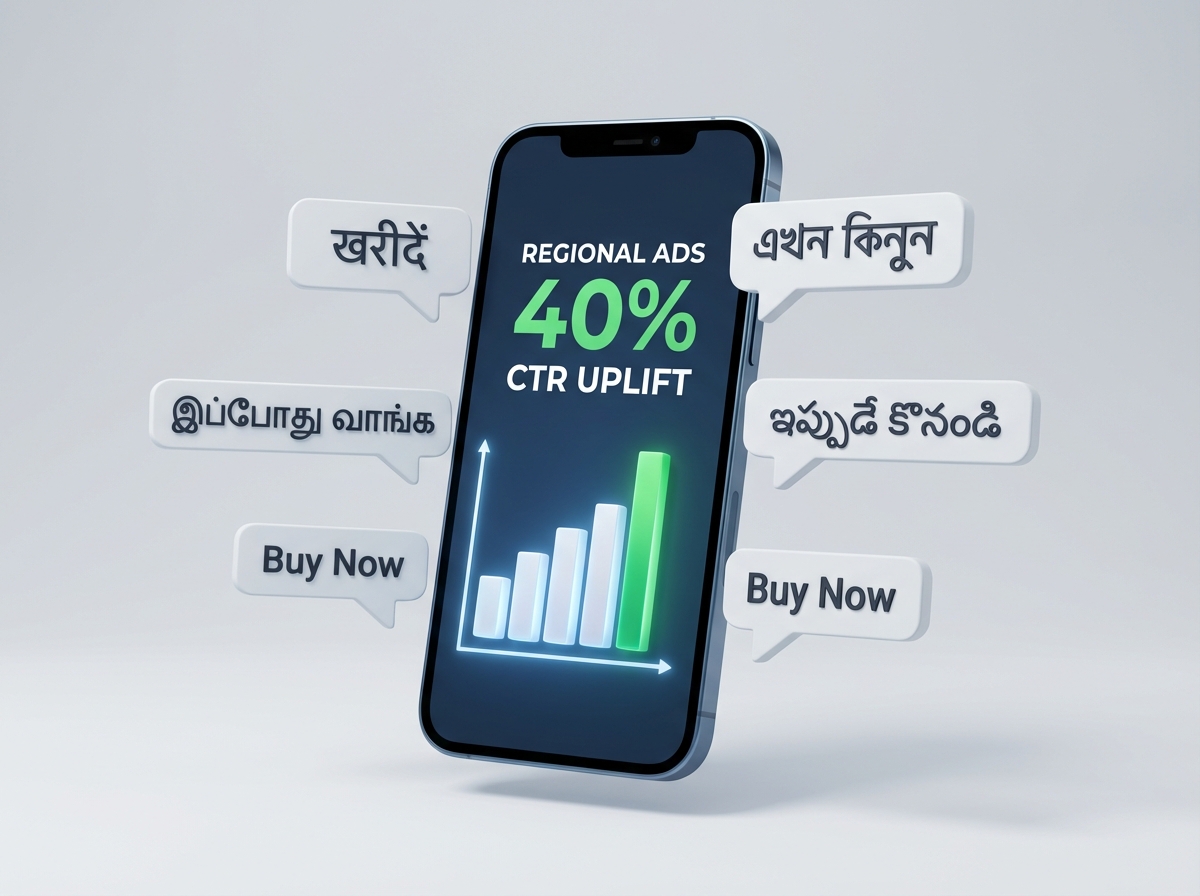
- Engagement ROI: FMCG brands utilizing hyper-local AI ads report a 40% higher Click-Through Rate (CTR) in Tier 2 and Tier 3 cities.
- Market Scale: The Indian AI market is projected to reach $17 billion by 2027, with creative automation for FMCG being a primary driver.
- Cost Reduction: The per-language cost of high-fidelity video localization has dropped by 70% since 2023 due to GPU optimization.
Platforms like Studio by TrueFan AI enable brand managers to navigate this complexity by providing enterprise-grade tools that bridge the gap between a single creative vision and a fragmented linguistic market.
Sources:
2. Strategic Workflow: Localize One Ad into 12+ Indian Languages with AI
To localize one ad into 12 Indian languages with AI, a structured, eight-step workflow is essential to maintain quality and compliance.
Step 1: Asset Ingest & Preparation
The process begins with the collection of high-quality master assets. This includes 4K/1080p video files, clean audio stems, and brand guidelines. For FMCG, this also requires a “legal copy bank” categorized by product type (e.g., Food, Personal Care, OTC) to ensure disclaimers are ready for each region.
Step 2: Transcription and Timecode Alignment
AI generates a verbatim transcript with frame-accurate timecodes. This step is critical for locking the rhythm of the original performance, ensuring that pauses and breaths are accounted for in the localized versions.
Step 3: Transcreation vs. Translation
This is where many brands fail. While translation handles factual lines, transcreation adapts idioms and cultural references. For example, a CTA in Chennai might mention “Order on Swiggy Instamart,” while in Patna, it might prioritize “Blinkit.” Ensuring minimum on-screen text sizes for complex scripts like Tamil or Malayalam is vital for legibility.
Step 4: Voice Design and Cloning
Brands can choose to clone the timbre of a professional actor AI voice cloning for Indian accents or select from a library of pro voice packs. In 2026, the nuance extends to dialects—distinguishing between Telangana Telugu and Andhra Telugu to build deeper local trust.
Step 5: AI Lip-Sync and Face Reanimation
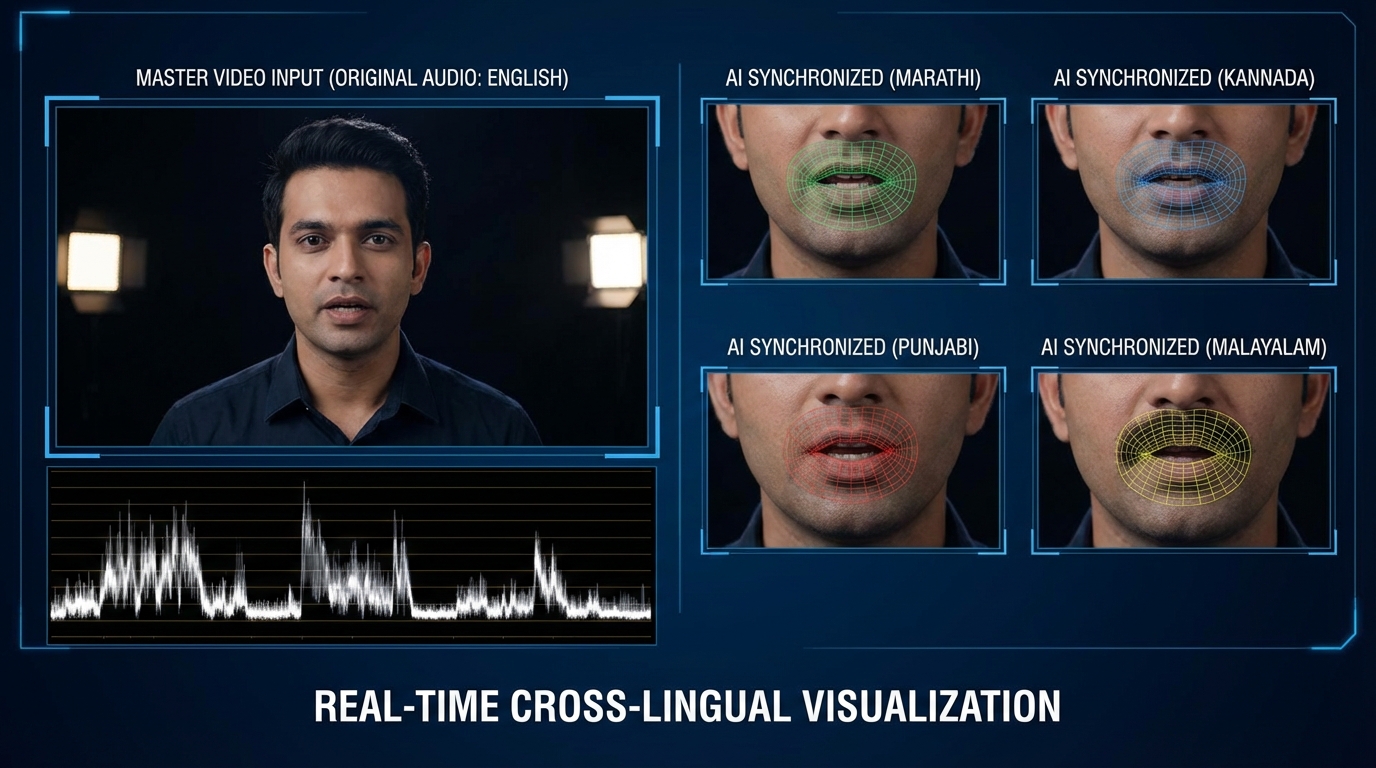
This is the technical core. AI lip-sync regional language ads apply phoneme/viseme-aligned movements. The AI must tune for Dravidian retroflex contrasts and Indo-Aryan aspirates, ensuring bilabial closures (the “p/b/m” sounds) are frame-perfect for realism.
Step 6: Graphics and Legal Overlays
Localized versions require regional script overlays for FSSAI declarations and ASCI-compliant labels. The system must ensure that safe areas are maintained for various platforms like Meta, YouTube, and CTV.
Step 7: QC and Human-in-the-Loop Sign-Off
A three-layer Quality Control (QC) process is mandatory:
- Linguistic: Checking idioms and brand tone.
- Visual: Verifying sync fidelity and lighting continuity.
- Legal: Ensuring all mandatory claims are present in the correct script.
Step 8: Batch Render and Trafficking
Finally, the system auto-exports variants in 16:9, 1:1, and 9:16 ratios. These are packaged with platform-specific bitrates and uploaded via API to ad managers or WhatsApp Business accounts.
Sources:
- TrueFan AI: AI Video Localization India 2025
- Dainik Jagran (English): Create Multilingual Content with an AI Video Generator
3. Talent Choices: AI Spokespersons vs. Real-Talent Shoots
The choice between a traditional shoot and an AI spokesperson for an FMCG brand in India AI spokesperson multilingual India depends on the campaign’s scale and frequency. An AI spokesperson is a digital twin trained on a consenting model or brand custodian that delivers messages photorealistically across dozens of languages.
Studio by TrueFan AI’s 175+ language support and AI avatars provide a scalable alternative to the traditional “shoot-and-dub” model.
When to Prefer AI Avatars:
- High Variant Counts: When the campaign requires 50+ localized variations for different retailers or micro-regions.
- Rapid Bursts: For tactical offers (e.g., a 48-hour flash sale) where a studio shoot is logistically impossible.
- Compliance Updates: When a legal disclaimer changes and 12 regional ads need an immediate update without a re-shoot.
The Hybrid Model:
The most effective 2026 strategy is the hybrid approach. Brands shoot a master “Hero” film with a celebrity or influencer. They then use an AI digital twin of that talent to generate the long-tail language variants and retail-specific cutdowns. This maintains the “star power” while achieving the efficiency of an AI video creator pan-India campaign.
Sources:
4. Compliance and Risk Management: ASCI & FSSAI Standards
For FMCG brands, compliance is the ultimate “moat.” Multilingual AI ad localization in India must adhere to strict regulatory frameworks, or the brand faces significant legal and reputational risk.
ASCI (Advertising Standards Council of India)
ASCI requires that all ads be legal, decent, honest, and truthful. When using AI, brands must:
- Clearly label AI-generated or synthetic content if it could mislead the consumer.
- Ensure that localized claims remain substantiated by the original evidence.
- Avoid misleading depictions of product performance in localized visuals.
FSSAI (Food Safety and Standards Authority of India)
For food and nutrition categories, the FSSAI Advertising and Claims Regulations (2018) are stringent.
- Mandatory Declarations: All disclaimers must be in the same language as the ad’s primary audio. If the ad is in Bhojpuri, the FSSAI license number and warnings must be in the Kaithi or Devanagari script as per regional usage.
- Truthful Claims: AI-generated scripts must not embellish nutritional benefits during the transcreation process.
Enterprise Guardrails
To manage these risks, top-tier platforms incorporate real-time moderation. This includes blocking sensitive or non-compliant keywords and providing watermarking for traceability. Audit trails ensure that every regional variant has been signed off by the Legal/MLR (Medical, Legal, Regulatory) team before it goes live.
Sources:
5. Formats, Distribution, and ROI for 2026
An AI video creator pan-India campaign is only as good as its distribution. In 2026, the format matrix has expanded beyond traditional TV.
The Format Matrix:
- 9:16 Reels/Shorts: Optimized for mobile-first consumption in regional markets.
- 1:1 Feed Ads: Ideal for Facebook and Instagram carousels.
- 16:9 CTV/OTT: High-definition variants for the growing Connected TV market in urban India.
- WhatsApp Drips: Short, 10–15 second localized clips sent via the WhatsApp Business API for direct-to-consumer engagement.
Measuring Success
Solutions like Studio by TrueFan AI demonstrate ROI through several key performance indicators (KPIs):
- Completion Rates: Does the Tamil audience watch the full 30 seconds when the lip-sync is perfect? (Typically 25% higher than non-synced dubs).
- CTR Uplift: Localized CTAs (“Buy at your nearest Kirana in Nagpur”) drive significantly higher clicks than generic ones.
- Cost per View (CPV): By reducing production costs, the effective CPV of a pan-India campaign drops, allowing for higher media spend.
The Launch Playbook: FMCG Product Launch AI Video India
- T-7: Master script lock and transcreation into 12 languages.
- T-2: Batch rendering and MLR sign-off.
- T-0: Simultaneous flighting across all language clusters.
- T+7: Performance analysis and iteration of weak-performing regional variants.
Sources:
Final Checklist for Brand Managers:
- [ ] Is the master video 4K with clean audio stems?
- [ ] Have the scripts been transcreated, not just translated?
- [ ] Are the FSSAI/ASCI disclaimers localized for each script?
- [ ] Has a regional linguist performed a final QC on the “Bhojpuri Hindi Tamil Telugu AI ad dubbing”?
- [ ] Is the trafficking kit ready for 9:16, 1:1, and 16:9 formats?
By following this strategic blueprint, FMCG brands can dominate the Indian market in 2026, turning linguistic diversity from a logistical hurdle into a powerful competitive advantage.
Recommended Internal Links
- AI Spokesperson Multilingual India: Launch Videos at Scale
- Bhashini AI Video API Tutorial: Text-to-Video in India 2026
- AI Voice Cloning Indian Accents: Scale Multilingual Content with Authenticity
- Cinematic AI Video Generator India: 2026 Tools Compared
- Cinematic AI Video Generator India: 2026 tools compared
Frequently Asked Questions
How does AI lip-sync handle complex Indian dialects like Bhojpuri or Haryanvi?
AI models in 2026 are trained on diverse datasets that include regional phonetic nuances. Unlike traditional dubbing, which often uses a “Neutral Hindi” accent, AI can replicate the specific prosody and rhythm of Bhojpuri or Haryanvi, making the ad feel authentic to the local culture.
Can I use AI to localize ads for WhatsApp marketing?
Yes. Studio by TrueFan AI’s integration with WhatsApp APIs allows brands to send personalized, localized video clips directly to consumers. This is particularly effective for FMCG brands looking to drive trial through regional retailers.
Is AI-generated video content compliant with ASCI and FSSAI?
AI content is compliant as long as it follows the same truth-in-advertising principles as traditional content. It is crucial to ensure that all mandatory regional-language disclaimers are present and that the AI does not alter the factual claims of the product.
What is the turnaround time for localizing one ad into 12 languages?
With an automated pipeline, the actual rendering time for 12 languages can be as low as 30 minutes. However, including human-in-the-loop QC and legal sign-offs, most enterprise brands complete the entire process in 48 to 72 hours.
How does “transcreation” differ from “translation” in AI video?
Translation is word-for-word. Transcreation is intent-for-intent. For an FMCG brand, this means changing a reference from “breakfast paratha” in a North Indian ad to “breakfast idli” in a South Indian variant, ensuring the product remains relevant to the local lifestyle.
Do I need a separate shoot for each language?
No. The primary advantage of an AI video generator for FMCG India Cinematic AI video generator India 2026 is that you only need one high-quality master shoot. The AI then handles the visual and auditory re-animation for all other languages, saving millions in production costs.



