
Customer health scoring automation: how AI video interventions cut churn for SaaS in 2026
Estimated reading time: ~14 minutes
Key Takeaways
- Automated customer health scoring turns noisy telemetry into clear risk signals, enabling proactive retention.
- Predictive, personalized videos triggered at red/yellow health thresholds lift reactivation and reduce churn windows.
- A centralized AI retention analytics platform unifies product, billing, and support data for real-time decisions.
- Lifecycle video automation across onboarding, milestones, and renewal reinforces value and habit loops.
- Follow a disciplined 90-day blueprint to map signals, integrate video, and scale A/B-tested rescue campaigns.
The landscape of subscription-based software has reached a critical inflection point where traditional, reactive retention strategies are no longer sufficient to maintain market share. Customer health scoring automation has emerged as the definitive solution for enterprise SaaS leaders who must navigate the complexities of 2026’s hyper-competitive digital economy. By integrating real-time data streams with sophisticated modeling, organizations can now transition from manual account reviews to a system of continuous, automated oversight.
In the current fiscal environment, the cost of customer acquisition has escalated by 45% compared to 2023, making the preservation of existing revenue streams the primary driver of valuation. Customer health scoring automation solves the fundamental problem of signal overload, where Customer Success Managers (CSMs) are often buried under mountains of telemetry data without actionable insights. This framework allows for the immediate identification of at-risk accounts through behavioral churn signal detection, triggering high-impact interventions before the customer even realizes they are disengaging.
The promise of this guide is to provide a comprehensive, implementation-ready blueprint for deploying an AI retention analytics platform. We will explore how to link granular behavioral data to lifecycle marketing video automation, ensuring that every at-risk signal is met with a personalized, high-conversion video response. By leveraging the orchestration capabilities of modern Indian tech stacks—including Freshworks, MoEngage, and Netcore—enterprises can now achieve a level of personalization at scale that was previously impossible.
The Mechanics of Behavioral Churn Signal Detection
To build a robust customer health scoring automation system, one must first master the art of behavioral churn signal detection. In 2026, a health score is no longer a static number updated once a quarter; it is a living, breathing metric that fluctuates based on a weighted composite of real-time KPIs. According to recent industry benchmarks, SaaS companies utilizing automated scoring have seen a 62% reduction in manual account review time, allowing CS teams to focus exclusively on high-value strategic initiatives.
The core of this detection system relies on identifying “silent churn” signals—those subtle shifts in user behavior that precede a formal cancellation by months. These include a decline in session frequency, a reduction in the depth of feature adoption, and a lengthening of the time-to-value (TTV) for new users. Freshworks defines the account health score as a single computed value derived from critical KPIs such as product usage, support ticket sentiment, and NPS/CSAT trends. By configuring these scores at the segment level, enterprises can ensure that a “healthy” score for a mid-market account reflects different behaviors than a “healthy” score for a global enterprise.
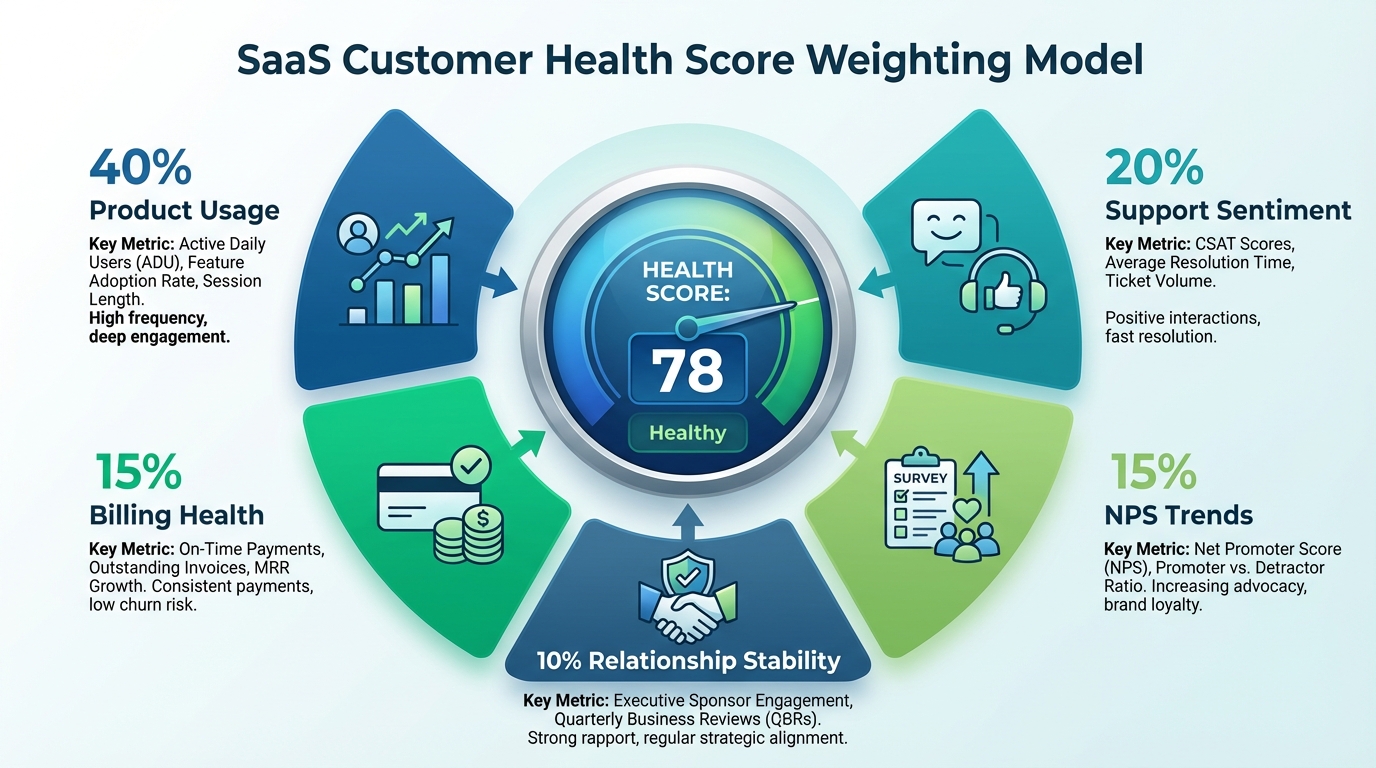
Weighting these signals is where the science of retention truly begins. A standard 2026 weighting model often allocates 40% to product usage depth, 20% to support sentiment, 15% to billing health (including failed payments), 15% to NPS/CSAT trends, and 10% to relationship stability, such as stakeholder changes. When these weights are calibrated quarterly against actual churn outcomes, the predictive accuracy of the model increases exponentially. This allows the AI retention analytics platform to move beyond simple rules-based logic into the realm of machine learning, where feature vector embeddings can predict churn propensity with over 90% accuracy.
Sources:
- Freshworks: Account Health Score overview
- Freshworks: Customer health scoring practical guide
- MoEngage: Data infrastructure and computed attributes
Deploying Predictive Churn Prevention Videos
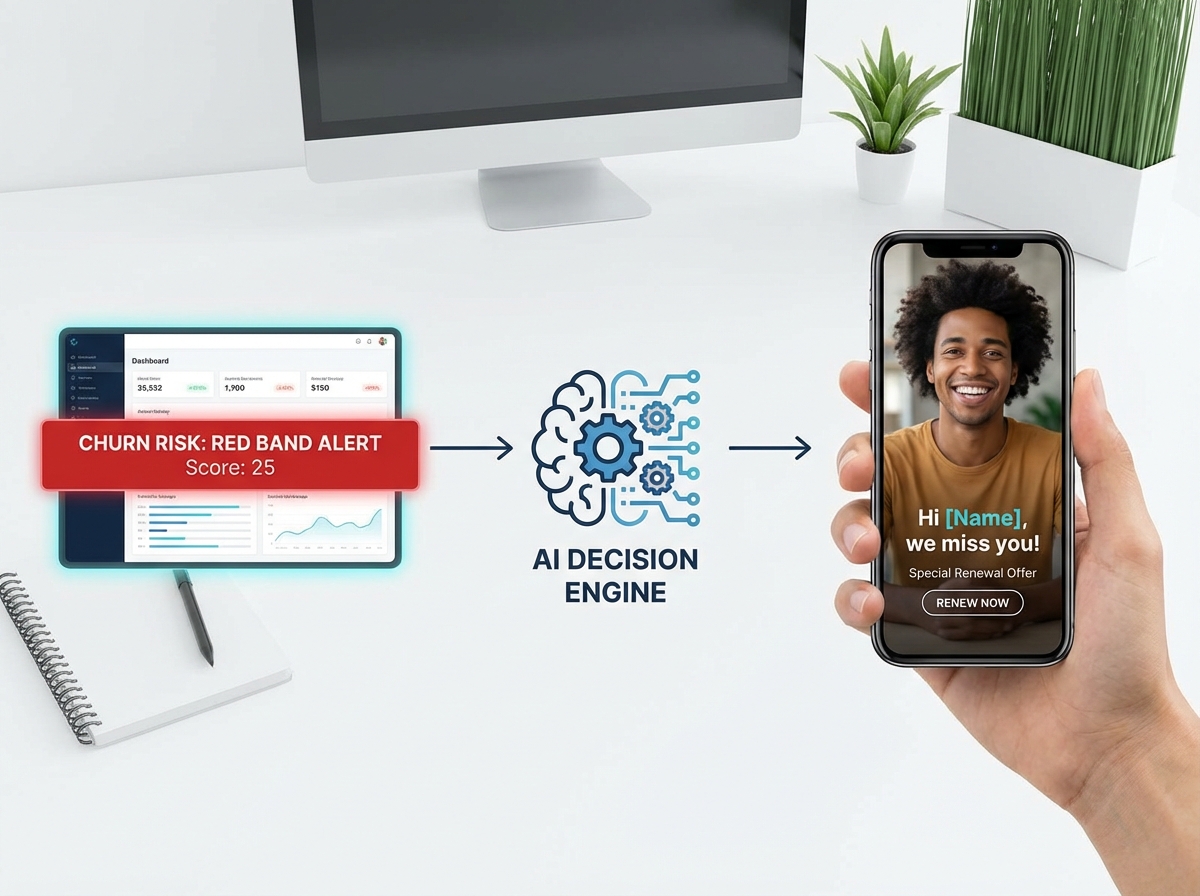
Once a health score drops below a critical threshold—typically the “Red Band” (0-39)—the system must act instantly. This is where predictive churn prevention videos become the primary weapon in a retention leader’s arsenal. Unlike generic automated emails, these videos are context-aware, short-form assets that address the user by name, acknowledge their specific usage hurdles, and provide a direct path to resolution.
Platforms like TrueFan AI enable the generation of these hyper-personalized videos at a scale that matches enterprise demand, rendering millions of unique assets from a single template with latencies under 30 seconds. This speed is crucial because the window of opportunity to “save” a customer after a negative experience or a drop in usage is often less than 24 hours. By the time a CSM manually reaches out, the user may have already begun evaluating a competitor.
The design of these triggers is as important as the content itself. For instance, if a user fails to activate a core feature by day seven of their lifecycle, the customer health scoring automation system triggers a “Value Boost” video. This video doesn’t just say “we miss you”; it demonstrates the specific feature the user is missing, shows the ROI they are leaving on the table, and includes a deep-link CTA to the in-app activation screen. In the Indian market, delivering these videos via WhatsApp has shown a 12.8x ROI, as conversational video flows significantly outperform traditional email outreach.
Sources:
- TrueFan AI: Personalized video software guide
- Netcore Cloud: WhatsApp video success story
- MoEngage: Predictions and automated triggers
Architecting the AI Retention Analytics Platform
The backbone of any successful retention strategy is a centralized AI retention analytics platform that serves as the “brain” of the operation. This platform must ingest data from disparate sources—product telemetry, billing systems like Stripe or Chargebee, support desks like Zendesk, and survey tools—to create a unified identity for every user. In 2026, the integration of these data feeds is no longer a luxury but a prerequisite for survival.
A sophisticated architecture involves real-time event ingestion and identity resolution, ensuring that a drop in usage on a mobile app is immediately correlated with a negative support ticket filed on the web. This data flows into the scoring engine, which updates the customer health scoring automation values. The decision engine then evaluates these scores against pre-defined trigger policies. For example, a “Yellow Band” score (40-69) might trigger a milestone celebration video to reinforce habit loops, while a “Red Band” score triggers an immediate proactive customer rescue campaign.
Governance and privacy are paramount in this architecture. Enterprise-grade platforms must adhere to ISO 27001 and SOC 2 standards, ensuring that PII is handled with extreme care and that video generation follows consent-first protocols. Furthermore, the platform must include a feedback loop where video engagement metrics—such as watch-through rates and CTA clicks—are fed back into the health score. If a customer watches a rescue video in its entirety but does not log in, their health score should reflect a continued high-risk state, perhaps escalating the issue to a human CSM.
Sources:
- MoEngage: Platform comparison (2026)
- Netcore Cloud: Analytics 2.0 and marketing funnels
- TrueFan AI: Enterprise compliance
Scaling Lifecycle Marketing Video automation
Lifecycle marketing video automation represents the transition from generic “drip” campaigns to dynamic, behavior-driven journeys. In 2026, the standard for SaaS excellence is a video-first approach across the entire customer journey, from the moment of signup to the critical renewal window. This ensures that the brand remains top-of-mind and that the value proposition is constantly reinforced through visual storytelling.
Automated customer onboarding videos are the first touchpoint. By Day 0, a user should receive a personalized welcome video that outlines their specific “Success Plan.” If the user is part of a marketing team, the video highlights marketing-specific features; if they are in Ops, it focuses on integrations. TrueFan AI’s 175+ language support and Personalised Celebrity Videos allow global enterprises to localize these onboarding experiences instantly, ensuring that a user in Mumbai receives a different cultural and linguistic experience than one in New York, all while maintaining brand consistency.
As the customer progresses, milestone celebration videos serve to build emotional loyalty. Celebrating a user’s 100th task completed or their first month of active usage creates a “habit loop” that makes the software indispensable. Finally, as the contract expiration nears, renewal reminder automation kicks in. Instead of a dry invoice, the user receives a personalized value recap video. This video summarizes the ROI they achieved over the past year—e.g., “You saved 40 hours of manual work”—and provides a one-click renewal button. This proactive approach has been shown to increase renewal rates by up to 22% in enterprise segments.
Sources:
The 90-Day Blueprint for 50% Churn Reduction Metrics
Achieving 50% churn reduction metrics is an ambitious goal that requires a disciplined, phased implementation. This 90-day blueprint is designed to move an organization from data silos to a fully automated, video-driven retention engine. The focus is on rapid experimentation and scaling what works, using a combination of AI-driven scoring and high-impact video interventions.
Weeks 1-3: Data Mapping and Model Design
The first phase involves inventorying all customer touchpoints and defining the behavioral churn signal detection parameters. You must connect your CRM (e.g., Freshworks) and your engagement platform (e.g., MoEngage) to your data warehouse. During this period, the initial rules-based health score is established. It is critical to identify the “North Star” metric for your product—the one action that, if taken, most correlates with long-term retention.
Weeks 4-6: Video System Integration
In the second phase, the creative and technical infrastructure for lifecycle marketing video automation is built. This includes drafting scripts for renewal, rescue, and onboarding templates. Personalization fields such as {First_Name}, {Company_Name}, and {Last_Feature_Used} are mapped to the TrueFan AI API. Solutions like TrueFan AI demonstrate ROI through their ability to handle high-volume bursts, such as 354,000 videos per day, ensuring that even the largest enterprise campaigns are delivered without latency.
Weeks 7-12: Pilot, Calibrate, and Scale
The final phase is the launch of proactive customer rescue campaigns targeting the “Red Band” accounts. A/B testing is conducted on video scripts using virtual reshoots to determine which messaging resonates most with at-risk users. By Month 3, the system should be fully operational, with dashboards tracking leading indicators like watch-through rates and lagging indicators like gross churn. To claim a 50% reduction, organizations must use a holdout control group to measure the incremental lift provided by the automated video interventions versus the standard outreach.
Sources:
Strategic Governance and Future-Proofing Retention
As we look toward the end of 2026, the maturity of customer health scoring automation will be defined by its ability to handle complex, multi-stakeholder environments. In enterprise SaaS, a single user’s behavior is rarely enough to predict an entire account’s churn. Future-proof systems will incorporate “Organizational Health” scores, which aggregate the sentiment and usage of multiple stakeholders, from the end-user to the C-suite decision-maker.
One often-overlooked subtopic is the integration of NLP-driven sentiment analysis from support tickets directly into the health score. If a user’s usage is high but their support tickets exhibit rising frustration or “negative sentiment” scores, the automation must recognize this as a high-risk signal. Similarly, dunning-specific video interventions—where a personalized video explains a failed payment and provides a secure link to update billing—can recover up to 15% of involuntary churn that traditional emails miss.
Finally, the deliverability of these assets is a critical technical hurdle. In regions with varying bandwidth, such as parts of India, optimizing video thumbnails and providing static fallbacks is essential. The use of WhatsApp as a primary delivery channel requires strict adherence to template approvals and opt-out management. By maintaining a high standard of deliverability and accessibility (including automated captions and transcripts), enterprises ensure that their retention message is heard by every customer, regardless of their device or location.
Sources:
Recommended Internal Links
- Customer health scoring automation
- Predictive churn prevention videos
- Predictive churn prevention videos guide
- Predictive churn prevention for SaaS
- Automated customer onboarding videos guide
- WhatsApp catalog video marketing
- WhatsApp catalog video marketing guide
Sources:
Frequently Asked Questions
How do I automate customer health scoring for a large enterprise?
Integrate product usage data, support tickets, and billing status into a centralized AI retention analytics platform. Define weighted signals (e.g., usage depth, NPS/CSAT, billing health) and thresholds that trigger automated workflows. Platforms like Freshworks and MoEngage can compute scores in real time and sync them with engagement tools for timely interventions.
What are predictive churn prevention videos?
Predictive churn prevention videos are personalized, short-form assets generated automatically when a customer’s health score indicates high churn risk. They use dynamic data to address specific pain points, offer tailored guidance or incentives, and provide direct CTAs to re-engage the user.
How do proactive customer rescue campaigns work?
They pair behavioral churn signal detection with immediate outreach. When a “Red Band” score is detected, the system triggers a personalized video via channels like WhatsApp or email, followed by a prioritized CSM task—combining high-tech automation with high-touch human follow-up.
Can TrueFan AI handle the volume required for global SaaS companies?
Yes. TrueFan AI is built for enterprise scale, generating millions of videos with sub-30-second render latency. Its 175+ language support and Personalised Celebrity Videos enable global brands to localize and personalize retention campaigns effectively.
What metrics should I track to prove a 50% churn reduction?
Track leading indicators (watch-through rates, feature adoption lift, login frequency) and lagging indicators (gross churn, net revenue retention, renewal uplift). Use an RCT with a holdout control to isolate the incremental impact of automated video interventions versus standard outreach.



