
Blockchain Video Verification India 2026: A CISO Playbook for Authentic AI Celebrity Videos
Estimated reading time: ~12 minutes
Key Takeaways
- Provenance-by-design beats detection: cryptographic manifests and signatures ensure deterministic authenticity.
- Hybrid blockchain (public + permissioned) enables transparent verification with enterprise privacy controls.
- Smart contracts automate DPDP-compliant consent, licensing, and instant revocation across campaigns.
- Trust signals (badges/QR) lift CTR and brand affinity by exposing verifiable content credentials.
- Phased rollout delivers ROI: start with pilots, scale NFT authentication, then automate rights and hybrid anchoring.
The Indian digital landscape in 2026 is defined by a paradoxical tension between hyper-personalized engagement and a systemic erosion of digital trust. As Chief Information Security Officers (CISOs) and brand safety leaders navigate this terrain, blockchain video verification India has emerged as the definitive enterprise-grade solution for securing synthetic media. The rapid proliferation of AI-generated celebrity endorsements, while driving unprecedented marketing ROI, has simultaneously expanded the attack surface for deepfake-driven corporate espionage and reputational sabotage.
For Indian enterprises, the mandate is no longer merely to create compelling content but to provide verifiable proof of origin, integrity, and consent. Implementing a robust framework for blockchain video verification India 2026 is now a critical compliance requirement under evolving MeitY guidelines and the Digital Personal Data Protection (DPDP) Act. This playbook outlines the strategic transition from reactive content monitoring to a proactive, provenance-by-design architecture that anchors brand equity in cryptographic certainty.
Platforms like TrueFan AI enable enterprises to bridge this trust gap by integrating sophisticated provenance markers directly into the generative pipeline. By establishing an immutable link between the celebrity’s digital likeness and the brand’s authorized distribution channels, organizations can effectively neutralize the threat of unauthorized synthetic media. This strategic shift ensures that every frame of AI-generated content serves as a verified asset rather than a potential liability.
Sources:
- MeitY IT Rules & Deepfake Advisory (2026)
- ASCI ADNext 2025 Report
- ET BrandEquity: Deepfakes in advertising—when fiction becomes fraud
Establishing the Gold Standard for AI Content Authenticity Certification
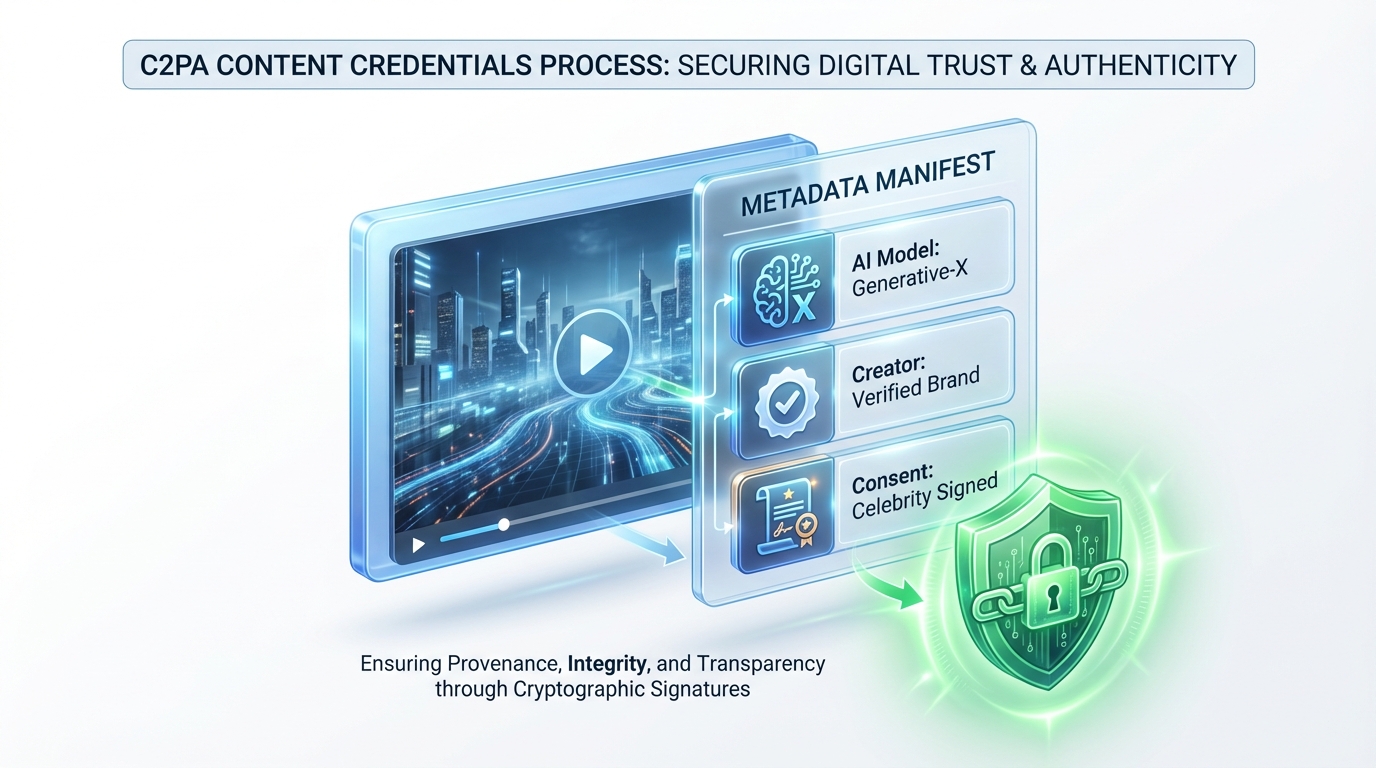
In the current regulatory climate, a simple watermark is insufficient to deter sophisticated adversarial AI; instead, brands must adopt a comprehensive AI content authenticity certification framework. This process involves the creation of a cryptographically signed manifest that travels with the video file, detailing its entire lifecycle from generation to final edit. By utilizing C2PA-style Content Credentials, Indian brands can embed metadata that includes the specific AI models used, the identity of the creator, and the explicit consent artifacts from the celebrity involved.
The core principle of this certification is “provenance-by-design,” which ensures that trust signals are baked into the asset at the moment of inception. Unlike post-facto detection tools, which often struggle with high false-positive rates, a certification system provides a deterministic proof of authenticity. This is particularly vital in India, where the 2026 TRM Labs Crypto Crime Report indicates that deepfake-related financial fraud has surged by 300% year-over-year, necessitating a shift toward zero-trust media environments.
To achieve this, enterprises must implement cryptographic content signing using Hardware Security Modules (HSMs) to protect the private keys used for asset validation. This ensures that even if a video is intercepted or modified, the digital signature will break, immediately alerting distribution platforms and consumers to the tampering. Such a tamper-proof video certification system creates a resilient barrier against the “liar’s dividend,” where bad actors exploit the existence of deepfakes to claim that authentic, damaging footage is actually AI-generated.
Sources:
- TrueFan AI: Content Authenticity Certification Guide
- TRM Labs: 2026 Crypto Crime Report
- NASSCOM: Blockchain Trends 2026 and beyond
Architectural Blueprint for a Blockchain Content Provenance Platform
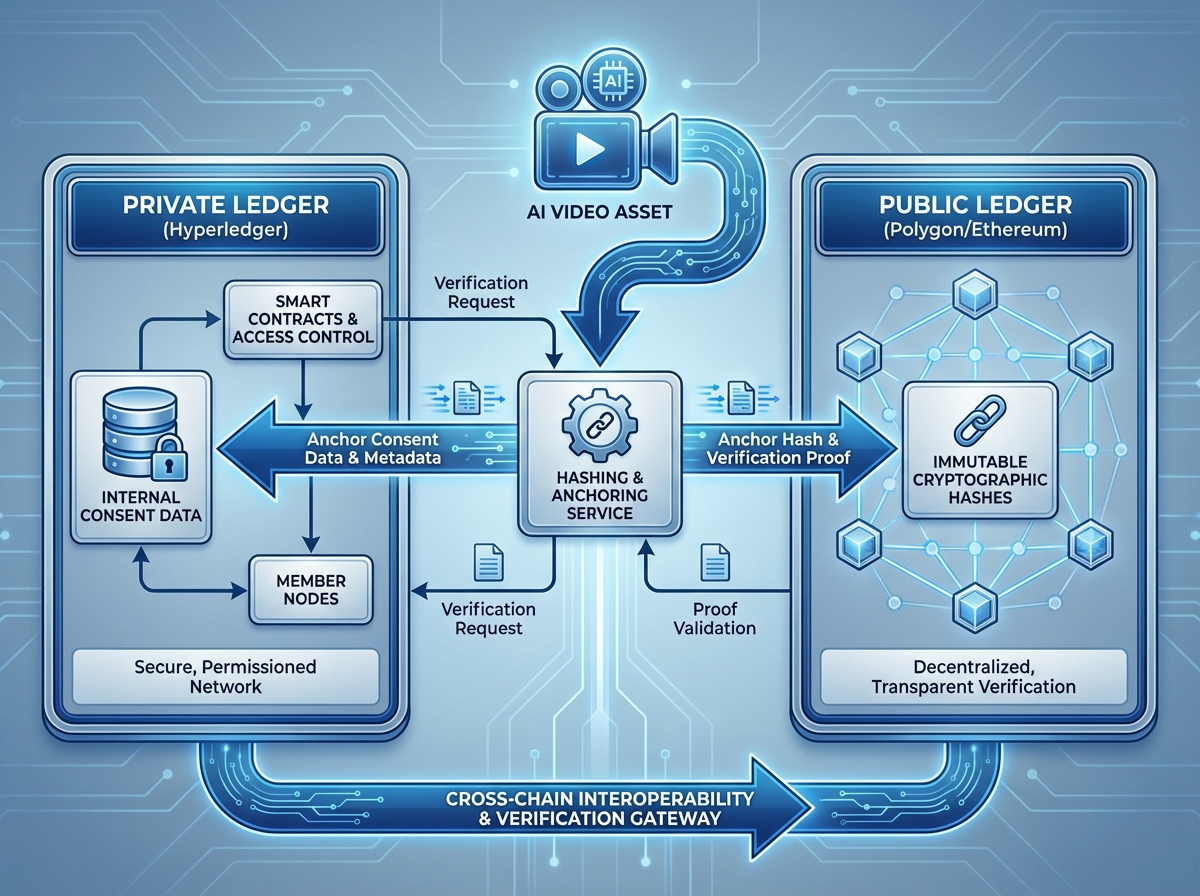
Deploying a blockchain content provenance platform within the Indian enterprise stack requires a sophisticated hybrid ledger strategy to balance transparency with data privacy. While public blockchains like Polygon or Ethereum provide the necessary immutability for public-facing verification, permissioned chains like Hyperledger Fabric are better suited for internal governance and high-throughput event logging. This dual-layered approach allows brands to store sensitive consent data and internal workflows on a private ledger while anchoring the final cryptographic hashes on a public chain for external auditing.
The data flow begins with the ingestion of AI celebrity video assets into the provenance engine, where a unique SHA-256 hash is generated for every version of the content. This hash, along with a pointer to the signed C2PA manifest, is then committed to the blockchain, creating an immutable content verification trail that is accessible to third-party platforms. By 2026, NASSCOM reports that 85% of Indian enterprises have adopted hybrid blockchain models to meet the stringent latency requirements of the domestic market, where verification must occur in under 250 milliseconds.
Furthermore, the integration of decentralized video validation endpoints allows for real-time integrity checks across diverse distribution channels, including OTT platforms, social media, and WhatsApp. This architecture prevents the “re-compression” problem, where traditional watermarks are stripped during platform optimization. Because the verification is tied to the file's cryptographic hash rather than visual pixels, the authenticity remains intact regardless of the distribution medium or resolution changes.
Sources:
- Rain Infotech: 2026 Enterprise Blockchain Trends
- Finextra: Blockchain security advances in 2026
- NASSCOM: Interoperability Standards
Implementing Smart Contract Video Rights Management for DPDP Compliance
The intersection of the Digital Personal Data Protection (DPDP) Act and AI marketing necessitates a transition toward smart contract video rights management. In 2026, Indian brands are legally obligated to maintain granular, revocable consent for any digital likeness used in advertising. By codifying these license terms into smart contracts, enterprises can automate the enforcement of geography-specific usage, language restrictions, and campaign expiry dates, ensuring that assets are never used outside their authorized scope.
These smart contracts act as the operational backbone for NFT video authentication in India, where each master asset is represented by a non-transferable (soulbound) token on the ledger. This token contains the “Master Certificate,” linking the video hash to the specific celebrity consent ID and the DPDP-mandated notice link. If a celebrity withdraws consent or a license expires, the smart contract automatically updates the asset's status to “revoked,” which is instantly reflected across all decentralized verification widgets.
This level of automation is critical for managing the scale of modern campaigns, where a single celebrity might appear in thousands of personalized video variants across 175+ languages. Traditional manual rights management is prone to human error, leading to costly legal disputes and regulatory fines. By leveraging distributed ledger content tracking, CISOs can provide auditors with a real-time, tamper-evident log of every consent event and usage instance, significantly reducing the burden of compliance during MeitY or ASCI investigations.
Sources:
Leveraging Synthetic Media Trust Signals for Marketing Growth
Provenance is not merely a security function; it is a powerful marketing tool that can be operationalized through synthetic media trust signals. In an era where 70% of Indian consumers express skepticism toward AI-powered advertisements, providing a visible “Verified by Blockchain” badge can significantly increase click-through rates and brand affinity. These signals, often delivered via a QR code or a “Trust Badge” on the video player, resolve to a public verification page that displays the asset’s origin, the celebrity’s authorized consent, and the blockchain transaction ID.
TrueFan AI's 175+ language support and Personalised Celebrity Videos are enhanced by these trust signals, ensuring that even hyper-localized content carries the weight of enterprise-grade verification. When a user interacts with a verified badge, they are not just seeing a label; they are accessing a decentralized video validation protocol that cross-checks the current asset against the immutable record on the ledger. This transparency builds a “trust premium,” allowing brands to charge more for verified placements and reducing the likelihood of ad-blocking by skeptical users.
Furthermore, aligning these trust signals with Web3 compliance marketing standards ensures that brands stay ahead of ASCI’s 2026 disclosure requirements. The ASCI ADNext report highlights that consumers now expect explicit labeling of AI-generated content that is both human-readable and machine-verifiable. By integrating these disclosures into the provenance UI, brands can fulfill their ethical obligations while simultaneously reinforcing their commitment to technological leadership and consumer protection.
Sources:
- TrueFan AI: Blockchain verification marketing (2026)
- ASCI ADNext 2025: Consumer expectations
- JSA Law: MeitY AI labeling advisory
A 12-Month Roadmap for NFT Video Authentication India Rollout
For the CISO, the transition to a blockchain-backed provenance ecosystem must be phased to ensure operational continuity and stakeholder alignment. The first 90 days should focus on a pilot program for verified celebrity video marketing, targeting high-impact campaigns with a limited set of AI assets. During this phase, the organization should establish its HSM-backed signing infrastructure and deploy the initial verification widgets on a permissioned ledger to test latency and UX friction on Indian mobile networks.
In the second phase (months 3-6), the focus shifts to scaling the NFT video authentication India framework across all synthetic media production. This involves integrating the provenance engine with the existing Digital Asset Management (DAM) and CRM systems, enabling automated certificate issuance for every personalized video variant. Solutions like TrueFan AI demonstrate ROI through this phase by reducing the manual overhead of content certification and providing real-time abuse monitoring that alerts the security team to any unauthorized attempts to replicate or modify brand assets.
The final phase (months 6-12) involves the full automation of smart contract video rights management and the implementation of a hybrid ledger anchoring strategy. By this stage, the enterprise should have a comprehensive KPI dashboard tracking provenance coverage, verification latency, and the “trust lift” in conversion metrics. This roadmap ensures that by the end of the year, the brand has moved from a state of vulnerability to a position of “provenance leadership,” where every piece of AI content is a cryptographically secured asset that strengthens the brand's digital sovereignty.
Sources:
- JPMorgan Payments: 2026 trends
- TrueFan AI: Implementation checklist
- TOI: FIU-IND identity integrity norms
Conclusion: Securing the Future of Indian Martech
The implementation of blockchain video verification India is no longer a futuristic luxury but a foundational necessity for the 2026 enterprise. As AI continues to redefine the boundaries of celebrity engagement and personalized marketing, the ability to prove authenticity will be the ultimate competitive advantage. By adopting a provenance-by-design philosophy, Indian brands can protect their reputations, ensure regulatory compliance, and build lasting trust with a discerning digital audience. The transition to a cryptographically verified media ecosystem is the only viable path forward in an age of synthetic ubiquity.
Recommended Internal Links
- AI Content Authenticity Certification for Trusted Video
- AI Content Authenticity Certification: India 2026 Guide
- C2PA Watermarking for AI Video Marketing: Enterprise Guide
Frequently Asked Questions
How does blockchain video verification India differ from traditional digital watermarking?
Traditional watermarking is often “fragile” and can be removed through re-encoding, cropping, or AI-based removal tools. In contrast, blockchain video verification India relies on cryptographic hashing and C2PA manifests that are anchored to a decentralized ledger. This creates a “hardened” provenance trail that is independent of the visual pixels, allowing for verification even if the video is compressed or shared across different social platforms.
Is smart contract video rights management legally binding in Indian courts?
While smart contracts provide automated operational control, they are typically paired with traditional Master Services Agreements (MSAs) to ensure full legal enforceability under the Indian Contract Act. However, the immutable logs generated by the blockchain serve as primary evidence of consent and usage, which is highly valuable for compliance with the DPDP Act and MeitY's 2026 evidentiary standards for digital content.
What is the impact of decentralized video validation on mobile page load speeds?
Modern provenance platforms use edge-cached manifests and pre-generated proofs to ensure that the verification process is nearly instantaneous. In the Indian context, where 5G penetration is high but network stability varies, a well-architected system targets a sub-250ms verification latency. This ensures that synthetic media trust signals do not negatively impact the user experience or Core Web Vitals.
Can TrueFan AI help our brand meet the 2026 MeitY deepfake labeling requirements?
Yes, TrueFan AI's enterprise offerings include built-in C2PA manifest generation and blockchain anchoring, which directly satisfy the labeling and provenance obligations set forth in the latest MeitY advisories. By using TrueFan AI, brands can automate the disclosure process, ensuring that every AI-generated celebrity video includes the necessary metadata and human-readable trust signals required for regulatory compliance.
How does NFT video authentication India prevent the unauthorized use of celebrity likeness?
By minting a non-transferable NFT for each authorized video template, the brand creates a “Master Certificate” that is the only recognized source of truth. Any video claiming to be an official endorsement that does not resolve to a valid on-chain certificate is immediately flagged as unauthorized. This allows for automated takedown notices and provides a clear signal to platforms like YouTube and Meta to remove the infringing content.
What are the primary KPIs for measuring the success of a provenance strategy?
CISOs should track “Provenance Coverage” (the percentage of AI assets with certificates), “Verification Latency,” and “Abuse Mitigation Rate” (the speed at which unauthorized deepfakes are detected and removed). From a marketing perspective, the “Trust Lift”—measured by the delta in CTR and conversion rates between verified and unverified content—is the primary metric for demonstrating ROI to the C-suite.
How does this approach handle re-compression and platform optimization?
Because verification is anchored to cryptographic hashes and manifests rather than visual pixels, authenticity remains intact even when videos are re-encoded, cropped, or optimized by social and OTT platforms. Decentralized validation endpoints compare the served asset to the on-ledger record, preserving verification across resolutions and formats.