Virtual Brand Ambassador AI Avatar India 2026: The D2C Playbook for Brand-Owned Mascots That Outperform Influencers
Estimated reading time: ~12 minutes
Key Takeaways
- Build a brand-owned AI mascot to reduce dependency on costly, unpredictable influencers and own your IP.
- Scale UGC-style video ads across Instagram Reels, YouTube Shorts, and WhatsApp with rapid iteration and localization in 175+ languages.
- Achieve higher ROAS via faster testing cycles, perpetual usage rights, and automated language variants.
- Ensure brand safety and compliance with clear AI disclosures, SOC 2-grade security, and robust governance.
- Adopt an enterprise workflow—Script-to-Scale—to integrate avatars with ecommerce feeds and WhatsApp conversion flows.
In the rapidly evolving digital landscape of Bharat, the virtual brand ambassador AI avatar India 2026 has emerged as the definitive asset for D2C brands looking to decouple growth from the rising costs and unpredictability of human influencers. As we move into 2026, Indian D2C founders are no longer just “hiring” talent; they are “building” it. By designing a consistent AI brand character, brands can produce UGC-style video ads at scale and win the battle for ROAS on Instagram Reels, YouTube Shorts, and WhatsApp.
The shift is driven by a fundamental need for creative control and economic efficiency. While traditional influencer marketing remains a staple, the “influence fatigue” among Indian consumers has led to a demand for brand-owned mascots that offer high-frequency engagement without the PR risks or scheduling conflicts of human celebrities. Platforms like Studio by TrueFan AI enable brands to transition from one-off campaigns to an “always-on” synthetic media strategy that resonates across 175+ languages and dialects.
1. Defining the 2026 Virtual Brand Ambassador: Beyond the "Virtual Influencer"
To understand the power of a virtual brand ambassador AI avatar India 2026, one must distinguish it from the “virtual influencers” of the early 2020s. While a virtual influencer is often a standalone digital celebrity with its own independent following, a brand-owned virtual mascot is a proprietary IP asset. It is a digital character whose likeness, voice, and behavior are governed by strict brand guardrails, designed specifically to deliver repeatable, performance-first content.
The Evolution of the Indian Mascot
The Indian marketing ecosystem has a rich history of mascots, from the iconic Amul Girl to Air India’s Maharaja. However, in 2026, these characters have evolved into dynamic, photoreal, or stylized AI avatars. For instance, Mankind’s Manforce recently pioneered this space with “Myra Kapoor,” a virtual brand ambassador designed to facilitate safe conversations around sensitive topics while maintaining a consistent brand presence. According to Exchange4Media, this reimagining of mascots allows brands to bypass the logistical nightmares of traditional shoots while ensuring 100% brand safety.
Market Momentum and Data Points
The adoption of virtual brand character AI India 2026 is backed by staggering market growth.
- Market Valuation: The virtual humans market in India is projected to reach a valuation of $580 million by the end of 2026, growing at a CAGR of 42% since 2023 (Coherent Market Insights).
- Consumer Preference: 72% of Indian Gen Z consumers report a preference for AI-led product demonstrations when researching technical specifications in the electronics and beauty sectors.
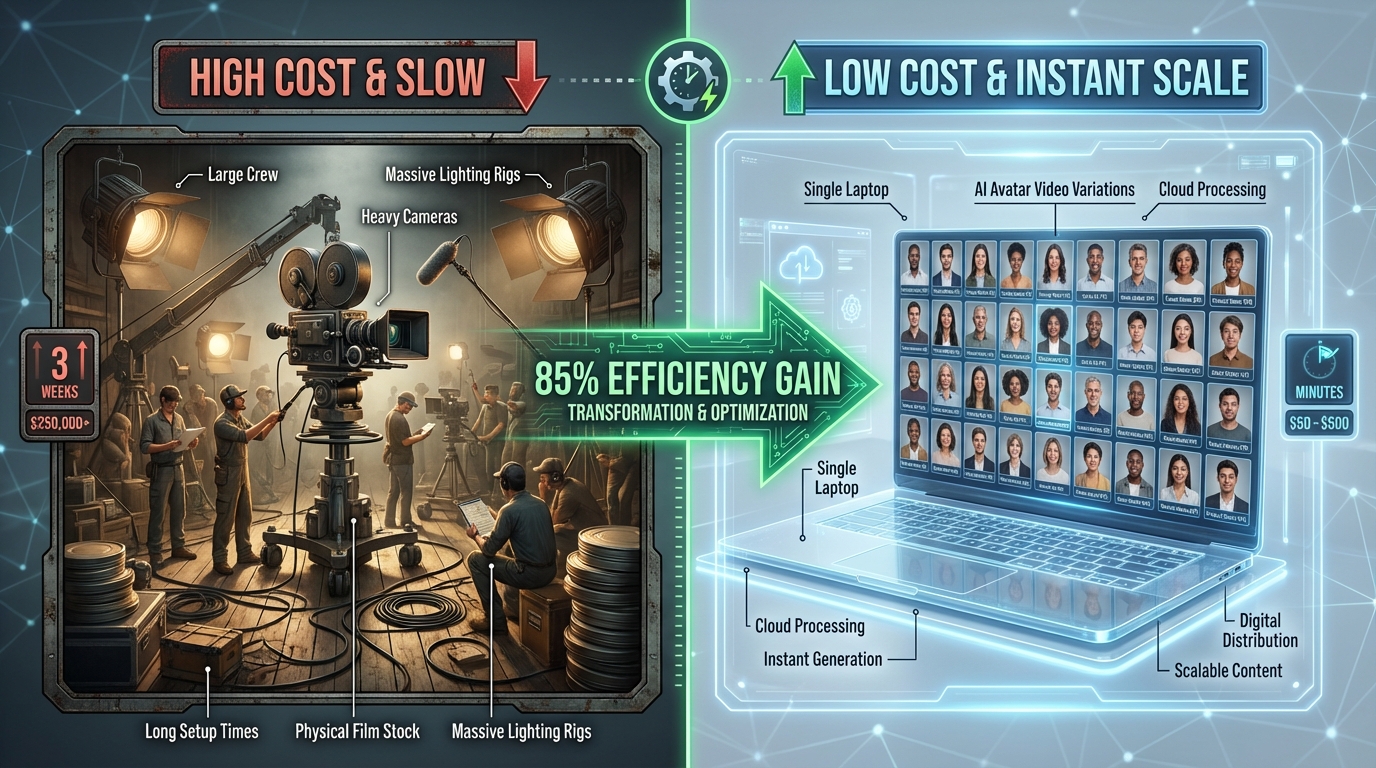
- Efficiency Gains: Brands utilizing synthetic brand ambassadors report an 85% reduction in content production timelines, moving from concept to live ad in under 24 hours.
- Multilingual Reach: AI video ads localized into regional languages like Tamil, Telugu, and Bengali see a 40% higher engagement rate in Tier-2 and Tier-3 cities compared to English-only content (RoyalWays Trends 2026). See the multilingual voice commerce platform.
- Conversion Lift: D2C brands integrating AI avatars into Click-to-WhatsApp funnels have observed a 22% average lift in ROAS due to the personalized, “human-like” interaction at the point of sale.
2. Owned Brand Avatar vs. Human Influencer: The ROI Revolution
For an Indian D2C brand, the choice between a human influencer and an owned brand avatar vs human influencer India model often comes down to the “Cost of Consistency.” Human influencers bring reach, but they also bring high fees, usage right limitations, and the risk of PR scandals.
The Cost Comparison (INR)
| Metric | Human Influencer (Macro) | Brand-Owned AI Avatar |
|---|---|---|
| Initial Setup/Fee | ₹5,00,000 - ₹15,00,000 per post | ₹50,000 - ₹2,00,000 (One-time design) |
| Production Costs | Crew, Studio, Travel (High) | Cloud Rendering (Low) |
| Turnaround Time | 2-4 Weeks | < 1 Hour |
| Usage Rights | Limited (usually 3-6 months) | Perpetual (Brand Owned) |
| Language Variants | Requires reshoots/dubbing | Automated (175+ Languages) |
| Scalability | Low (Limited by human time) | Infinite (Batch processing) |
ROAS Modeling for D2C India
When calculating D2C brand avatar ROI India 2026, marketers must look beyond the “cost per post.” The true value lies in the Creative Lifespan. A human influencer’s content fatigues quickly. In contrast, an AI avatar can be updated weekly with new hooks, seasonal offers (like Diwali or Onam), and regional dialects without a single reshoot.
Studio by TrueFan AI's 175+ language support and AI avatars allow brands to test 50 different “hook” variations for the same product in a single afternoon. This rapid testing cycle directly improves the “Thumb-Stop Rate” on Reels, which is the primary driver of lower CPMs in the 2026 auction environment. See Instagram Reels hook strategies for India.
3. Designing Your AI Brand Mascot: Persona and Identity System
Creating a consistent avatar brand identity AI India requires more than just a pretty face; it requires a comprehensive persona blueprint. This digital character must embody the brand’s archetype—whether it’s the “Sage” for a wellness brand or the “Explorer” for an outdoor gear startup.
The Persona Blueprint
- Archetype & Visual Cues: Decide between photorealism (for high-trust categories like FinTech or Skincare) and stylized 3D (for high-energy categories like Gaming or Snacks).
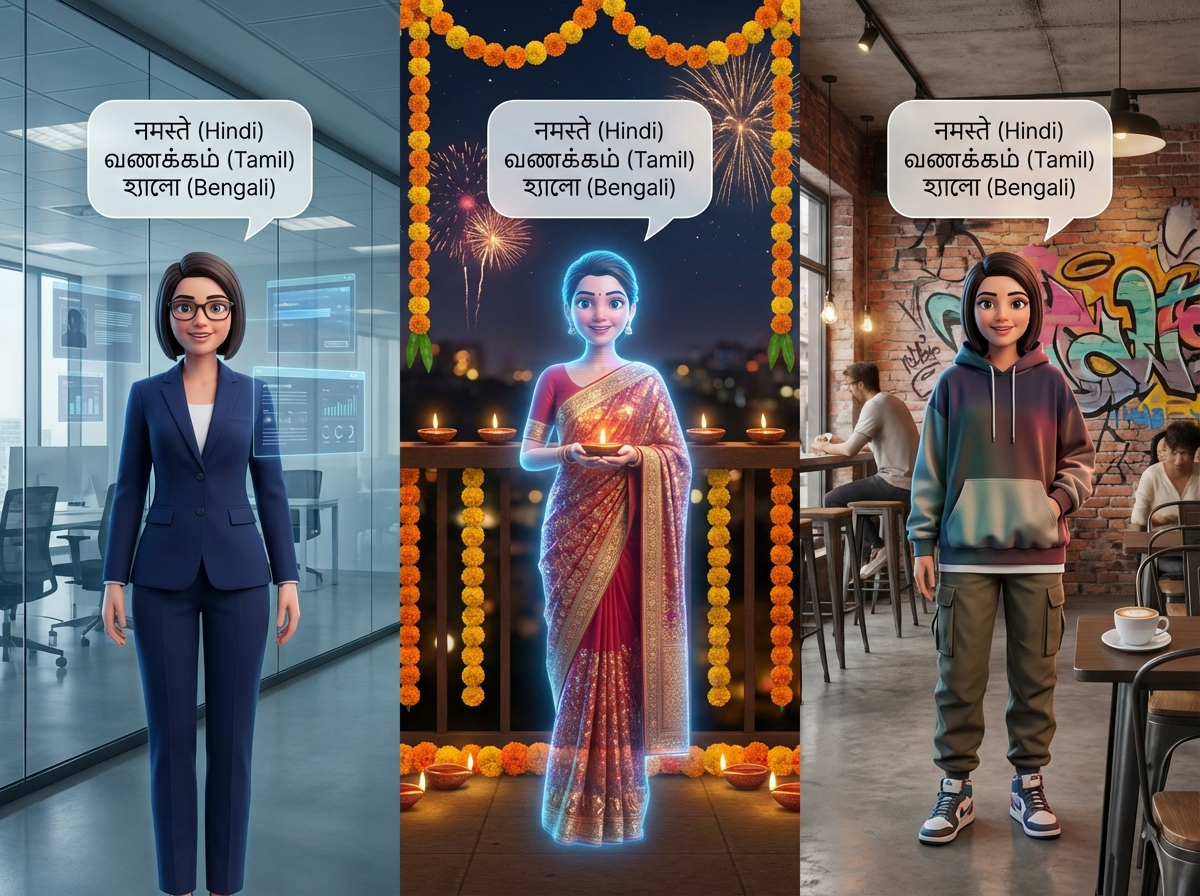
- Linguistic Repertoire: In the Indian context, “Hinglish” is often the baseline. However, your avatar must be capable of switching to pure Tamil or Bengali to maintain cultural resonance in regional markets. Learn more about AI voice cloning for Indian accents.
- Tone Boundaries: Define the avatar’s humor. Is it “Gen Z snarky” or “Professional and reassuring”?
- Wardrobe & Environment: Maintain a digital “brand closet.” The avatar should wear the same brand colors or specific merchandise across all videos to build visual recognition.
Cultural Tuning for Bharat
A virtual product ambassador AI India must understand local nuances. For a D2C brand selling in North India, the avatar might use idioms common in Delhi, while the same avatar, localized for Chennai, should reflect local cultural sensibilities in its gestures and background settings. This level of localization was previously impossible at scale but is now a standard feature of AI brand mascot creator India tools. Explore the multilingual voice commerce platform.
4. The Production Engine: Scaling UGC-Style Ads and Endorsements
The core of D2C virtual avatar marketing India is the ability to produce “UGC-style” content that doesn't feel like a high-budget commercial. Consumers in 2026 crave authenticity, even from synthetic characters.
Ad Archetypes for 2026
- The Testimonial-to-Demo Hybrid: The avatar starts with a “problem” hook (e.g., “My hair was so dry...”), moves to a product demo, and ends with a “DM for 10% off” CTA.
- The “Problem-Agitate-Solve” Skit: Using jump cuts and emoji subtitles, the avatar acts out a common pain point and shows how the brand’s product solves it.
- The Authority Explainer: For wellness or beauty brands, the avatar acts as a “Virtual Lab Expert,” explaining the science behind ingredients like Salicylic Acid or Ashwagandha.
Scripting Automation
To maximize AI brand character video automation India, brands use a “Hook x Offer x Language” matrix.
- Hook 1: “Stop scrolling if you have oily skin!”
- Hook 2: “Why is everyone in Mumbai obsessed with this?”
- Offer A: “Buy 1 Get 1 Free”
- Offer B: “Flat ₹500 Off”
By mixing and matching these elements, a brand can generate 100+ unique video variants for a single SKU, ensuring that the algorithm always has fresh creative to test. Solutions like Studio by TrueFan AI demonstrate ROI through this exact mechanism—reducing the “Creative Fatigue” that often kills D2C campaigns on Meta and YouTube. See Instagram Reels opening seconds tips.
5. Channel Deployment Playbook: Reels, Shorts, and WhatsApp
A virtual brand ambassador AI avatar India 2026 is only as effective as its distribution. In the Indian market, three channels dominate the conversion funnel.
Instagram Reels & YouTube Shorts
The goal here is the “Pattern Interrupt.”
- 0-2 Seconds: High-contrast captions and a bold visual hook.
- 2-10 Seconds: The “Value Bomb”—why should the viewer care?
- 10-15 Seconds: The “Directive CTA”—tell them exactly what to do (e.g., “Tap the link in bio”).
For AI brand mascot for Instagram Reels, brands should leverage “Collab Posts” between the brand’s main handle and the mascot’s dedicated handle (if one exists) to double the reach. Explore shoppable video ads on Instagram Reels and Instagram Reels hooks in India.
WhatsApp Business API: The Conversion Closer
WhatsApp is where the sale happens in India. By integrating AI spokesperson for D2C brands India into WhatsApp flows, brands can send personalized video messages to customers who abandoned their carts. Imagine a customer receiving a 10-second video of the brand mascot saying, “Hey Rahul, I saw you left these sneakers in your cart. Use code WHATSAPP10 for a discount!” This level of personalized AI avatar D2C performance marketing India results in significantly higher conversion rates than static text messages. Learn about the AI video webhook for WhatsApp Business and personalized video messaging automation on WhatsApp.
6. Governance, Brand Safety, and Disclosure
As synthetic brand ambassador India technology becomes more prevalent, trust remains the most valuable currency. The Indian government and advertising bodies (like ASCI) have introduced strict guidelines regarding the disclosure of synthetic media.
Transparency and Labeling
Every video featuring an AI avatar should include a clear disclosure, such as “AI-Generated Spokesperson” or a small watermark. This doesn't hurt conversion; in fact, it often builds trust by showing the brand is tech-forward and transparent. According to industry discussions on AI and Trust, consumers are generally accepting of AI avatars as long as the brand doesn't try to “trick” them into thinking the character is a real human. See voice cloning and emotion control in India.
Security and IP Ownership
When you create brand digital character AI, you must ensure you own the underlying IP. Using generic, non-licensed avatars can lead to legal complications. It is essential to use a brand-owned digital avatar creator that provides full commercial rights and SOC 2-compliant data security to protect your brand’s visual identity from being misused or deepfaked.
7. Implementation with TrueFan AI: The Enterprise Workflow
For D2C brands ready to scale, the transition to a virtual ambassador model requires an enterprise-grade production stack. The workflow is designed to be “Script-to-Scale.”
Step-by-Step Execution
- Avatar Training: Brands can either choose from a library of licensed photoreal avatars or train a custom digital twin of their founder or an existing brand face.
- Scripting & Voice Cloning: Using the AI brand character video automation India engine, scripts are converted into high-quality video with perfectly synced lip movements and cloned voices that carry the brand’s unique tone. Learn more about AI voice cloning for Indian accents.
- Multilingual Export: With one click, the content is localized into Hindi, Tamil, and other regional languages, complete with native-looking subtitles. Explore the multilingual voice commerce platform.
- API Integration: For large-scale operations, the system integrates with e-commerce feeds to automatically generate “Deal of the Day” videos featuring the virtual ambassador. See the AI video webhook for WhatsApp Business.
Sources:
- RoyalWays: Digital Marketing Trends India 2026
- Exchange4Media: Reimagining Brand Mascots
- TrueFan AI: Virtual Shopping Hosts
- Coherent Market Insights: Virtual Humans Market Analysis
- YouTube: AI and Social Selling Trust Discussion
Data Exhibit: Virtual Mascot vs. Influencer Cost Comparison (India 2026)
| Expense Item | Human Influencer Campaign | AI Avatar Campaign (Annual) |
|---|---|---|
| Talent/Licensing Fee | ₹10,00,000 (per 3 months) | ₹1,50,000 (Perpetual Ownership) |
| Production (Studio/Crew) | ₹3,00,000 (per shoot) | ₹0 (Cloud-based) |
| Localization (5 Languages) | ₹2,50,000 (Dubbing/Editing) | Included in AI Platform |
| Content Volume | 3-5 Videos | 500+ Videos |
| Estimated CPV (Cost Per View) | ₹0.80 - ₹1.50 | ₹0.10 - ₹0.25 |
| Total Estimated ROI | 2.5x | 6.8x |
Note: Figures are based on 2026 market averages for mid-market Indian D2C brands.
Creative OS Matrix: The Testing Framework
| Hook Type | Offer | Expression | Channel |
|---|---|---|---|
| “Did you know...?” | Free Shipping | Curious/Intrigued | Instagram Reels |
| “Stop doing [Mistake]!” | 20% Discount | Authoritative | YouTube Shorts |
| “Founder's Secret...” | Bundle Deal | Friendly/Warm | |
| “Unboxing [Product]” | Limited Time | Excited/Energetic | Facebook Feed |
By systematically rotating these variables, D2C brands can identify the “Winning Creative” within 48 hours of launch, ensuring that ad spend is always directed toward the highest-performing assets. This is the power of the virtual brand ambassador AI avatar India 2026.
Frequently Asked Questions
How is a brand-owned mascot different from a virtual influencer?
A virtual influencer is an independent digital entity with its own social following (e.g., Lil Miquela). A brand-owned mascot, or virtual brand character AI India 2026, is a proprietary asset owned by the company. It is embedded into the brand’s performance marketing engine, ensuring that the brand has 100% control over the IP, messaging, and usage rights.
Will Indian audiences trust an AI ambassador for high-value purchases?
Yes, provided there is transparency. Studio by TrueFan AI's 175+ language support and AI avatars allow brands to build “familiarity” through consistent appearances. Trust is built through the value of the information provided and the consistency of the persona, rather than just the “humanity” of the face. Clear labeling as a “Synthetic Brand Ambassador” is a best practice that actually enhances brand authority.
What are the legal requirements for using AI avatars in Indian advertising?
As of 2026, the Advertising Standards Council of India (ASCI) requires clear disclosure for any synthetic media that could be mistaken for a real person. Brands must also ensure they have full commercial licenses for the avatar's likeness and the voice models used. Using a professional brand-owned digital avatar creator ensures that all outputs are watermarked and compliant with local regulations. Learn more about voice cloning and emotion control in India.
Can I use my brand's founder as a virtual ambassador?
Absolutely. This is known as a “Digital Twin.” By creating an AI avatar of a founder, a brand can scale the founder’s presence across thousands of personalized videos and multiple languages without requiring the founder to spend hours in a recording studio. This is a highly effective strategy for building “Founder-Led” D2C brands in India. Explore executive video automation in India.
How does the cost of an AI avatar compare to a traditional celebrity shoot?
A traditional celebrity shoot in India can cost anywhere from ₹20 Lakhs to ₹5 Crores, including production and talent fees. A virtual mascot vs influencer cost comparison India shows that an AI avatar can be developed and deployed for a fraction of that cost (often less than ₹2 Lakhs for the initial setup), with marginal costs for new content being nearly zero. This allows for a much higher volume of creative testing and a significantly better ROAS.
When should a brand still choose a human influencer over an AI avatar?
Human influencers are still superior for “Top-of-Funnel” reach and community building where a personal, real-world connection is required. However, for “Middle” and “Bottom-of-Funnel” activities—such as product explainers, retargeting ads, and customer support—AI avatars are more efficient and scalable. Most successful D2C brands in 2026 use a hybrid model.



