YouTube AI avatar monetization India 2026: A faceless creator’s enterprise-grade guide to AdSense eligibility, disclosure, and avoiding demonetization
Estimated reading time: ~13 minutes
Key Takeaways
- AI avatar channels are eligible for AdSense in India (2026) if they add original value and avoid reused or repetitive content.
- Mandatory AI disclosures (Altered or Synthetic Content) and MeitY-aligned practices are required to prevent strikes and legal risk.
- Sustainable monetization requires AI-assisted, not AI-only workflows: unique scripts, varied editing, and localized context.
- Follow a disciplined SOP for rights, licensing, metadata, and pre-publish checks to pass YPP reviews.
- Enterprise teams can scale safely with consent-first platforms like Studio by TrueFan AI to maintain compliance and ROI.
The landscape of digital creation has shifted fundamentally, and YouTube AI avatar monetization India 2026 is now the primary frontier for both independent creators and enterprise media houses. As the Indian creator economy is projected to influence over $400 billion in consumer spending this year, the opportunity for faceless channels has never been larger—provided you navigate the increasingly complex web of AdSense eligibility and MeitY (Ministry of Electronics and Information Technology) regulations. Reassuringly, AI avatar content is fully allowed on YouTube in 2026, but only if it is original, properly disclosed, and avoids the "automation-only" traps that have led to mass demonetization in recent months.
In 2026, the three most significant risks to your revenue are:
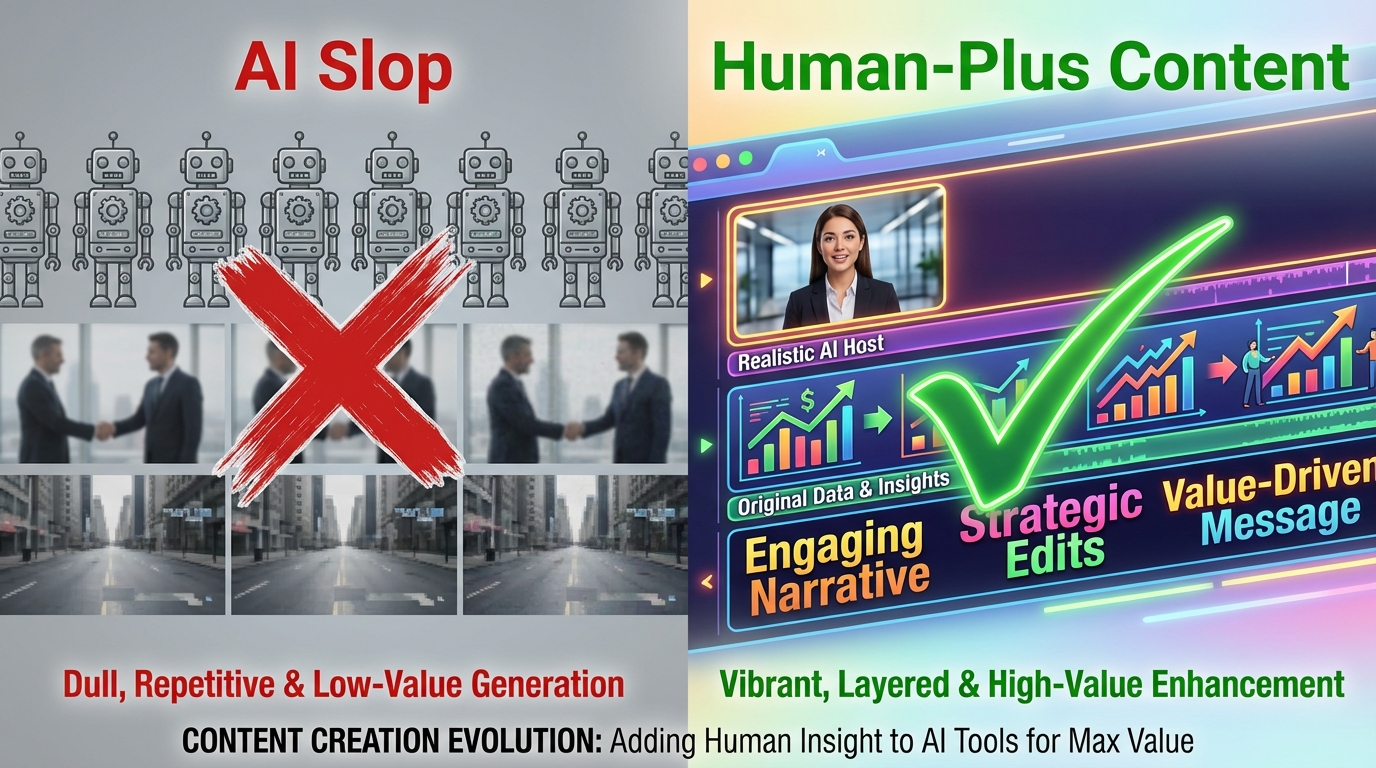
- Reused and Repetitive Content Flags: YouTube’s 2026 algorithms now detect "AI slop"—mass-produced videos with minimal human transformation—with 99% accuracy.
- Improper AI Disclosure: Failure to use the "Altered or Synthetic Content" label can lead to immediate strikes or permanent suspension under the latest YouTube AI video policy creators India must follow.
- Consent and Copyright Gaps: Using synthetic likenesses without explicit rights is a violation of both YouTube policy and the 2026 MeitY deepfake advisory.
This guide provides the enterprise-grade SOPs, checklists, and recovery plans needed to build a sustainable, monetized faceless empire in India.
YouTube AI avatar demonetization India 2026 — what actually triggers it
The "gold rush" of 2024–2025 led to a surge in low-quality automation, prompting YouTube to tighten its enforcement of "Reused Content" and "Repetitive Content" policies. In 2026, demonetization isn't just about copyright; it’s about the value-add.
Defining the Red Zones
- Reused Content: This occurs when a channel repurposes someone else's content without adding significant original commentary or educational value. In the context of AI, this includes taking a trending Bollywood clip or a cricket highlight and simply overlaying a generic AI voiceover without transformative editing. See the faceless YouTube copyright safety guide.
- Repetitive Content: This is the "template trap." If your channel produces 50 videos that all use the same AI avatar, the same background loop, and the same script structure with only minor keyword swaps, the algorithm flags it as mass-produced spam.
The 2026 Scrutiny Patterns
Manual reviewers in 2026 are specifically trained to look for "automation-only" outputs. According to industry data, AI-generated content now accounts for 21–33% of new user feeds, leading YouTube to prioritize "human-plus" content. If your video consists of a scraped script, a generic Text-to-Speech (TTS) voice, and stock footage loops, your YPP (YouTube Partner Program) application will likely be rejected. Explore the faceless YouTube channel AI India review checklist.
India-Specific Hotspots:
Channels focusing on "News Aggregation" or "Fact Channels" in regional languages like Hindi, Tamil, and Telugu are under the highest scrutiny. To pass, these channels must include original data visualizations, on-screen citations, and unique narrative arcs that go beyond simple newsreading.
Source: YouTube Partner Program Policies, upGrowth India Monetization Guide
YouTube AI content policy India 2026 — disclosures and labels
Transparency is the new currency of the 2026 creator economy. YouTube’s disclosure requirements are no longer optional "best practices"—they are hard requirements enforced by both the platform and Indian law.
The "Altered or Synthetic Content" Label
YouTube requires creators to disclose when content is "realistic" and made with AI. This includes:
- Realistic Avatars: If your AI host looks like a real human (digital twin).
- Synthetic Voices: If the voice sounds indistinguishable from a human, especially if it mimics a known personality.
- Altered Scenes: If you use AI to make it look like a real-world event happened when it didn't.
MeitY’s 2026 Regulatory Backdrop
The Ministry of Electronics and Information Technology (MeitY) has issued strict advisories regarding deepfakes and misinformation. In India, failing to label AI content that could mislead the public isn't just a YouTube policy violation; it can lead to legal action under the IT Act. Enterprise creators must maintain a "Rights and Disclosure Log" to prove compliance during audits. Learn more in the real-time interactive AI avatars in India overview.
Where Labels Appear:
- The Video Player: A "How this content was made" label appears in the expanded description or on the video player itself for sensitive topics (health, news, finance).
- YouTube Studio: You must toggle the "Altered or synthetic content" switch during the upload flow.
Source: YouTube Blog: Disclosing AI Content, MeitY Deepfake Advisory
Can AI avatar channels get monetized India? Is AI avatar content allowed on YouTube India?
The short answer is Yes. AI avatar channels are not only allowed but are among the fastest-growing niches in the Indian market. However, the path to monetization requires a shift from "AI-generated" to "AI-assisted" content. See the Hinglish faceless YouTube 2026 guide.
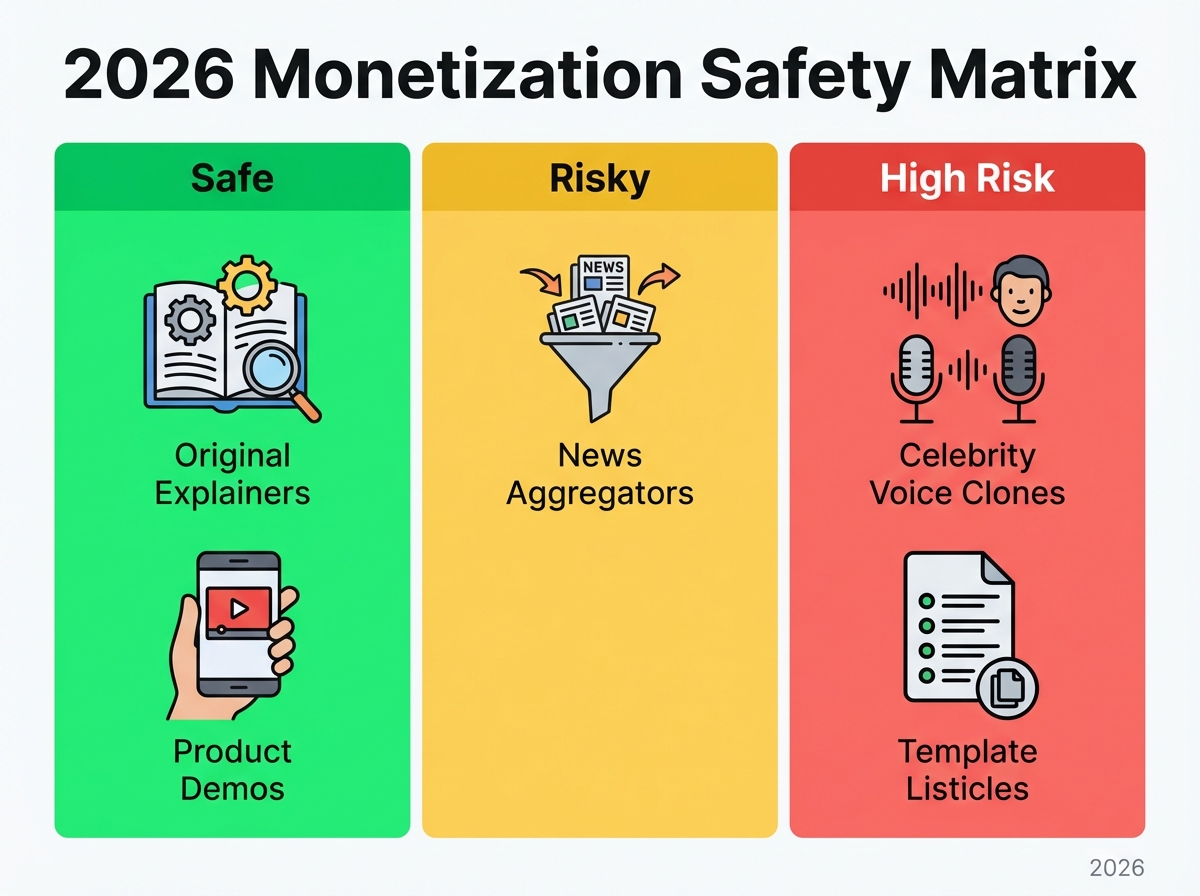
The "Allowed vs. Risky" Matrix for 2026
| Content Type | Status | Why? |
|---|---|---|
| Original Explainers | Safe | Uses unique scripts, data overlays, and original research. |
| Product Demos | Safe | Features proprietary screen recordings or physical product footage. |
| Regional Storytelling | Safe | Localizes folklore or history with unique narrative perspectives. |
| News Aggregators | Risky | Often lacks transformation; scripts are often scraped from news sites. |
| Celebrity Voice Clones | High Risk | Violates likeness rights and consent policies without explicit permission. |
| Template Listicles | High Risk | Flagged as "Repetitive Content" due to lack of visual/structural variety. |
The Value-Add Requirement
To pass a monetization review in 2026, your content must demonstrate "Human Input." This means the script should reflect a unique voice, the editing should include varied B-roll and transitions, and the AI avatar should serve as a host for original ideas, not a replacement for them. Statistics show that videos with optimized AI-driven thumbnails and human-edited scripts see a 30–154% improvement in CTR compared to fully automated "slop." Reference: faceless YouTube channel AI strategies.
AI avatar channel AdSense eligibility India and YPP thresholds — the 2026 reality check
While the core requirements for the YouTube Partner Program (YPP) remain anchored in subscriber counts and watch hours, the 2026 landscape has introduced nuanced paths for faceless creators.
YPP Baseline (2026 Update)
- Standard Path: 1,000 subscribers and 4,000 valid public watch hours in the last 12 months.
- Shorts Path: 1,000 subscribers and 10 million valid public Shorts views in the last 90 days.
- Fan Funding Path: Some creators may access "Super Thanks" and "Memberships" at 500 subscribers and 3,000 watch hours, though AdSense revenue usually requires the full threshold. Read the faceless YouTube earnings India 2026 breakdown.
AdSense Setup for Indian Creators
For Indian creators, the AdSense process involves several critical steps to ensure your INR payouts are processed without delay:
- PAN-Based Verification: You must provide a valid Permanent Account Number (PAN) for tax purposes.
- Bank Account Linking: Ensure your bank account name matches your AdSense and government ID exactly.
- Address PIN Verification: YouTube will mail a physical PIN to your Indian address once you hit the $10 (approx. ₹830) threshold.
- Tax Info: Complete the US Tax Info form (W-8BEN) to avoid maximum withholding on US-based viewership.
Pro Tip: In 2026, YouTube has increased scrutiny on "Address Fraud." Ensure your physical location matches your AdSense country to avoid "Country Mismatch" demonetization.
Source: YouTube Help: YPP Overview
Faceless YouTube AI avatar monetization guide — end-to-end SOP for India
Building a monetized channel in 2026 requires a disciplined Standard Operating Procedure (SOP). Follow this 6-step blueprint to ensure your channel remains compliant and profitable.
Step 1: Topic and Originality Gate
Never start with a tool; start with a script. Use original research, personal insights, or unique data sets. Avoid "scraped" content. If you are covering a trending topic like "UPI Fraud Prevention," ensure your script includes local Indian context that isn't just a copy-paste of a news article.
Step 2: Rights-Cleared Inputs
Ensure every asset in your video is licensed. This includes:
- Scripts: 100% original or licensed.
- Visuals: Use high-quality stock (like Getty or Envato) or proprietary footage.
- Music: Use the YouTube Audio Library or licensed services.
Step 3: Produce Avatar-Led Video with Human Value-Add
This is where you integrate professional tools. Studio by TrueFan AI's 175+ language support and AI avatars allow you to create high-quality, lip-synced hosts that feel premium rather than "uncanny." To avoid the "Repetitive Content" flag, vary your camera angles, add on-screen text overlays, and use B-roll to break up the avatar's screen time. See also the faceless YouTube channel AI playbook.
Step 4: Disclosure in YouTube Studio
During the upload process, navigate to the "Content" tab. Under "Altered or synthetic content," select "Yes" if your avatar is realistic. This generates the mandatory "How this content was made" label, protecting you from policy strikes.
Step 5: Metadata Blueprint
- Title: Include your primary keyword (e.g., "YouTube AI avatar monetization India 2026") naturally.
- Description: Include a disclosure note: "Portions of this video were created using AI technology (Avatar/Voice) to enhance the educational experience."
- Captions: Always include accurate captions in the target Indian language to improve accessibility and SEO.
Step 6: Pre-Publish Compliance Check
Run your video through a final "Brand Safety" review. Does it mimic a celebrity without consent? Does it make medical claims? If it passes, you are ready to publish.
Enterprise workflow and scale — faceless channel AI avatar AdSense India with governance
For media houses and marketing agencies in India, scaling faceless channels requires more than just a single creator's effort; it requires a governance framework.
The 2026 Tech Stack Comparison
When choosing a platform for enterprise-scale video production, creators often compare various tools. In the 2026 market, the choice usually boils down to:
- Studio by TrueFan AI: The preferred choice for Indian enterprises due to its "Consent-First" model. It uses real influencers as AI avatars with full licensing, ensuring you never run into likeness rights issues. Explore real-time interactive AI avatars in India.
- HeyGen/D-ID: Strong global players, but often lack the deep regional Indian language nuances and local compliance features required by MeitY.
- Synthesia: High-quality avatars but can be cost-prohibitive for high-volume regional content production in the Indian market.
Platforms like Studio by TrueFan AI enable enterprise teams to manage multiple channels from a single dashboard while maintaining a 100% compliance record. By using licensed digital twins of real Indian influencers, brands can build trust that generic CGI avatars cannot achieve.
Governance and ROI
Solutions like Studio by TrueFan AI demonstrate ROI through a 90% reduction in production time and the ability to A/B test content variants across 175+ languages. For an enterprise, this means the ability to launch a "Finance Tips" channel in Hindi, Marathi, and Bengali simultaneously, with each channel maintaining its own AdSense eligibility through localized, non-repetitive content.
Enterprise Checklist:
- ISO 27001/SOC 2 Certification: Ensure your AI provider protects your data.
- Audit Trails: Maintain a log of every prompt and script for legal compliance.
- Watermarking: Use traceable watermarks to prevent unauthorized use of your AI assets.
Avoid YouTube demonetization AI avatar — 10 red flags and fixes
If your channel is struggling with monetization or has been hit with a "Reused Content" flag, check for these 10 red flags. For deeper context, read the copyright safety guide for faceless YouTube channels.
- Red Flag: TTS-only over stock loops.
Fix: Add original commentary, personal insights, and data overlays. - Red Flag: Identical template hooks across all videos.
Fix: Rotate your "hooks" and visual structures every 3–5 videos. - Red Flag: Newsreading without analysis.
Fix: Add "What this means for you" sections and on-screen citations. - Red Flag: Unlicensed Bollywood/Cricket clips.
Fix: Replace with licensed stock or owned B-roll. - Red Flag: Misleading thumbnails.
Fix: Ensure thumbnails accurately represent the AI-generated content. - Red Flag: Celebrity voice clones without consent.
Fix: Use neutral, licensed AI voices or your own cloned voice. - Red Flag: Missing AI disclosure.
Fix: Retroactively update your YouTube Studio settings for all realistic AI videos. - Red Flag: "Translation Spam" (Literal clones in other languages).
Fix: Localize the context and examples for each regional language. - Red Flag: Automation-only Shorts spam.
Fix: Ensure each Short has a unique narrative arc and human-edited pacing. - Red Flag: Overuse of a single AI identity across unrelated niches.
Fix: Diversify your avatars to match the specific niche (e.g., a professional avatar for finance, a casual one for lifestyle).
Safe AI avatar video for YouTube India — printable compliance checklist
- Originality: Is the script 100% original or significantly transformed?
- Licensing: Are all visuals, music, and the avatar likeness fully licensed?
- Disclosure: Is the "Altered or synthetic content" toggle set to "Yes" in Studio?
- Value-Add: Does the video include B-roll, text overlays, or data charts?
- MeitY Compliance: Does the content avoid misleading deepfakes of public figures?
- Metadata: Does the description include a clear AI disclosure statement?
- Localization: Are regional language captions reviewed for accuracy?
- Quality: Is the video rendered in at least 1080p (HD) for professional appeal?
- Consent: If using a digital twin, do you have a signed likeness release?
- Brand Safety: Is the content free of "AI slop" patterns (repetitive loops)?
Disclaimer: This guide is for informational purposes and does not constitute legal advice. Always verify the latest policies on the YouTube Help Center and official MeitY portals before publishing.
Frequently Asked Questions
Can AI avatar channels get monetized in India?
Yes, AI avatar channels are eligible for monetization in India. They must meet YPP thresholds and comply with the "Reused Content" policy by adding significant original value and commentary. For tactics and examples, see the Hinglish faceless YouTube 2026 guide.
Is AI avatar content allowed on YouTube India?
Yes. YouTube’s 2026 policy permits AI content as long as it is not deceptive and includes the required "Altered or Synthetic Content" labels for realistic visuals or voices.
What are the YouTube AI disclosure requirements in India (2026)?
Creators must disclose realistic synthetic media via the "Altered or synthetic content" toggle in YouTube Studio during upload. Failing to do so can result in content removal or YPP suspension.
How do I avoid YouTube demonetization with AI avatars?
Avoid automation-only workflows. Use original scripts, transformative editing, and diverse visuals. Always apply the required AI disclosure. For more, read the faceless YouTube copyright safety guide.
How to ensure AI avatars are compliant with Indian laws?
Studio by TrueFan AI uses a consent-first model with licensed influencer likenesses, helping ensure compliance with YouTube policies and MeitY’s 2026 deepfake advisories. Learn more about interactive AI avatars and compliance in India.
How to maintain AdSense eligibility for AI avatar channels in India?
Maintain originality, avoid repetitive templates, keep the channel free of copyright strikes, and ensure AdSense verification with a valid Indian PAN and address. See the earnings and eligibility guide for 2026.
What are the core YouTube monetization rules for AI avatars in 2026?
Disclose realistic AI, comply with YPP originality standards, adhere to MeitY deepfake advisories, and use likenesses and voices only with proper consent/licensing.