AI avatar micro-influencer marketing 2026: Vernacular, regional trust at enterprise scale
Estimated reading time: ~12 minutes
Key Takeaways
- AI avatar micro-influencers let enterprises scale vernacular, hyper-local trust across India’s fragmented markets.
- Regional influencer AI cloning creates consented digital twins for rapid, authentic content with virtual reshoots in seconds.
- Pin-code and language personalization boosts engagement and CTR in Tier-2/3 by delivering messages in local dialects.
- Video automation at scale via platforms like TrueFan AI turns one capture into thousands of variants, reducing CAC and time-to-market.
- Compliance-by-design with ASCI disclosures and India’s DPDP ensures safe, enterprise-grade rollout and governance.
The landscape of digital engagement is undergoing a seismic shift as brands move away from high-cost, low-frequency celebrity endorsements toward scalable, hyper-local authenticity. For enterprise marketing teams, the primary challenge in 2026 is no longer just reaching an audience, but doing so with a voice that resonates across India’s fragmented linguistic and cultural landscape. AI avatar micro-influencer marketing has emerged as the definitive solution to the bottlenecks of creator bandwidth, vernacular fragmentation, and the prohibitive speed-to-market delays inherent in traditional video production.
By leveraging digital twins of trusted local voices, brands can now deploy personalized content at a scale previously reserved for static text or display ads. This strategy is specifically designed for Brand Marketing Teams, Regional Expansion Leaders, and CRM/Martech owners who need to penetrate Tier-2 and Tier-3 markets without the friction of repeated physical shoots. Platforms like TrueFan AI enable this transition by providing the infrastructure to turn a single 15-minute capture session into thousands of unique, vernacular-first video assets through vernacular video automation in India.
The promise of 2026 is a playbook that prioritizes grassroots AI marketing in India, ensuring that every customer—regardless of their pin code—receives a message that feels local, personal, and trustworthy. This guide explores the technical, strategic, and regulatory frameworks required to master this new frontier of influence.
1. The 2026 Market Landscape: Why AI avatar micro-influencer marketing is the breakout strategy
The maturity of the Indian influencer economy has reached a critical inflection point where performance and compliance are now as important as reach. According to EY India, the influencer marketing sector is projected to reach INR 3,375 crore by 2026, reflecting a robust 18% CAGR as budgets shift toward micro and nano-creators via nano-influencer marketing in Bharat (2026) who offer higher engagement rates. Furthermore, BrandEquity reports that the overall industry has crossed the INR 10,000 crore mark, signaling a shift toward institutionalized, data-driven campaign execution.
This growth is being fueled by the "Bharat" consumer, with Tier-2 and Tier-3 cities now powering approximately 60% of all e-commerce demand in India. These users are not looking for generic, English-first content; they demand regional relevance. Ipsos research indicates that vernacular content drives significantly deeper digital engagement in these regions, supported by the widespread adoption of 5G and low data costs. Consequently, the demand for AI avatar micro-influencer marketing 2026 is driven by the need to bridge the gap between national brand identity and local consumer trust.
The structural shift is evident: users from Tier-2 cities are scripting the next chapter of India’s digital economy growth. To capture this momentum, marketers are moving beyond "one-size-fits-all" videos. They are adopting grassroots AI marketing India tactics that allow for pin-code level personalization, ensuring that a consumer in Coimbatore receives a message in Tamil while a user in Lucknow hears the same brand promise in local Hindi dialects.
Sources:
- EY India: How influencer marketing is impacting brands in India
- ET BrandEquity: India’s influencer marketing crosses INR 10,000 crore
- Market-Xcel: Tier-2/3 India e-commerce boom
- Ipsos: The State of Digital Marketing in India 2025 (PDF)
- Economic Times: Tier-2 cities powering India’s digital growth
2. Regional influencer AI cloning: Building authentic regional AI spokespeople
At the heart of this revolution is regional influencer AI cloning, a process that allows brands to create a consented, high-fidelity digital double of a local creator or community leader. Unlike generic AI avatars, these digital twins retain the unique mannerisms, vocal tonality, and cultural nuances of the original person. This ensures that the "influence" remains authentic, even when the content is generated programmatically.
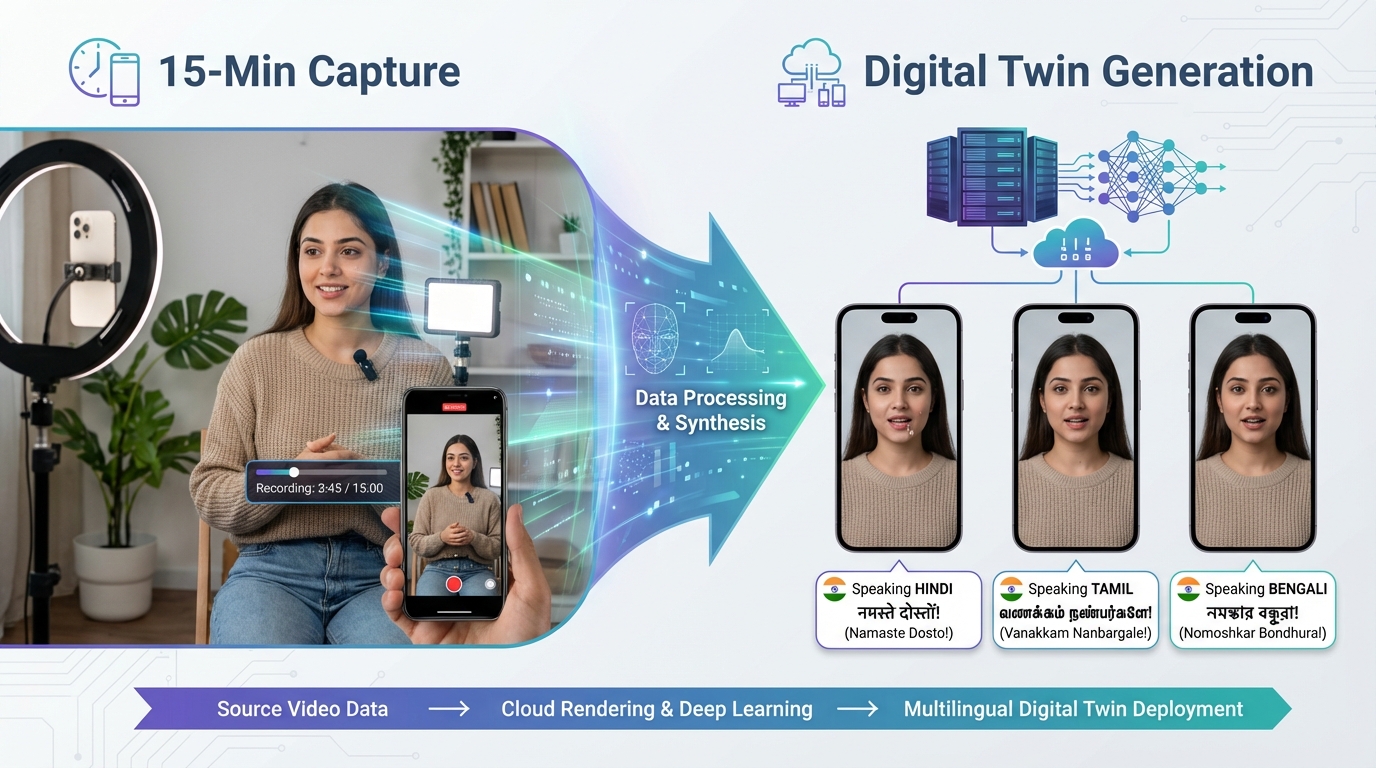
The process begins with a "capture session," where the creator provides approximately 15 minutes of video and audio data. This data is used to train a model capable of digital twin influencer marketing, allowing the brand to generate new video content by simply providing a script. This solves the creator burnout problem, as the influencer no longer needs to spend days in a studio for every campaign iteration. They provide the "likeness," and the AI handles the "labor."
For enterprise brands, this means they can maintain a roster of authentic regional AI spokespeople who are always on-call. Whether it is a health camp announcement in rural Kerala or a loan literacy drive in Bihar, the AI avatar can deliver the message with the authority of a known local figure. This level of AI spokesperson regional markets integration allows for a speed-to-market that was previously impossible, as virtual reshoots can update offers or dates in under 30 seconds.
Sources:
3. Cracking Tier-2/3 reach with local language AI avatars and personalization
To effectively reach the next 500 million users, brands must master the art of vernacular influencer personalization. This involves more than just translating a script; it requires the AI to handle phoneme-level lip-sync across multiple Indian languages and dialects. Local language AI avatars must be able to switch between Hinglish with AI-created Hinglish video, Tamil, Telugu, Bengali, and Marathi while maintaining the creator’s original voice profile.
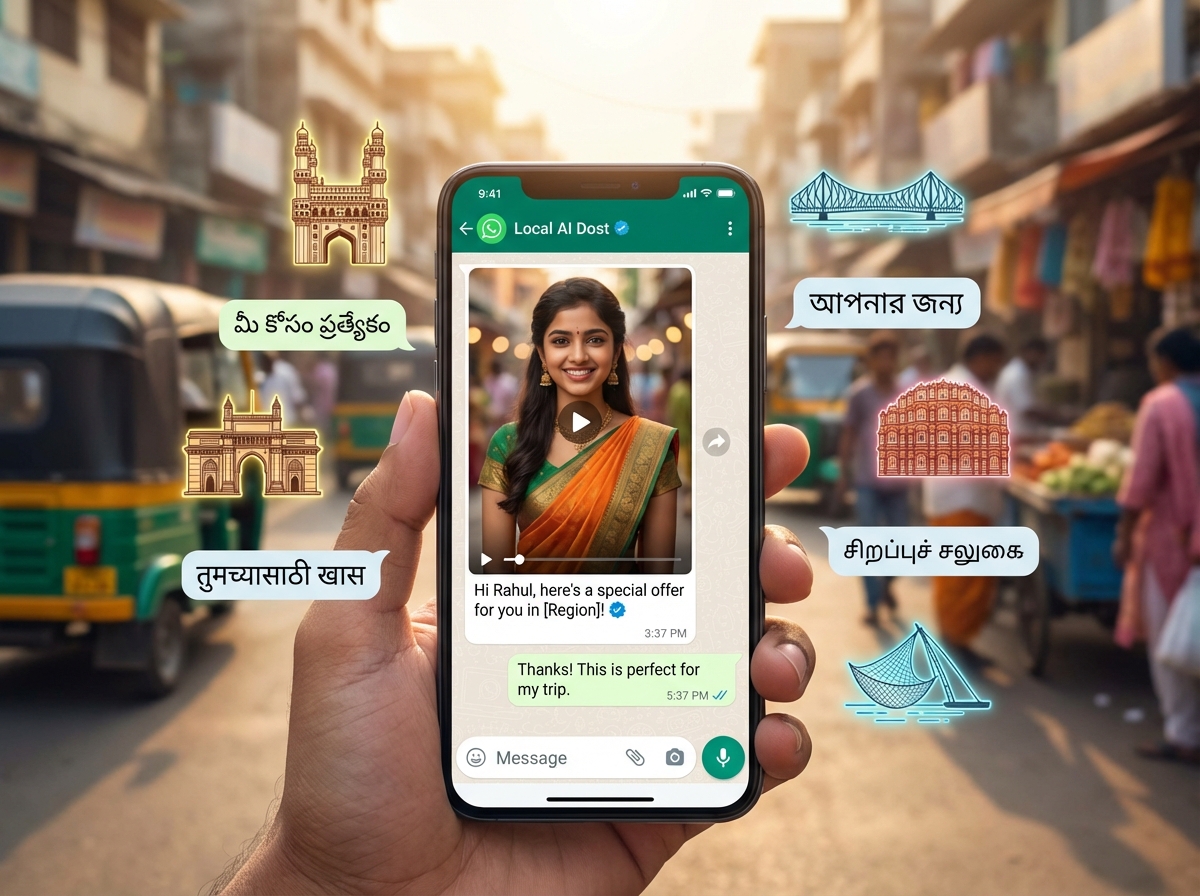
The distribution stack for these campaigns is equally localized. While Instagram Reels and YouTube Shorts are vital, platforms like ShareChat, Moj, and the WhatsApp Business API are the primary drivers of conversion in Tier-3 markets. By integrating AI video generation with CRM triggers, a brand can send a personalized video message to a user the moment they abandon a cart or express interest in a product.
This is where tier-2 city AI avatars and tier-3 market AI influencers become indispensable. A master script can be written once, and then 5–8 regional variants can be generated automatically. These variants can include dynamic fields such as the user’s name, their city, the nearest physical store location, and a specific festival-themed offer. This granular level of targeting transforms a generic advertisement into a personal recommendation from a trusted local voice.
Sources:
4. Local celebrity video automation: Scaling output without creator burnout
The traditional influencer model is fundamentally unscalable because it relies on the physical presence of the creator. Local celebrity video automation breaks this bottleneck by allowing for the generation of thousands of localized cuts from a single capture. This is particularly effective for micro-celebrity AI videos, where the creator may have a dedicated following in a specific niche or geography but lacks the resources of a national superstar.
TrueFan AI’s 175+ language support for vernacular video automation (2024) and Personalised Celebrity Videos provide the technical backbone for this automation. The platform’s cloud-agnostic GPU farm can render these videos in under 30 seconds, enabling real-time personalization. For example, during a festive season with Tier-2 festival commerce automation, a brand can generate 2.4 million unique greetings featuring a regional star, each mentioning the recipient by name and offering a localized discount code.
This approach also enables regional trust building automation. By testing different openers—such as a name-first callout versus a direct offer—brands can measure watch-through rates and CTRs at a variant level. This data-driven approach to influence ensures that the creative strategy is constantly optimized for ROI. Solutions like TrueFan AI demonstrate ROI through significant uplifts in WhatsApp read rates and reader activation, proving that personalization is the key to breaking through the digital noise.
Sources:
- TrueFan AI: Case studies (Zomato, Hero MotoCorp, Goibibo, Dainik Bhaskar)
- Exchange4Media: 2025—the year regulation caught up with influencer marketing
5. The Enterprise Playbook: From pilot to scale in 30 days
Implementing a grassroots AI marketing India strategy requires a structured approach to ensure both creative quality and technical reliability. An enterprise-grade rollout can typically be achieved in four weeks, moving from initial discovery to full-scale programmatic distribution.
Week 1: Discovery and Consent
The first step is identifying the right micro-influencers or community leaders for priority states. It is critical to execute ASCI-compliant contracts that clearly define rights, disclosures, and usage windows. A 15-minute capture session is conducted for each talent to build their digital twin. This stage also involves setting up a "consent store" for interactive video data capture and rights to archive all legal permissions and likeness rights.
Week 2: Script and Avatar Build
During this phase, the master scripts and regional variants are finalized. This includes building custom lexicons for Indian names and places to ensure the AI’s pronunciation is flawless. The avatars are trained and subjected to rigorous QA, checking for lip-sync accuracy and tonal consistency across languages like Hinglish and native dialects.
Week 3: Personalization and Integration
The AI video engine is connected to the brand’s CRM (e.g., Salesforce or HubSpot) and the WhatsApp Business API. This allows for trigger-based generation, where a specific user action (like a lead form submission) automatically initiates a video render. A/B testing is launched to compare different opening lines and CTA wording to find the most effective regional hooks.
Week 4: Launch and Optimize
The campaign scales to thousands of renders per day. Marketers use "virtual reshoots" to update offers or creative elements without needing the influencer to return to the studio. Performance is monitored in real-time, tracking CAC reduction and conversion rate lift across different pin codes. This iterative process ensures that the AI avatar micro-influencer marketing strategy remains agile and high-performing.
Sources:
6. Compliance, Safety, and the Future of AI Influence
As AI-generated content becomes mainstream, regulatory scrutiny is intensifying. In 2026, compliance is not optional; it is a core component of brand safety. The Advertising Standards Council of India (ASCI) has updated its guidelines to require clear, upfront disclosures for all AI-generated influencer content. Labels like "Ad" or "Sponsored" must be prominent and, crucially, must match the language of the advertisement itself.
Furthermore, the Digital Personal Data Protection (DPDP) Act and DPDP-compliant personalization strategies in India mandates strict controls over how user data is used for personalization. Brands must ensure purpose limitation, data minimization, and robust retention policies. When deploying authentic regional AI spokespeople, it is essential to have an audit trail that proves the creator’s consent for every specific use case. This transparency builds long-term trust with the consumer and protects the brand from legal and reputational risks.
The future of this space lies in the "Digital Twin" as a persistent brand asset. Whether it is a founder-led trust message in Tamil or an FMCG mascot delivering seasonal offers in 15 languages, the digital twin becomes a governed, always-on representative of the brand. By baking watermarking and disclosure defaults into the rendering pipeline, enterprises can scale their AI spokesperson regional markets strategy with total confidence.
Sources:
- ASCI: 2025 Influencer Disclosure Update (PDF)
- BuzzInContent: Enforcement of influencer ad disclosures
- Government of India: DPDP overview
Frequently Asked Questions
Is regional influencer AI cloning legal in India?
Yes, regional influencer AI cloning is legal provided there is explicit, written consent from the creator for the use of their likeness and voice. Brands must also adhere to the ASCI Influencer Guidelines regarding disclosures and the DPDP Act regarding data privacy and purpose limitation.
How should we disclose AI-generated spokesperson content?
According to ASCI, you must use clear, upfront labels such as "AI-Generated" or "Virtual Influencer" in addition to standard "Ad" or "Sponsored" tags. These labels should be in the same language as the video content and remain visible long enough for the viewer to notice.
What performance lift can we expect from tier-2 city AI avatars?
While results vary by industry, early benchmarks show that name-first personalization and vernacular delivery can increase WhatsApp read rates by 15–20% and significantly improve CTR compared to generic video ads. The key is using tier-2 city AI avatars to create a sense of local familiarity.
Can AI avatars handle complex Indian dialects?
Modern platforms like TrueFan AI support over 175 languages and dialects. By using custom pronunciation dictionaries and regional tone presets, the AI can accurately reproduce the nuances of local speech, ensuring the content feels authentic to native speakers.
How does TrueFan AI ensure the security of creator data?
TrueFan AI is ISO 27001 and SOC 2 certified, employing enterprise-grade encryption and role-based access controls. The platform uses a consent-first model where all likeness rights are strictly governed and audited to prevent unauthorized use of a creator’s digital twin.
What is the cost difference between traditional shoots and AI renders?
Traditional shoots involve high day rates, travel, and post-production costs for every new language or offer. In contrast, AI renders at scale can cost as little as ₹10–₹25 per video, providing a massive reduction in CAC and a much higher ROI for high-volume personalized campaigns.