How to Create AI Clone of Yourself India (2026-Ready Guide for YouTube & Reels)
Estimated reading time: ~12 minutes
Key Takeaways
- Build a photorealistic AI digital twin that looks and sounds like you for YouTube and Reels
- Stay compliant with MeitY labeling and DPDP consent requirements in India
- Follow a proven step-by-step workflow for datasets, training, and script-to-video
- Optimize content per platform with YouTube, Shorts, and Reels playbooks
- Use automation and localization to cut costs and scale output across 175+ languages
The creator economy in India has undergone a seismic shift. As we navigate 2026, the question for every serious influencer and brand builder is no longer “if” they should use artificial intelligence, but how to create AI clone of yourself India to stay competitive. With the Indian creator economy now valued at over $12 billion and digital media accounting for nearly a third of the total media and entertainment market, the pressure to produce high-quality, multi-lingual content at scale is immense.
An AI clone, or digital twin, is a photorealistic AI avatar that looks, sounds, and moves exactly like you. By leveraging advanced generative AI, you can now deliver scripts for YouTube, Instagram Reels, and LinkedIn Digital Twin LinkedIn Strategy India (CEO Avatar Guide 2026) without ever stepping in front of a camera. In 2026, this technology has moved from a futuristic novelty to a mainstream necessity for creators who want to dominate regional markets like Hindi, Tamil, and Bengali simultaneously. Platforms like Studio by TrueFan AI enable creators to bridge the gap between human creativity and machine-driven scale, ensuring that your personal brand remains active 24/7 while you focus on strategy and high-level ideation.
1. Understanding the 2026 Landscape: Digital Twins vs. AI Avatars
Before diving into the technical steps, it is crucial to understand the terminology of 2026. The market has matured, and the distinctions between different types of synthetic media are now clearly defined by both technology and regulation.
What is an AI Digital Twin?
In the context of an Indian creator, an AI digital twin is a data-driven, photorealistic model of your likeness. Unlike generic avatars, a digital twin captures your specific facial nuances, voice modulation, and delivery style. It is designed to present scripts as video on demand. In 2026, these twins are capable of “code-switching”—seamlessly moving between English, Hindi, and Hinglish—while maintaining your unique personality.
AI Avatar vs. AI Spokesperson
- AI Avatar: This is often a virtual human that may or may not be based on a real person. Creators use these as “co-presenters” or to “clone yourself” for specific segments where their physical presence isn’t required.
- AI Spokesperson: Create a Selfie-to-AI Spokesperson in India. These are on-brand virtual presenters used for repeatable content like product explainers or educational clips. For a personal brand, your AI spokesperson is essentially your clone, trained on your specific brand guidelines.
Why This Matters in India 2026
The “Digital Doppelganger” trend has taken over Indian consumer media. According to recent reports, 93% of Indian firms expect positive returns from AI investments within three years, with many already seeing a 15% ROI in 2025. For creators, the ROI is found in localization. An AI clone allows a creator in Mumbai to speak fluent Malayalam to an audience in Kochi without learning the language, reducing production costs by up to 80% compared to traditional dubbing and re-shooting.
Sources:
- LinkedIn/FindCreators: India’s Creator Economy Reaches $12 Billion
- Times of India: Digital Doppelgangers Are Officially Trending
- India Today: AI Impact Summit 2026
2. Compliance Snapshot: Navigating MeitY and DPDP Rules in 2026
Creating an AI version of yourself in India is not just a technical challenge; it is a legal one. The 2026 regulatory environment is strict, designed to prevent deepfakes while allowing legitimate creators to flourish.
MeitY IT Rules (2026 Amendments)
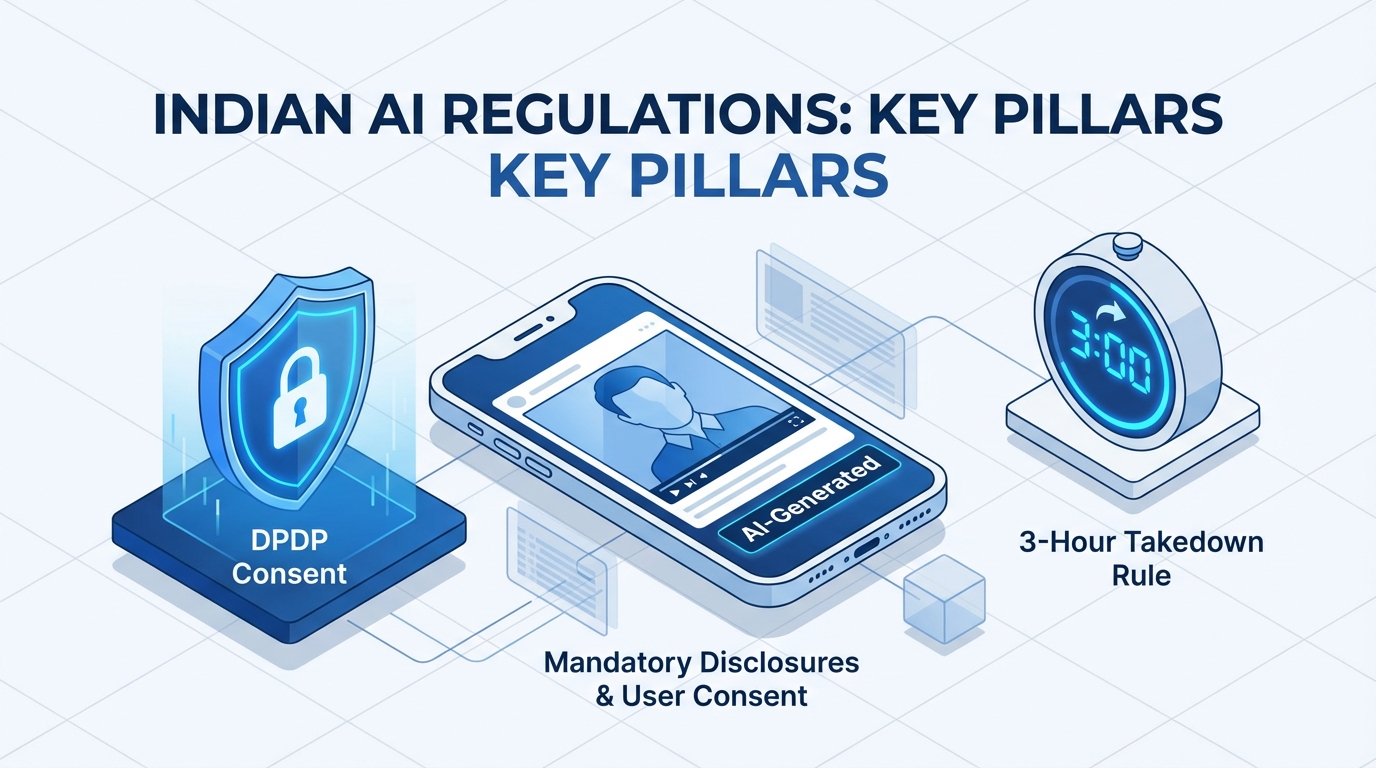
The Ministry of Electronics and Information Technology (MeitY) has operationalized a comprehensive framework for “Synthetically Generated Information” (SGI).
- Mandatory Labeling: All AI-generated content that depicts a real person must be prominently labeled. This isn’t just a suggestion; it’s a requirement to prevent misinformation.
- 3-Hour Takedown: If an AI clone is used maliciously or without consent, platforms are now under a 3-hour expedited takedown obligation.
- Traceability: Every AI video must have embedded metadata or watermarks that identify the source platform and the creator.
The DPDP Act and Biometric Consent
The Digital Personal Data Protection (DPDP) Act is now fully in force. When you create an AI clone, you are processing highly sensitive biometric data (your face and voice).
- Explicit Consent: You must maintain a digital log of your own consent for the “purpose” of cloning.
- Revocable Rights: If you are a brand hiring an influencer to create a clone, the influencer must have the right to revoke that consent, at which point the clone must be “deleted” from the server.
- Data Residency: Many Indian creators now prefer platforms that store data within Indian borders to comply with sovereign data preferences.
YouTube and Instagram Disclosure
YouTube’s 2026 policy requires creators to use a specific toggle in the Creator Studio to disclose “altered or synthetic content.” Failure to do so can lead to content removal, suspension from the Partner Program, or even account termination. Instagram Reels follows a similar path, with “AI-generated” tags appearing automatically if the platform’s algorithms detect synthetic patterns.
Sources:
- Official MeitY PDF: IT Amendment Rules 2026
- Google Support: YouTube AI Disclosure Policy
- Freshfields: India targets deepfakes and AI-generated content
3. Tooling Overview: From Free Trials to Enterprise Power
Choosing the right tool depends on your stage in the creator journey. In 2026, the market is divided into three distinct tiers.
The Free/MVP Track
For those searching for “AI spokesperson clone free India,” try this curated starter list: AI Avatar Free Trial India — Top Zero-Cost Tools for 2026. These are great for testing the waters.
- Pros: Zero cost, quick setup.
- Cons: Heavy watermarks, low-resolution (720p), and often “uncanny valley” lip-sync.
- Risk: Many free tools operate outside Indian jurisdiction, posing a risk to your biometric data security.
The Custom Personal Brand Track
Solo creators who have found their niche often move to custom AI avatars. This involves training a model specifically on your likeness for better visual fidelity.
- Pros: Better brand alignment, higher resolution.
- Cons: Requires manual effort for batching and lacks integrated compliance features.
The Professional Choice: Studio by TrueFan AI
For creators and agencies managing multiple channels, a robust SaaS solution is required. Studio by TrueFan AI’s 175+ language support (Accurate Lip-Sync in 175+ Languages) and AI avatars provide a “walled garden” approach where safety and scale coexist.
- Self-Serve Studio: A browser-based platform where you can select from a library of licensed influencers (like Gunika or Aryan) or upload your own 5–10 minute dataset to create a custom twin.
- Enterprise Pipeline: Designed for agencies, this tier allows for batch generation of hundreds of videos per week, integrated with WhatsApp APIs and e-commerce platforms.
- Differentiators: ISO 27001 & SOC 2 certification, pricing in INR (starting at ₹2,999), and a consent-first model that aligns perfectly with India’s DPDP Act.
4. Step-by-Step: How to Make an AI Version of Yourself for Videos
Follow this 2026-optimized workflow to ensure your AI clone looks professional and stays compliant.
Step 1: Content Planning and Consent Log
Before recording a single second, define your content pillars. Are you doing finance tips in Hindi or ed-tech explainers in Tamil?
- Action: Create a “Consent Folder” in your Google Drive. Record a 30-second video of yourself stating: “I, [Name], give explicit consent for my likeness and voice to be used for AI cloning purposes on [Platform Name] as of [Date].” This is your legal shield under the DPDP Act.
Step 2: Capturing the Face Dataset
To feed an AI face clone video generator, you need high-quality source footage.
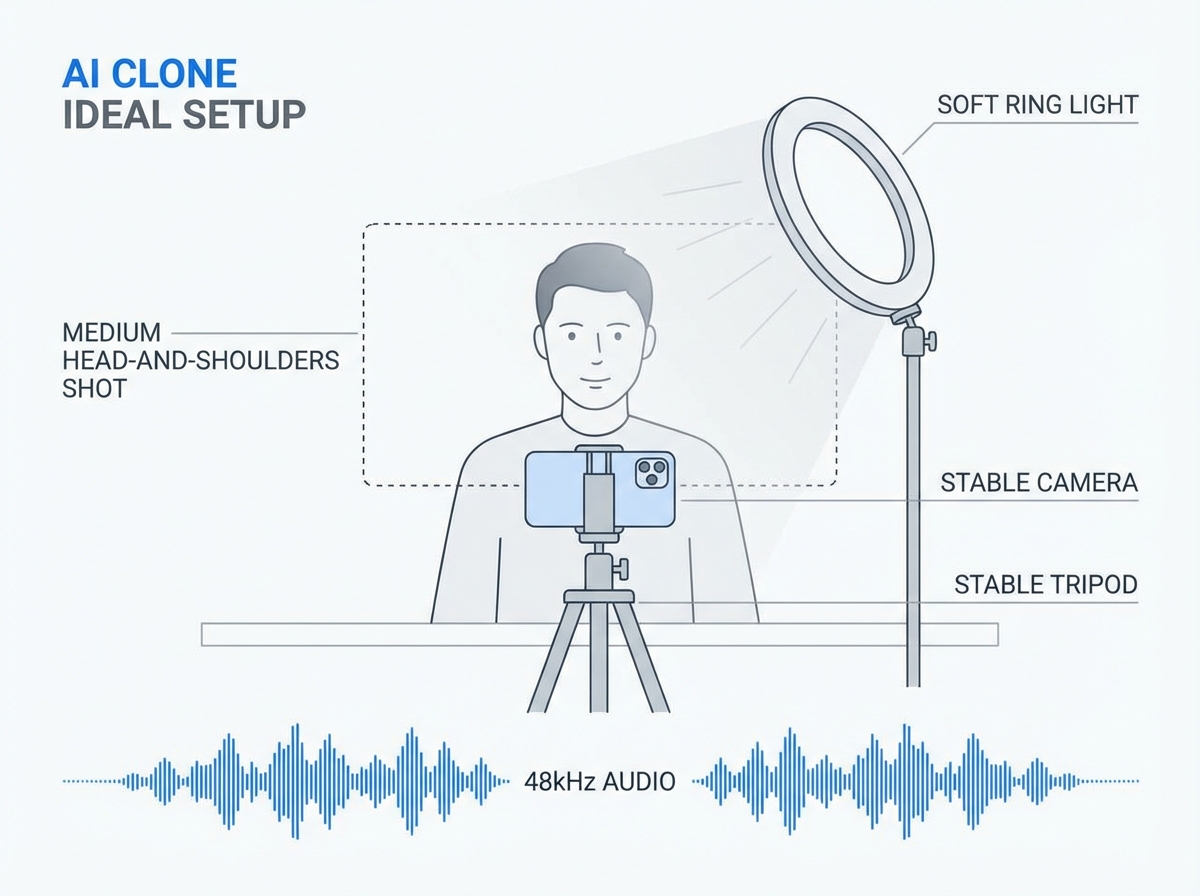
- Equipment: Use a smartphone with 4K capabilities at 30fps. A stable tripod is non-negotiable.
- Lighting: Soft, even lighting. Avoid harsh shadows that confuse the AI’s depth perception.
- The Shoot: Record 5–10 minutes of yourself talking naturally. Do not just stare; include natural head tilts, slow blinks, and varied expressions.
- Framing: Head-and-shoulders (medium shot). Ensure your hair doesn’t cover your eyes and avoid wearing heavy glasses that create glare.
Step 3: Capturing the Voice Dataset
Your voice is 50% of the “clone” experience.
- Environment: A quiet room with minimal reverb (closets work wonders).
- Script: Read a variety of topics. Include “Hinglish” phrases to help the AI understand your specific Indian prosody and accent.
- Technical: Record in 48 kHz WAV format. Aim for 10 minutes of clean audio.
Step 4: Training Your Avatar
Upload your datasets to your chosen platform. If you are using a professional service, the platform will handle the heavy lifting of “stitching” the voice to the facial movements.
- Validation: Check the lip-sync specifically for plosive sounds (P, B, M). In Indian languages like Hindi, these are frequent, and poor sync here is a dead giveaway of “AI slop.”
Step 5: Script-to-Video Generation
Once your twin is ready, you can move to text-to-video AI with your face.
- Scripting: Keep segments between 100–120 characters for the smoothest lip-sync.
- Localization: Use the one-click translation features to convert your English script into regional languages.
- B-Roll: In 2026, “talking head” videos alone are not enough. Overlay your AI clone with relevant images or screen recordings to keep the audience engaged.
Step 6: Scaling with Automation
The real power of an AI video creator without camera is batching.
- Workflow: Create one master script, translate it into 5 languages, and render all 5 versions in minutes. Use naming conventions like
finance_tips_hindi_reels_v1to keep your library organized.
5. Platform Playbooks: YouTube, Shorts, and Instagram Reels
Each platform in India has a different “vibe” and technical requirement for AI content.
AI Digital Twin for YouTube India
YouTube is the home of long-form authority. For policy specifics, see AI avatar YouTube monetization rules for India 2026.
- The Strategy: Use your AI clone for the “educational” parts of your video. For example, if you are a tech reviewer, use the clone to read out the specs while you show the actual product in B-roll.
- Disclosure: Place a small, non-intrusive watermark or a text overlay at the start: “AI-generated likeness of [Your Name].” This builds trust with your audience.
- SEO: Use the transcript generated by the AI to create perfect closed captions, which boosts your search rankings.
AI Clone for Instagram Reels India
Reels are about speed and trends. Explore tooling with the AI avatar Instagram Reels generator for India 2026.
- The Strategy: Use your AI clone to respond to trending news within minutes. If a new financial policy is announced at 11 AM, your AI clone can have a Reel explaining it by 11:15 AM.
- Visuals: Use the 9:16 aspect ratio. Keep the “safe zones” clear of captions so the “AI-generated” tag (which Instagram may apply) doesn’t cover your face.
- Engagement: Use Hinglish faceless YouTube 2026 guide. Data shows that Hinglish content has a 24% higher engagement rate among Indian Gen Z compared to pure English or pure Hindi.
Faceless YouTube Channels
For those who want to remain anonymous, a personal AI avatar for faceless YouTube is the ultimate solution. You can create a consistent “character” that represents your brand, allowing you to build a multi-million subscriber channel without ever showing your real face. Learn how to launch with Faceless YouTube Channel AI India and automate Shorts with YouTube Shorts Automation AI.
6. Quality Benchmarks, ROI, and Troubleshooting
As we move deeper into 2026, the “quality bar” has moved. Viewers are sophisticated; they can spot low-effort AI.
Troubleshooting Common Issues
- The “Dead Eye” Look: If your AI clone looks robotic, it’s usually because the source dataset didn’t have enough blinking or micro-expressions. Re-record your 5-minute dataset with more “energy.”
- Audio-Visual Lag: This often happens during the export process. Ensure you are exporting at the same frame rate (e.g., 30fps) as your source footage.
- Sibilance in Hindi: Some AI voices struggle with the “sh” and “s” sounds in Hindi. Use a “warm” tone setting in your editor to dampen these harsh frequencies.
Measuring Success (ROI)
Solutions like Studio by TrueFan AI demonstrate ROI through three key metrics:
- Production Time: Reducing the time-to-publish from 48 hours to 30 minutes.
- Audience Reach: Increasing views by 3x through regional language localization.
- Cost per Video: Bringing the cost down from ₹5,000 per professional shoot to under ₹500 per AI-generated clip.
Conclusion and Next Steps
The journey to how to create AI clone of yourself India starts with a single dataset but leads to infinite possibilities. In 2026, your digital twin is your most valuable asset—it is your brand’s ambassador in every language and on every platform.
Your Action Plan:
- Record your dataset: Spend this weekend capturing 10 minutes of high-quality video and audio.
- Choose your platform: Start with a tool that understands the Indian context.
- Publish and Disclose: Create your first 3 Reels with clear AI labels and monitor the engagement.
- Scale: Once you see the ROI, automate your workflow.
Ready to dominate the Indian creator economy with a compliant, high-fidelity digital twin? Book a demo with the experts to see how a professional pipeline can transform your content strategy.
Sources & Further Reading:
- Galaxy Classes: MeitY AI Content Labeling Rules
- OrangeMonke: India’s New IT Rules Explainer
- Khurana & Khurana: Deepfake Regulation India 2025/26
- Google Blog India: YouTube 2026 Vision
Recommended Internal Links
- Digital Twin LinkedIn Strategy India: CEO Avatar Guide 2026
- AI avatar 175 languages India: Accurate Lip-Sync 2026
- AI Avatar Free Trial India: Top Zero-Cost Tools for 2026
- YouTube Shorts Automation AI: Scalable, AI-Driven Short-Form Creation
- AI avatar YouTube monetization rules for India 2026
- AI avatar Instagram Reels generator for India 2026
- Hinglish faceless YouTube 2026: Monetize with AI avatars
- Faceless YouTube Channel AI India: Launch with AI Avatars
- Selfie to AI Spokesperson India: Create Your Digital Twin
Frequently Asked Questions
Is it legal to clone my own face and voice in India?
Yes, provided you give explicit consent under the DPDP Act. You must also comply with MeitY’s 2026 disclosure rules by labeling the content as AI-generated when it appears realistic.
Will YouTube demonetize my channel if I use an AI clone?
No, as long as you follow the disclosure policy. YouTube’s 2026 guidelines specifically state that synthetic content is allowed but must be labeled to maintain transparency with viewers.
Can I create an AI clone for free in India?
Yes, there are trial versions of various tools available. However, for professional use, these often come with watermarks and limited language support. For a serious personal brand, a paid tier is usually necessary.
How many languages can my AI clone speak?
Studio by TrueFan AI offers 175+ language support, enabling speech in major global and Indian regional languages like Marathi, Punjabi, and Kannada with accurate lip-sync.
What is the best way to avoid the “uncanny valley” effect?
High-quality 4K video with natural movement and a clean, professional-grade voice recording are essential. Avoid over-processing audio; a bit of natural room tone keeps the AI sounding human.
How do I handle the 3-hour takedown rule?
Embed content IDs or digital watermarks in all videos. If someone misuses your AI clone, these markers help platforms verify authenticity and execute expedited takedowns.



