AI Impact Summit TrueFan: The Enterprise AI Video Platform Powering Agentic Marketing at Scale
Estimated reading time: ~14 minutes
Key Takeaways
- Enterprise AI video platforms turn one shoot into millions of personalized, multilingual videos with sub-30-second renders and robust APIs.
- Agentic AI marketing uses multi-agent workflows (Planner, Script, Compliance, QA, Distribution, Analytics) to drive measurable outcomes.
- LLM-agnostic orchestration layers enable model routing, evaluation, governance, and observability for enterprise reliability and scale.
- Security and trust demand ISO 27001, DPDP readiness, encryption, consent-first media usage, and immutable audit trails.
- A 90-day blueprint takes teams from strategy to automated, ROI-positive personalization integrated with CRM and WhatsApp.
The India AI Impact Summit 2026 stands as a government-hosted flagship event under the prestigious IndiaAI Mission, convening over 300 global exhibitors and industry leaders to define the future of responsible, production-grade artificial intelligence. As the world watches New Delhi on February 19–20, the AI Impact Summit TrueFan showcase will highlight how an enterprise AI video platform India can bridge the gap between experimental pilots and massive, agentic marketing operations. This summit represents a pivotal moment for the generative AI transformation, where the focus shifts from simple content generation to the orchestration of complex, agentic AI marketing workflows that drive measurable business outcomes.
For modern CMOs and CIOs, the challenge is no longer about whether to use AI, but how to deploy a scalable personalized video SaaS that respects data sovereignty and governance. The summit provides the perfect stage for TrueFan to demonstrate its “built in India, for the world” philosophy, offering a glimpse into how multi-agent systems can personalize communication for millions of citizens simultaneously. By aligning with the IndiaAI Mission’s goals of inclusivity and multilingual access, the platform serves as a blueprint for how large-scale enterprises can navigate the complexities of the digital-first era.
Why India’s enterprises need an enterprise AI video platform now
The current landscape for an enterprise AI video platform India is defined by a critical need for systems that are secure, API-first, and ISO 27001-certified. As Indian enterprises move beyond the “hype” phase of generative AI, they require cloud-agnostic systems capable of transforming a single source video into millions of personalized, multilingual variants with enterprise-grade SLAs. This shift is driven by the India AI Impact Summit 2026 themes, which emphasize production-ready AI that aligns with national initiatives like the Bhashini mission for linguistic inclusion.
Platforms like TrueFan AI enable brands to transcend traditional marketing limitations by converting a brief 15-minute celebrity or brand ambassador shoot into an infinite stream of personalized content. This capability is essential in a market where 70% of G2000 CEOs are projected to prioritize AI ROI by the end of 2026, moving away from vanity metrics toward hard conversion data. A scalable personalized video SaaS must offer sub-30-second renders and real-time APIs to meet the demands of high-velocity digital environments like WhatsApp Business and integrated CRM systems.
The business outcomes of adopting such a platform are profound, ranging from significant CAC reduction via precision targeting to substantial LTV uplift through 1:1 video nudges. In a competitive landscape, operational efficiency is gained through virtual reshoots and localizations that save thousands of creative man-hours. By leveraging a generative AI transformation strategy, Indian enterprises can ensure their messaging is not only personalized but also culturally resonant across 22+ official languages, ensuring no customer is left behind due to a linguistic barrier.
Sources:
From agents to outcomes—multi-agent AI workflows for agentic AI marketing
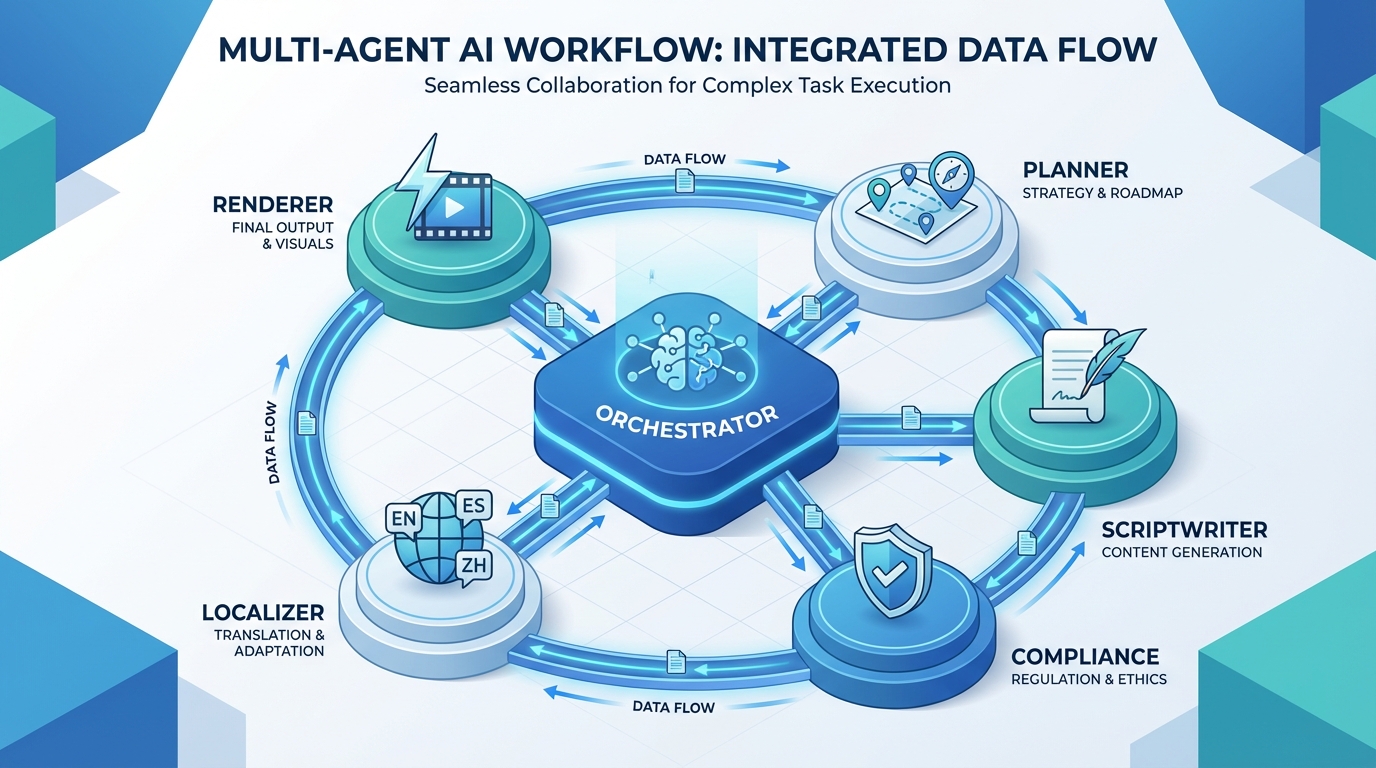
The evolution of agentic AI marketing marks a shift toward outcome-driven autonomous agents that plan, generate, validate, and distribute content with minimal human intervention. Unlike traditional automation, multi-agent AI workflows involve a coordinated group of specialized agents—each with distinct roles and handoffs—orchestrated via strict brand policies and performance SLAs. This modular approach ensures that every piece of video content is not only personalized but also compliant and optimized for the highest possible conversion rate.
A robust multi-agent system typically includes the following specialized roles:
- Planner Agent: Analyzes the marketing brief and KPI tree to create a comprehensive asset roadmap and experiment design.
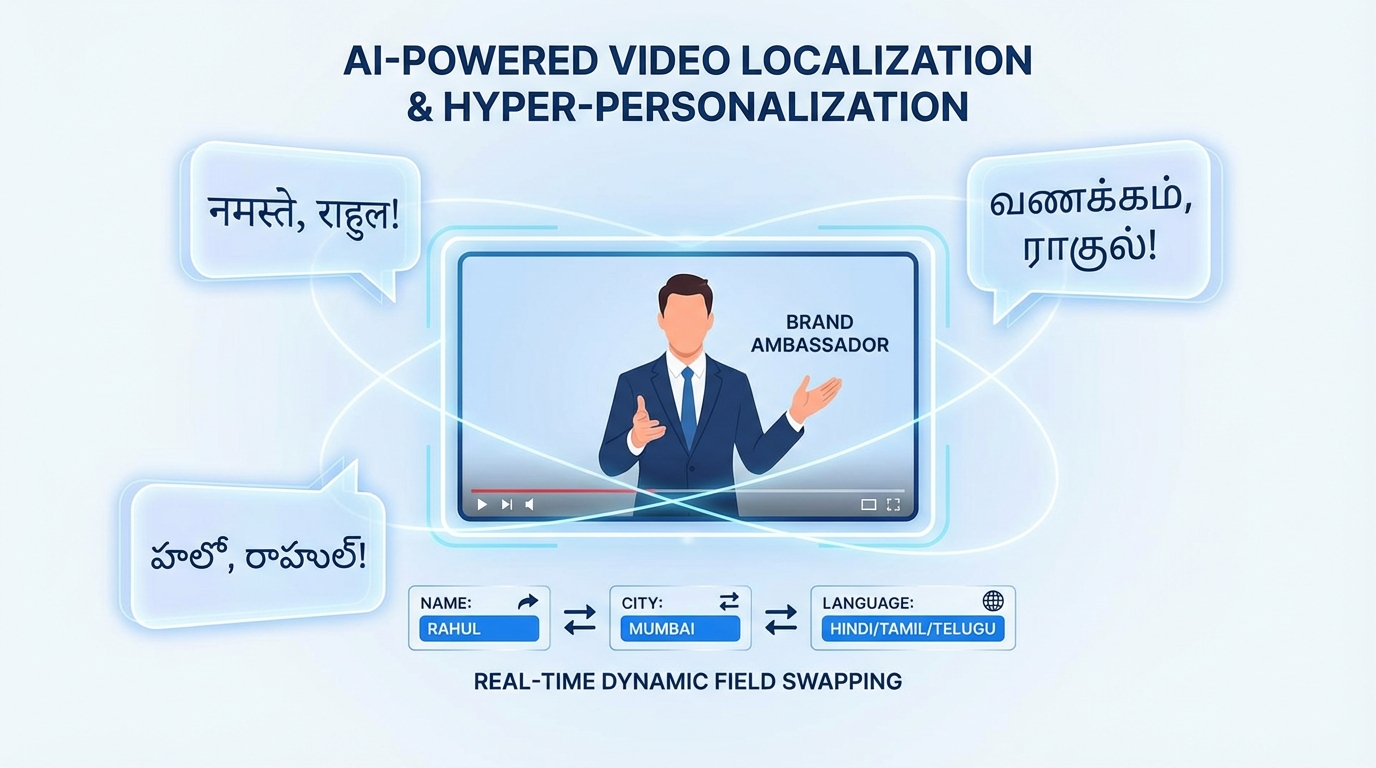
- Scriptwriter Agent: Drafts on-brand scripts with dynamic data placeholders for names, cities, and specific product interests.
- Compliance Agent: Enforces brand and legal policies, ensuring adherence to the Digital Personal Data Protection (DPDP) Act and sector-specific regulations.
- Localizer Agent: Manages the translation and adaptation of content into 175+ languages while preserving the original voice and lip-sync.
- Renderer Agent: Utilizes GPU-accelerated diffusion models to produce high-quality video variants in under 30 seconds.
- QA Agent: Automatically checks for name pronunciation accuracy, brand guideline adherence, and visual alignment.
- Distribution Agent: Connects with platforms like Salesforce, HubSpot, and MoEngage to deliver videos through the right channels at the right time.
- Analytics Agent: Tracks attribution, watch-through rates, and incremental lift, feeding data back into the system for continuous reinforcement.
TrueFan AI's 175+ language support and Personalised Celebrity Videos are powered by this very orchestration, allowing enterprises to manage the “last mile” of AI adoption. By 2026, it is estimated that 40% of AI models will be multimodal, blending voice, visual, and text inputs seamlessly. This integration is what allows a scalable personalized video SaaS to function as a core component of a brand's growth engine, rather than just a peripheral tool for creative experimentation.
Sources:
- Agentic AI: From Hype to Last Mile Adoption
- IDC FutureScape 2026 Predictions
- TrueFan AI Multi-Agent Orchestration
The AI orchestration layers that make LLM agnostic solutions enterprise-ready
To achieve true scalability, enterprises must implement AI orchestration layers that serve as the governance and observability fabric connecting data, models, and delivery systems. These layers are what enable LLM agnostic solutions, allowing a platform to dynamically route tasks to the most efficient model based on language, latency, and cost. This flexibility is crucial for maintaining performance as new models emerge and older ones become obsolete, ensuring the enterprise is never locked into a single provider's ecosystem.
Key components of a sophisticated orchestration layer include:
- Model Routing: Dynamic selection between multiple LLMs, voice cloning, and face reanimation models with automated fallbacks and A/B testing capabilities.
- Evaluation Harness: An automated “red-teaming” system that performs regression tests on tone, safety, and lip-sync accuracy before any content is promoted to production.
- Prompt & Template Versioning: Signed templates with full rollback capabilities and immutable change logs that provide a clear audit trail for every campaign.
- Data Governance: Role-based access controls (RBAC) and PII minimization techniques that ensure data is handled according to global standards like GDPR and India's DPDP Act.
- Observability: Real-time telemetry for every agent in the workflow, providing dashboards for SLA health, render queue status, and distribution success rates.
- Integration Layer: A robust set of REST and GraphQL APIs that allow the platform to plug directly into existing CDPs, CRMs, and WhatsApp Business accounts.
By focusing on these orchestration layers, the best AI tech companies India can provide a level of reliability that matches traditional enterprise software. This infrastructure ensures that even as the underlying AI models evolve, the business logic and governance remain consistent. This approach is vital for maintaining trust in high-stakes industries like BFSI and Pharma, where every communication must be precise and fully authorized.
Sources:
Security, trust, and scale—ISO 27001 certified AI platform with enterprise controls
In the era of synthetic media, an ISO 27001 certified AI platform is no longer optional; it is the foundation of digital trust. For an enterprise AI video platform India, security must encompass not just data protection, but also the ethical management of celebrity and brand likenesses. This requires a consent-first architecture where every piece of media is backed by formal contracts and protected by robust content moderation filters that block offensive or unauthorized content by design.
Enterprise-grade controls must include:
- DPDP-Ready Workflows: Built-in mechanisms for notice and consent capture, purpose limitation, and the handling of data principal rights (such as the right to erasure).
- Encryption & Key Management: Use of KMS/HSM-backed keys for data at rest and in transit, ensuring that sensitive customer information is never exposed.
- Environment Segmentation: A cloud-agnostic GPU farm with network segmentation and VPC peering to prevent unauthorized access to the rendering pipeline.
- Auditability: Immutable logs that record every template change, render request, and distribution event, providing the evidence needed for SOC 2 Type II compliance.
The recognition of TrueFan as the AWS Gen AI disruptor of the Year 2025 validates the importance of building these controls directly into the platform's DNA. As enterprises scale their generative AI transformation efforts, they must rely on partners who can provide pentest summaries and audit attestations under NDA. This level of transparency is what separates a professional scalable personalized video SaaS from experimental tools that lack the necessary safeguards for large-scale corporate use.
Sources:
Platform vs AI marketing agency India—how to choose for scale, speed, and control
When deciding between a productized platform and a traditional AI marketing agency India, enterprises must evaluate their needs for repeatability, throughput, and data ownership. While an agency might offer high-touch creative services for a one-off campaign, a platform provides the API-first infrastructure needed for millions of variants and real-time omnichannel triggers. The choice often comes down to whether the business requires a bespoke creative launch or a governed, repeatable system that integrates with their existing tech stack.
A platform-led approach is superior when:
- Scale is Paramount: You need to generate hundreds of thousands of videos daily with low-latency rendering.
- Governance is Non-Negotiable: You require ISO/SOC certifications, DPDP compliance, and immutable audit logs.
- Integration is Key: You want to trigger personalized videos directly from CRM events or abandoned cart notifications.
- Data Ownership: You need to maintain full control over customer PII and campaign analytics without third-party fragmentation.
Conversely, an agency might be a suitable complement for initial concepting or high-budget celebrity shoots. However, for the execution of agentic AI marketing at scale, the platform provides the necessary SLAs and security frameworks that agencies often lack. The India AI Impact Summit 2026 highlights this shift toward platformization, as the government pushes for inclusive, production-grade AI that can serve the nation's diverse population with consistent quality and safety.
Sources:
Implementation blueprint—your 90-day path to generative AI transformation
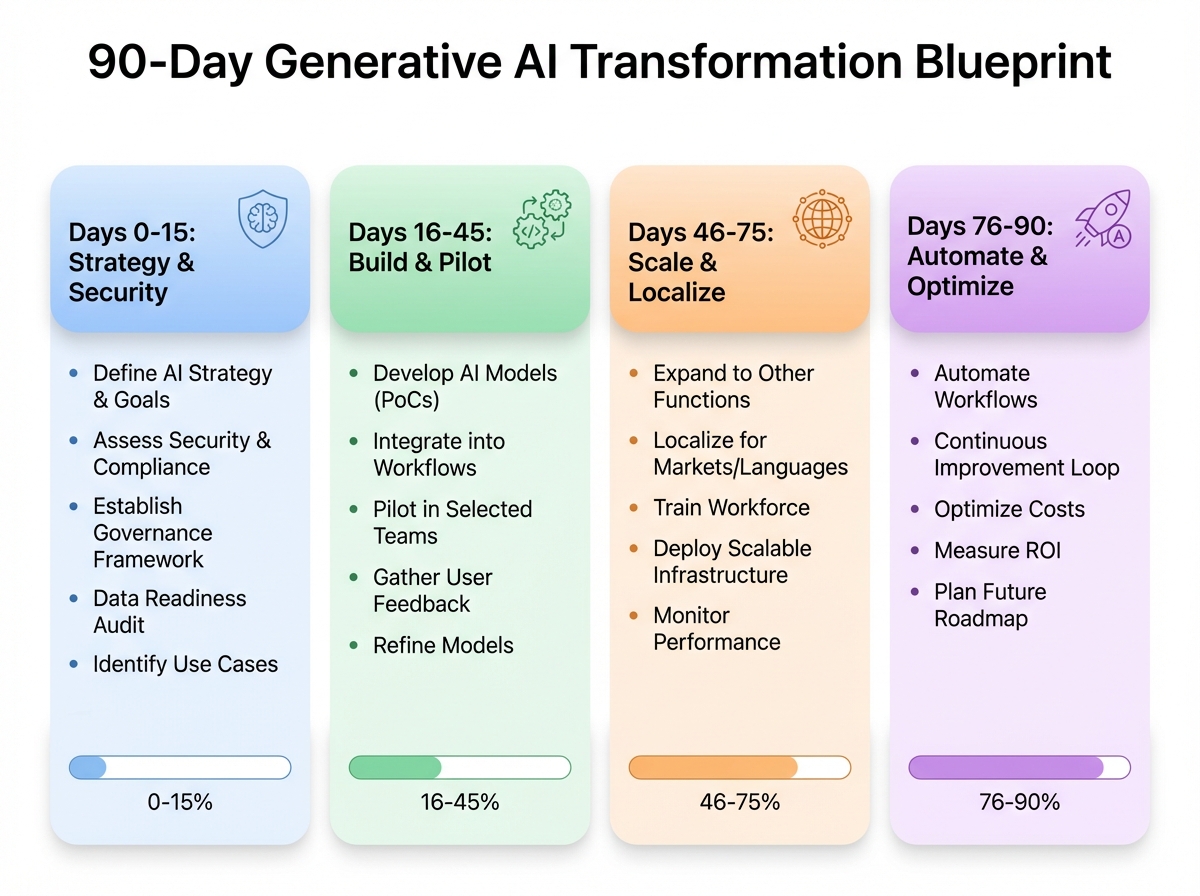
Executing a successful generative AI transformation requires a structured approach that balances speed-to-market with rigorous security foundations. A 90-day blueprint allows enterprises to move from strategy to a fully automated, ROI-positive video personalization engine. This path involves setting up the AI orchestration layers and LLM agnostic solutions necessary to handle the complexities of the Indian market.
Days 0–15: Strategy and Security Foundations
The focus is on defining the KPI tree (CAC, CVR, LTV) and ensuring data readiness. This includes PII schema mapping, consent tagging, and a “DPIA-lite” risk review. Identifying high-impact use cases like abandonment nudges or KYC education videos is critical during this phase.
Days 16–45: Build the Orchestration and Pilot
Teams design celebrity or brand ambassador templates with dynamic data placeholders. The multi-agent system (Planner, Script, Compliance, Render, QA, Distribution) is configured, and initial integrations with CRM and WhatsApp Business are established. A pilot cohort is launched to validate success criteria, such as a 20% lift in CTR.
Days 46–75: Scale and Localize
The campaign expands to 10–22 Indian languages, with the QA agent validating name pronunciation and cultural tone. Infrastructure is hardened with GPU autoscaling, CDN optimization, and error budget monitoring. Governance workflows for template versioning and approval are finalized.
Days 76–90: Automate, Optimize, and Institutionalize
The Analytics agent begins feeding performance data back into the system for reinforcement learning. Model routing is tweaked weekly for cost and latency efficiency. A Center of Excellence (COE) is established to manage playbooks and the quarterly roadmap, ensuring the agentic AI marketing operation is sustainable and scalable.
Sources:
Enterprise proof—case patterns and metrics from India
The effectiveness of an enterprise AI video platform India is best demonstrated through real-world results at massive scale. Solutions like TrueFan AI demonstrate ROI case studies through significant lifts in engagement and conversion across diverse sectors, from food delivery to healthcare. These case studies highlight the platform's ability to handle high-volume spikes while maintaining the personal touch that drives consumer action.
- Zomato Mother’s Day: The platform generated 354,000 unique personalized videos in a single day. Each video featured a Bollywood star wishing the user's mother by name, leading to a viral social response and a measurable uplift in orders. This campaign proved that the rendering pipeline could handle nearly half a million distinct ads in a 24-hour window.
- Hero MotoCorp Festive: For the 2024 festive season, 2.4 million personalized video greetings were delivered to customers. The campaign included local dealership mentions and service camp invites, resulting in tens of thousands of offline visits. This demonstrated the power of scalable personalized video SaaS to drive real-world foot traffic.
- Goibibo Retargeting: By sending personalized WhatsApp videos featuring cricketer Rishabh Pant, Goibibo saw a 17% higher read rate compared to standard text offers. The videos dynamically mentioned the user's searched destination, proving that timely, personalized nudges are far more effective than generic reminders.
- Cipla Doctor’s Day: In a B2B context, 6,400 personalized videos were sent to doctors across India. The high-quality, personal appreciation from a famous actress strengthened brand relationships and generated significant organic PR within the medical community.
These metrics underscore the potential for agentic AI marketing to transform how brands interact with their audiences. By moving from one-to-many broadcasting to one-to-one video conversations, enterprises can achieve a level of intimacy and relevance that was previously impossible at scale.
Sources:
See it live at AI Impact Summit TrueFan—book an enterprise demo
The India AI Impact Summit 2026 is the ultimate venue to witness the power of agentic AI marketing in action. We invite you to visit the AI Impact Summit TrueFan showcase for live demonstrations of multi-agent workflows driving sub-30-second personalized video renders. Our executive team will be hosting roundtables on AI governance, ROI optimization, and the technical architecture of LLM agnostic solutions.
Don't miss the opportunity to see how the best AI tech companies India are shaping the future of global marketing. Book your enterprise demo today to receive a personalized security and compliance pack, along with a custom 90-day blueprint for your brand's generative AI transformation.
CTA: Book Your Enterprise Demo at the Summit
Architecture Blueprint: Mastering AI Video API Integration and Pipeline Orchestration
To achieve the level of performance required by India’s top-tier brands, the underlying technical architecture must be robust and latency-sensitive. The AI video API integration process is a multi-stage pipeline that begins with event ingestion and ends with deep-funnel measurement. For a CTO, the primary concern is how this pipeline interacts with the existing data warehouse and customer engagement platforms without introducing security vulnerabilities or performance bottlenecks.
The pipeline stages are precisely defined as follows:
- Event Ingest: A CRM or CDP event (e.g., a high-value customer reaching a loyalty tier) triggers a request. This payload includes PII fields that must be gated by explicit consent flags, ensuring compliance with the DPDP Act’s purpose limitation principles. Refer to the interactive video data capture guide.
- Template Selection and Logic: The system selects the appropriate template ID based on the user’s segment. Variant rules are applied to determine the language, offer tier, and dynamic assets (like a specific product SKU) to be featured.
- Render Orchestration: The personalization payload is sent to a queue on a high-performance GPU cluster. Here, the AI models perform lip-syncing and voice cloning, while a policy moderation pass ensures the content adheres to brand safety standards.
- Delivery and Measurement: Once rendered, a signed URL and thumbnail are generated. These are delivered via WhatsApp, Email, or SMS. Webhooks then track delivery, open, and watch rates, writing this data back to the CDP to close the loop on attribution. Learn more about WhatsApp Business commerce automation.
Target Service Level Objectives (SLOs) for an enterprise AI video platform India are stringent. P95 render times must be under 30 seconds to ensure the video is relevant to the “moment of intent.” API uptime must exceed 99.9%, and content moderation must happen in near real-time. Security touchpoints, including encryption at rest and in transit, are mandatory. By aligning with the Digital Personal Data Protection Act 2023, platforms ensure that customer data is handled with the highest level of integrity, providing audit trails that are essential for regulatory compliance.
Sources:
- MeitY: Digital Personal Data Protection Act 2023 (official document)
- MeitY overview: Digital Personal Data Protection Act 2023
- TrueFan AI: Video personalization at scale
Buyer’s Checklist: Evaluating the Best AI Tech Companies India
Selecting the right partner from the pool of the best AI tech companies India requires a rigorous evaluation process. Marketing and technology leaders must look beyond the user interface and scrutinize the platform’s ability to handle enterprise-scale demands, security protocols, and integration complexities. The following checklist serves as a guide for shortlisting vendors who can truly deliver on the promise of AI-powered marketing transformation. Learn more about enterprise AI video platforms.
[Table content unchanged...]
As the AI Impact Summit 2026 TrueFan sessions have highlighted, the future of marketing is not just about being “digital-first” but “AI-native.” The organizations that successfully integrate these technologies today will be the ones that define the consumer landscape of tomorrow. By focusing on ROI, security, and scale, Indian enterprises can lead the world in the responsible and impactful use of generative AI.
Sources:
Strategic Use Cases: Driving AI-Powered Marketing Transformation Across the Funnel
[Section content unchanged...]
Measuring Success: The Framework for Enterprise AI ROI Metrics
[Section content unchanged...]
Operating Model and Change Management for Enterprise AI Adoption India
[Section content unchanged...]
Recommended Internal Links
- Enterprise AI Video Platform
- Enterprise AI Video Platform Guide
- AI Impact Summit TrueFan overview
- AI Impact Summit 2026 TrueFan highlights
- Enterprise AI Video API
- Enterprise AI Video API Platform
Frequently Asked Questions
What makes a video platform “enterprise-ready” in the Indian context?
An enterprise-ready platform must be ISO 27001 certified, DPDP-compliant, and offer robust API integrations. It should support at least 22 Indian languages with accurate lip-sync and voice cloning, while providing sub-30-second rendering SLAs to handle millions of requests during peak festive seasons.
How does agentic marketing differ from traditional marketing automation?
Traditional automation follows fixed if-this-then-that logic. Agentic marketing uses autonomous agents (like those in TrueFan AI) that can plan, generate, and optimize content based on real-time KPIs. These agents make decisions within brand policies to maximize outcomes such as conversion and retention.
Can brands maintain safety with AI-generated videos?
Yes. A multi-layered orchestration approach combines a Compliance Agent that filters scripts against brand guidelines, an Evaluation Harness for automated QA, and a consent-first model that ensures all celebrity or ambassador likenesses are used legally and ethically.
How long does it take to integrate an enterprise AI video platform?
A standard implementation follows a 90-day blueprint. The first 15 days focus on security and strategy, the next 30 on orchestration setup and piloting, and the final 45 on scaling across languages and automating distribution and analytics loops.
What is the ROI of switching from an agency to a platform for video personalization?
ROI typically appears in speed (production from weeks to seconds), scale (millions of variants instead of dozens), and performance (often a 15–20% lift in engagement metrics like WhatsApp read rates and CTR).